
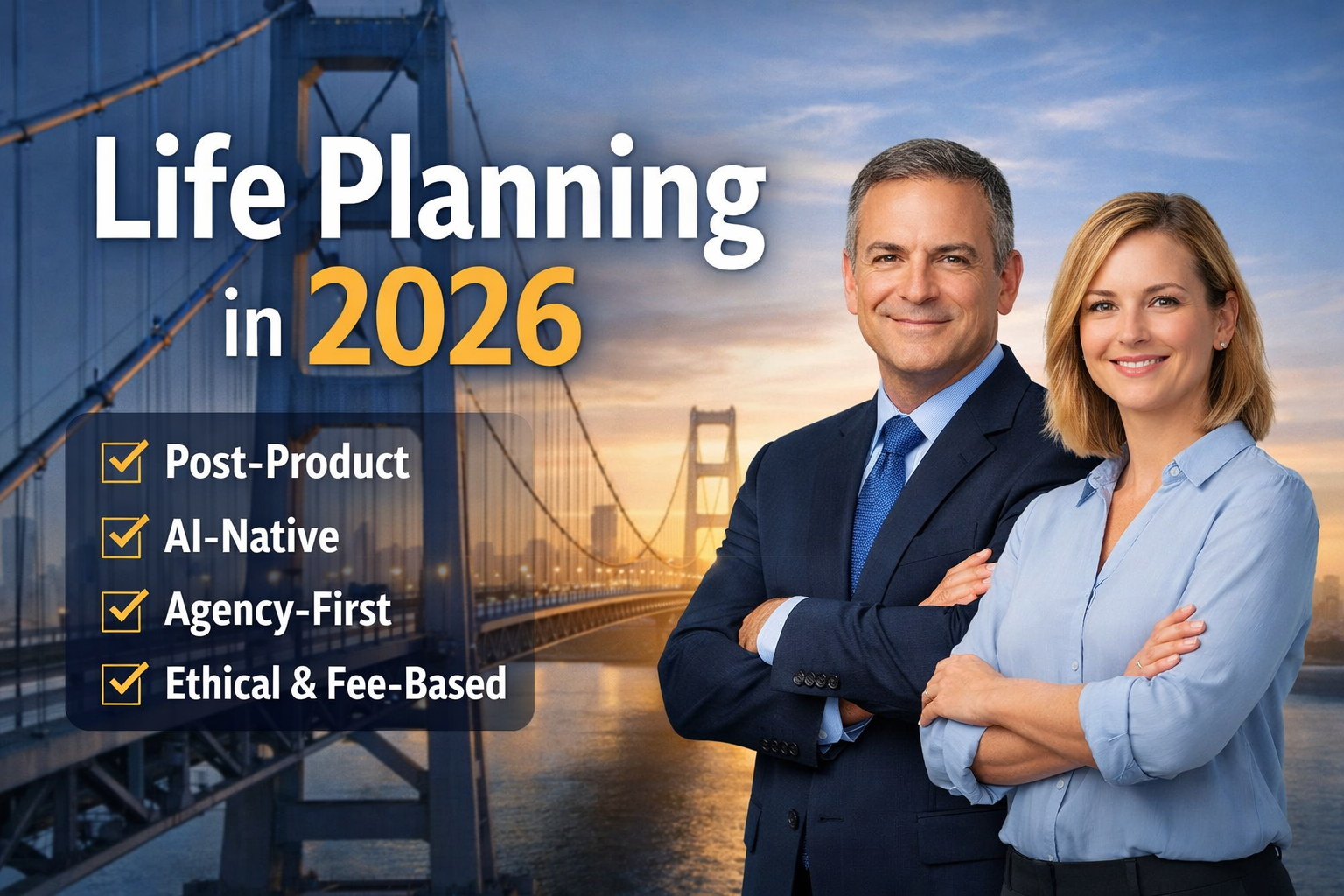
A bridge-safe reflection for planners sensing the next step
For many planners, life planning began as a profound shift.
A move away from product talk.
A deeper conversation.
A focus on meaning, freedom, and what really matters to the client.
For some, that training was genuinely life-changing. It restored dignity to the profession and reminded us why we entered it in the first place.
And yet, quietly, many planners are now sensing a tension.
Not with life planning itself — but with the frame it still sits within.
When a conversation outgrows the container
Most early life-planning training was developed in a very different world:
- Before AI
- Before widespread distrust in financial institutions
- Before the advice gap widened into a chasm
- Before clients began explicitly rejecting asset-based charging
- Before planners themselves started questioning whether AUM models still align with their values
The result is something many planners recognise but rarely articulate:
A deeply human conversation, followed by a structurally familiar outcome.
Often, the conversation explores purpose, freedom, and aspirations —
yet the implementation still defaults to assets under management, ongoing percentage fees, and a business model that depends on keeping money “inside the system”.
This isn’t usually malicious.
It’s structural.
But clients increasingly feel it.
And planners increasingly feel uneasy about it.
The trust paradox
There’s a subtle paradox at the heart of traditional life-planning-within-advice models:
- Trust is built through openness, vulnerability, and depth
- But monetisation often arrives later, tied to assets rather than agency
Many planners sense the discomfort of this transition — even if it’s never spoken aloud.
Clients talk about their lives.
Their fears.
Their hopes.
And then, quietly, the commercial architecture appears.
For some clients, this feels coherent.
For many others in 2026, it does not.
A changing client expectation (2026 reality)
Today’s clients increasingly want:
- To own their plans, not rent them
- To understand their choices, not outsource them
- To reduce dependency, not deepen it
- To pay transparently, not implicitly
- To use technology as an enabler, not a black box
They are not rejecting guidance.
They are rejecting intermediation without agency.
This shift isn’t ideological.
It’s generational, technological, and cultural.
A quiet evolution: from life planning to total wealth planning
This is where the Academy of Life Planning sits — not as a replacement for life planning, but as its next evolution.
Life planning is still essential.
But it is no longer sufficient on its own.
In 2026, planners increasingly need a framework that:
- Integrates purpose and execution
- Treats human capital as seriously as financial capital
- Separates planning from product
- Enables clients to act, adapt, and self-direct
- Supports planners to build viable, ethical businesses without relying on asset extraction
This is what we mean by Total Wealth Planning.
Life planning is inside this model — not abandoned, but no longer isolated.
What changes for the planner?
For planners crossing this bridge, several things quietly shift:
- You stop needing assets to justify your value
- You stop positioning yourself as a gatekeeper
- You stop relying on hidden cross-subsidies
- You gain permission to be a guide, coach, and architect — openly
Your role becomes clearer, not weaker.
And your clients feel it.
Why some planners feel “called” to this now
Many planners arriving at the Academy say similar things:
- “I love the conversations — but the business model no longer fits.”
- “Clients want more agency than my structure allows.”
- “I don’t want to surprise people with fees after trust has been built.”
- “I want to teach people how to plan — not keep them dependent.”
These aren’t criticisms of the past.
They are signals of readiness.
A bridge, not a rejection
The Academy of Life Planning does not ask you to abandon what you’ve learned.
It asks a gentler question:
What if life planning was the beginning — not the ceiling?
What if the same depth, care, and humanity were placed inside a structure designed for transparency, agency, AI-enablement, and ethical sustainability?
That is the bridge we offer.
Where the Academy sits in 2026
In simple terms:
- We are post-product
- post-intermediation
- AI-native
- agency-first
- IP-free
- business-viable without AUM dependency
We help planners:
- build practices aligned with their values
- serve clients without structural conflicts
- and remain relevant in a rapidly changing world
Not louder.
Not bigger.
But coherent.
A gentle invitation
If you recognise yourself anywhere in this reflection, there’s nothing to decide today.
Bridges don’t demand crossing.
They simply exist — ready when the timing is right.
You’re welcome to explore how the Academy supports planners who are quietly asking:
“What does integrity look like for me now?”
Find out more, at the Academy of Life Planning.
 Academy of Life Planning