
AI Is at the Door — and It’s Knocking
What Matthew Griffin’s warning really means for the future of financial planning
Dear reader, the quote below isn’t just an observation. It’s a signal flare.
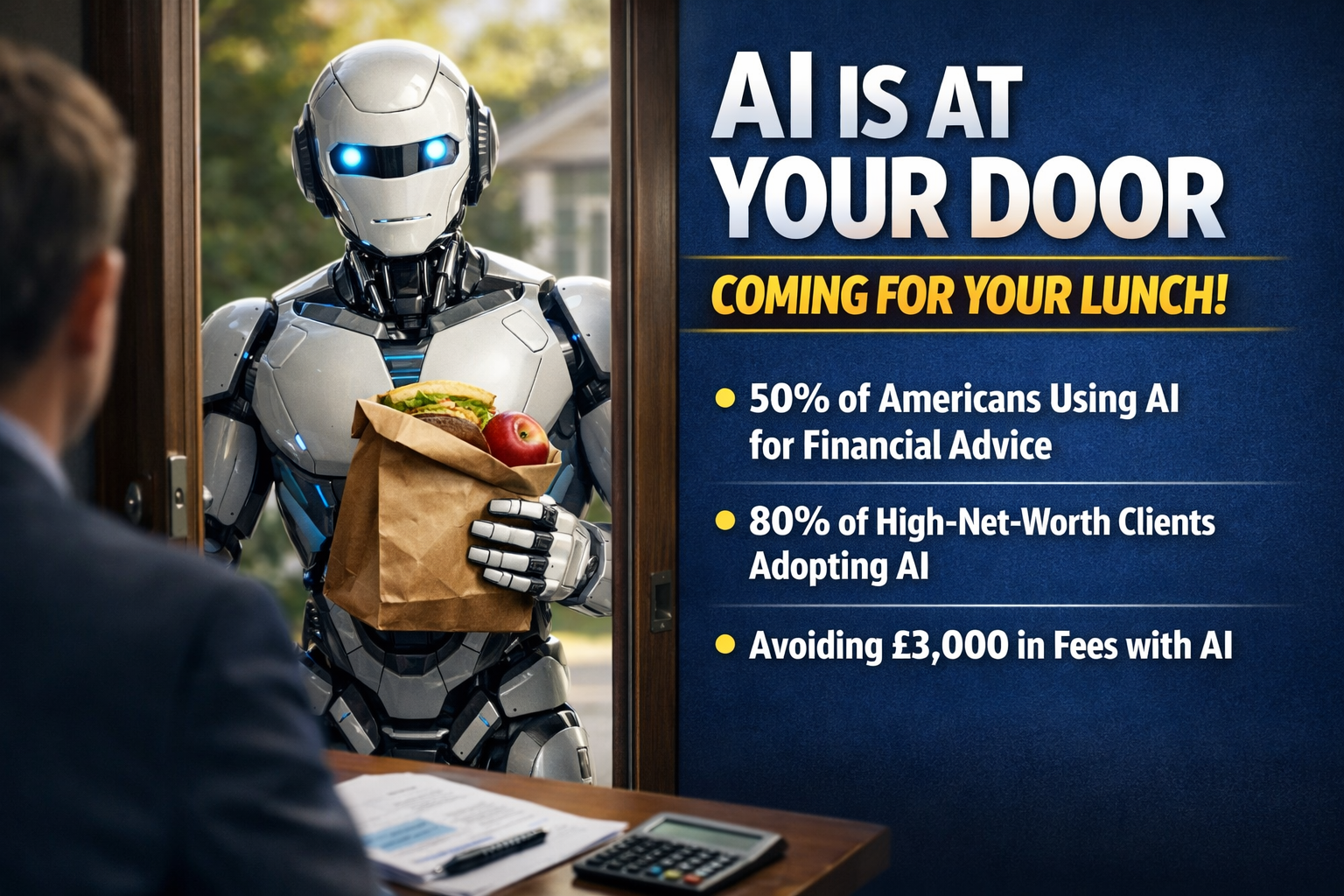
When Matthew Griffin — widely described as “the adviser behind the advisers” — says “AI is coming for your lunch”, he’s not speculating from the sidelines. He’s describing what he is already doing, what his clients are already experiencing, and what the market is already validating.
“For the past month I’ve been using AI for financial and investment advice — and when used correctly, it’s doing a superb job. Over 50% of Americans and around 80% of high-net-worth individuals are now doing the same. As these systems improve through 2026, AI isn’t just changing advice — it’s coming for the industry’s lunch.” — Matthew Griffin, futurist, founder & CEO, 311 Institute
Let’s unpack why this matters so deeply for the Academy of Life Planning — and why it actually strengthens, rather than threatens, the Total Wealth Planning model.
1. The headline most planners are missing
Griffin highlights three uncomfortable facts:
- Over 50% of Americans are already using AI for financial advice
- 80% of high-net-worth individuals — traditionally the core IFA market — are doing the same
- For $20 per month, AI has helped him avoid ~£3,000 in fees and commissions
This is not about future disruption.
This is present-tense disintermediation.
AI is no longer a back-office tool. It is becoming a front-of-mind decision partner for consumers — especially those who are:
- fee-sensitive,
- time-poor,
- distrustful of conflicted advice,
- and increasingly comfortable with technology.
2. The real market AI is eating first
Crucially, Griffin doesn’t say AI is replacing thinking.
It’s replacing extraction.
AI is rapidly eroding:
- high-cost discretionary fund selection,
- opaque fee layers,
- commission-driven “value adds”,
- generic portfolio optimisation.
In other words, it is hollowing out the industrial middle of wealth management — exactly where trust has been weakest.
This is why large “wealth” firms are feeling the impact first.
3. Why this is not a threat to Total Wealth Planners
Here’s the inversion most of the industry gets wrong:
AI does not eliminate the need for planners — it eliminates the need for intermediaries.
AI is exceptional at:
- modelling scenarios,
- analysing trade-offs,
- explaining options,
- stress-testing assumptions.
But it cannot:
- define meaning,
- resolve life tension,
- hold emotional space,
- challenge unconscious scripts,
- or help someone decide what “enough” actually is.
That work lives in human capital and human-to-human economics, not financial products.
This is precisely why the AoLP model ages with AI rather than against it.
4. The coming split: advisers vs guides
As AI improves through 2026, the market will separate cleanly into two roles:
❌ The declining role
- Product-centred advice
- Asset-gathering as identity
- Value justified by access, not insight
- Fees defended rather than earned
✅ The rising role
- Life-first planning
- Human capital architecture
- AI-enabled self-direction
- Ethical, product-agnostic guidance
The second category is not disrupted by AI.
It is amplified by it.
5. AoLP’s quiet advantage
What Griffin describes validates something the Academy has been building for years:
- Planning My Life → AI-supported self-agency (done-by-you)
- Total Wealth Planning → goals before money, life before assets (done-with-you)
AI becomes:
- a literacy tool,
- a confidence engine,
- a transparency mechanism,
- a cost-reduction force.
Not a replacement for wisdom — but a delivery system for it.
6. The real question for the industry
Griffin ends with the right challenge:
“This could be interesting and problematic unless the industry has a response.”
Most of the industry’s response will be defensive:
- lobbying,
- reframing,
- re-packaging,
- “AI-powered” versions of the same extraction model.
AoLP’s response is simpler — and more radical:
Give people the tools, the framework, and the confidence to plan their own lives — and stand beside them when it matters.
That is not something AI is coming for.
That is what AI is clearing the ground for.
Closing thought
AI isn’t knocking politely.
It’s knocking because the door has already been unlocked by decades of misaligned incentives.
For planners willing to move upstream into meaning, purpose, and human capital, this is not the end of relevance — it’s the beginning of a far more honest profession.
And the clock is already ticking.
A final thought — and an invitation
Noah didn’t wait for the floods to arrive before he started building.
He didn’t argue with the weather.
He didn’t try to save everything at once.
He built a bridge to the future, one beam at a time.
That’s where we are now.
AI isn’t a storm on the horizon — it’s already changing the tide.
And the choice for planners isn’t panic or resistance.
It’s transition.
At the Academy of Life Planning, we’re not asking anyone to leap.
We’re offering fast-tracks across the bridge:
- from product-led to life-led,
- from extraction to empowerment,
- from adviser dependency to AI-enabled self-direction.
You can cross one capability at a time.
One conversation model.
One client journey.
One revenue stream.
But the time to start building is before the water rises.
If you sense that the old model is narrowing —
and that something more human, more honest, and more sustainable is calling —
now is the moment to step onto the bridge.
Don’t wait for the floods.
Let’s build the ark — together.
A grounded invitation
If you’re a planner who senses that traditional financial planning no longer goes far enough—and that your clients need help navigating work, purpose, resilience, and reinvention as much as investments—then you’re already thinking like a Total Wealth Planner.
The Academy of Life Planning exists to support that transition.
Not by adding complexity.
But by restoring coherence.
 Academy of Life Planning