
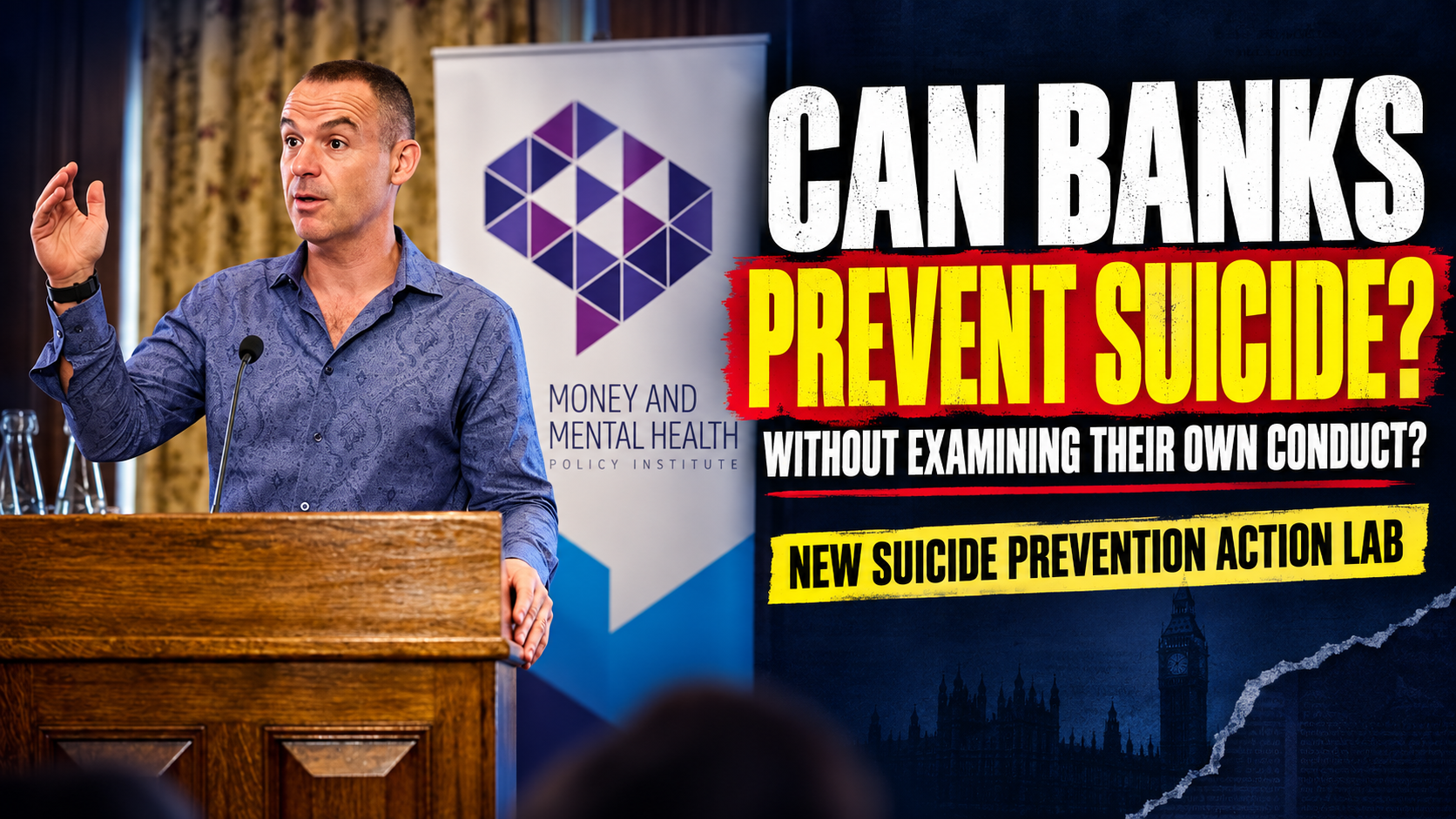
“A “groundbreaking” new project to help tackle suicide has been launched today (10 September) by The Money and Mental Health Policy Institute (MMHPI) – the charity founded by MoneySavingExpert.com founder Martin Lewis. It brings five major banks together in a bid to find the gaps and test new ways to identify and support people in crisis.”
The new Suicide Prevention Action Lab is welcome. Its hardest question may be whether banks are only observers of financial distress—or sometimes participants in it.
A few days after receiving one of the most troubling emails I have encountered in my work, I read about a new initiative from the Money and Mental Health Policy Institute.
The email came from someone with lived experience of financial difficulty, a prolonged dispute with a bank and suicidal distress.
He believed the bank’s conduct had contributed materially to his circumstances. After several years attempting to obtain recognition of his concerns, he told me that he intended to undertake a hunger strike. He contemplated the possibility that his death might provide the documented case needed to prove that banking malpractice can drive a customer towards suicide.
I told him I could not support that course.
A person’s death cannot safely be turned into evidence, leverage or a campaigning strategy. Nor would it necessarily establish the legal causation he believed it would prove.
The proper response was to improve the evidence: construct a chronology, separate documented events from personal testimony, distinguish inference from established fact, consider alternative explanations and formulate questions capable of independent investigation.
Then I read about the new Suicide Prevention Action Lab.
It may offer precisely the kind of evidence-led route this issue requires.
A welcome recognition of the problem
The Lab brings together the Money and Mental Health Policy Institute with Barclays, HSBC, Lloyds, Monzo and Nationwide.
Over approximately 26 months, the participants will explore how banks might use their knowledge of customers’ financial circumstances to recognise people approaching crisis and direct them towards appropriate support.
The starting point is sobering.
According to the Institute, more than 420,000 people in problem debt in England consider taking their own life each year, and more than 100,000 attempt suicide.
Martin Lewis describes the relationship between mental-health difficulties and debt as a “marriage made in hell”. Each can intensify the other. Long-term financial pressure can grind people down, while deteriorating mental health can make money problems harder to address.
Banks occupy a uniquely important position within this relationship. They can see falling income, increasing borrowing, missed payments and other signs that someone’s circumstances may be deteriorating.
The Lab will ask how that information might be used safely and considerately to identify people who need help.
This is important work.
It also validates a concern without making an accusation.
Financial difficulty can contribute to suicidal distress. Aggressive collections can intensify hopelessness. Banks may possess information that enables them to intervene before a customer reaches crisis.
But those propositions do not prove that a particular bank caused a particular person’s suicidal distress. Still less do they establish criminal responsibility for a particular death.
Recognising a risk pathway is not the same as proving legal causation.
It does, however, create a responsibility to investigate the pathway properly.
The dual-role blind spot
The announcement contains one particularly careful statement:
“Banks don’t cause all these problems.”
That is plainly true.
Banks do not cause every loss of employment, relationship breakdown, business failure, illness, addiction or other event that may place someone under severe financial and emotional pressure.
But “banks do not cause all these problems” should not quietly become “banks never contribute to these problems”.
That is the question the Lab must remain open to examining.
A bank can occupy two positions simultaneously.
It can be an observer of distress. Its transactional data may reveal a fall in income, escalating borrowing or increasingly chaotic financial behaviour.
But it can also be a participant in the customer’s circumstances through its lending decisions, collections practices, account restrictions, response to vulnerability or handling of a complaint.
I call this the dual-role blind spot.
It arises when an institution is treated as part of the rescue system without examining whether its own conduct may also form part of the causal system.
If the Lab looks only for patterns in customer data and then refers distressed people to mental-health or debt-support services, it risks medicalising a problem that may sometimes have been aggravated by institutional conduct.
The bank may ask:
How can we detect that this customer is becoming suicidal?
But it should also ask:
What have we done, or failed to do, that may be worsening this customer’s position?
Those questions are not accusations. They are necessary components of responsible safeguarding.
This is no longer merely a theoretical concern
In April 2026, Parliament debated hidden credit liabilities and the role of the Financial Conduct Authority.
MPs described cases in which small-business owners were allegedly sold complex financial products carrying undisclosed liabilities. As interest rates fell, those liabilities were said to have damaged internal credit assessments, triggered covenant breaches and contributed to viable businesses being transferred into restructuring units.
The consequences described in the debate included insolvency, bankruptcy, repossession, serious ill health, family breakdown and loss of life.
Most significantly for the Suicide Prevention Action Lab, John McDonnell told Parliament that one of the cases he had handled involved reading the final letter of a business owner who took his own life:
“One of the cases I have dealt with involved reading the last letter of a man who committed suicide in the hope that his insurance would pay out to save his family home.”
That statement is now part of the official Hansard record.
It must be interpreted carefully.
A statement made in Parliament is not a judicial finding. It does not establish that a bank legally caused the death. We do not yet have, within the public record, the complete chronology, banking documents, medical evidence or assessment of alternative and cumulative causes required to reach that conclusion.
But nor should the case be dismissed as anecdotal noise.
Parliament has heard evidence of a business owner who took his own life after the seizure of assets and threatened loss of the family home, believing that an insurance payment was the only remaining way to protect his family.
That establishes a sufficiently serious and plausible safeguarding concern to warrant independent investigation.
It also illustrates the dual-role question.
Was the financial institution merely observing a customer in distress?
Or did its products, disclosures, recovery decisions, treatment of personal guarantees or handling of the customer’s circumstances contribute to the sequence that ended in his death?
We cannot responsibly presume the answer.
We can responsibly insist that the question be examined.
What our documented experience may contribute
The more recent case I have encountered contains potentially relevant material of a different kind.
There are records concerning the individual’s banking relationship, collections activity, complaints, vulnerability disclosures, requests for personal information and contact with mental-health services.
The individual believes that these records establish serious institutional wrongdoing. My assessment is more cautious.
The material currently combines several different evidential categories:
- documented events;
- personal testimony;
- interpretations of institutional conduct;
- wider inferences about other customers;
- statistical hypotheses; and
- allegations of criminal culpability.
These categories cannot safely be treated as interchangeable.
Personal distress, however genuine, does not by itself establish legal causation. Evidence of regulatory failings elsewhere does not prove what happened in one individual case. Population-level associations between debt and suicide cannot be converted into estimates of deaths attributable to a particular institution without defensible evidence.
But that does not mean the individual has nothing relevant to contribute.
It means the material must be reconstructed into a form capable of examination.
With informed consent and appropriate safeguarding, it may be possible to prepare a chronology showing:
- the relevant financial relationship and products;
- dated decisions and actions by the bank;
- collections, account-management and complaint-handling events;
- disclosures of vulnerability or suicidal distress;
- what the bank knew at each stage;
- the response recorded by the bank;
- relevant medical or support-service involvement;
- subsequent complaint and ombudsman activity;
- alternative or cumulative causes of distress;
- gaps where evidence is missing or disputed; and
- which statements are documented facts, personal recollections, inferences or hypotheses.
That chronology would not be offered as proof that the bank caused suicidal distress or committed a criminal offence.
It would be a safeguarding case study.
It could help investigators identify where warning signs appeared, what information was available, how responsibilities were divided and whether anyone within the system could see the complete picture.
What an investigation of the parliamentary case could look like
The case placed before Parliament may provide another identifiable starting point.
Subject to the family’s consent and appropriate safeguards, an independent inquiry could:
- obtain the business owner’s complete financial chronology and final letter;
- identify the bank, products, guarantees, liabilities and recovery decisions involved;
- establish what had been disclosed when the agreements were entered into;
- determine what the bank knew about the customer’s financial and psychological circumstances;
- examine the decisions affecting the business assets and family home;
- review communications between the customer, bank, advisers, insurers and public bodies;
- obtain relevant medical and family evidence;
- consider alternative and cumulative contributors to the death;
- determine whether institutional actions made a material contribution; and
- examine whether similar patterns are present in other documented cases.
This is what moving from allegation to investigation looks like.
It neither presumes guilt nor protects the institution from uncomfortable evidence.
It asks what happened, what was known, what could reasonably have been foreseen and whether a different institutional response might have changed the outcome.
When every institution sees only its own fragment
One of the problems with complex financial harm is that institutions divide the experience between themselves.
The collections department sees missed payments.
The vulnerability team sees a disclosure of distress.
The complaints team sees disputed conduct.
The data-protection team sees a subject access request.
The ombudsman sees a complaint within a defined jurisdiction.
The health service sees the resulting psychological crisis.
Each may deal with the fragment allocated to it. No one necessarily examines the sequence as a whole.
For the individual, however, there is only one lived experience.
This is why a documented chronology matters. It restores the whole case across organisational boundaries.
It may also reveal an important data gap.
The Financial Ombudsman Service has previously indicated that information relevant to suicidal distress may not be recorded in a form that allows it to be reported in aggregate without manually reviewing individual files.
That does not prove concealment. It raises a legitimate data-governance question:
If vulnerability and self-harm risks are foreseeable within financial complaints, how does the system identify patterns and learn from them if the relevant information cannot be aggregated?
The Action Lab has an opportunity to help answer that.
What should the Lab investigate?
The Lab should certainly explore how banks can identify customers at risk and connect them with appropriate support.
Based on the evidence available so far, I suggest it also examine the following questions.
Do vulnerability records follow the customer?
If someone discloses suicidal thoughts to one department, is that information available—appropriately and safely—to the other teams making decisions that affect them?
Or must the customer repeatedly disclose their distress to collections, complaints, account-management and legal teams?
Does disclosure change institutional behaviour?
Signposting someone towards external support may be appropriate, but it cannot be the end of the bank’s responsibility.
Does a disclosure lead the bank to reconsider collections activity, account restrictions, communications or an adversarial complaint process?
Can the bank examine its own contribution?
Are staff encouraged to consider whether the institution’s actions may be aggravating distress?
Or is the customer’s mental health treated only as an external condition to be managed?
What happens after referral?
Does the bank know whether the customer reached the service to which they were directed?
Was the service appropriate and accessible?
Did the bank’s own treatment of the customer change?
Are repeated complaints treated as warning signals?
Persistent correspondence is sometimes characterised as vexatious behaviour. Sometimes it may be.
But repetition can also indicate that a distressed person feels unheard, cannot understand the process or believes that no one has addressed the substance of their concern.
How does the institution distinguish between these possibilities?
How are serious incidents reviewed?
When a customer dies or attempts suicide during a financial dispute, is there an independent review of what the bank knew and how it responded?
Can lessons be shared across institutions without making unsupported assumptions about causation?
What information reaches the ombudsman?
Are vulnerability disclosures and safeguarding actions included consistently within complaint files?
Can the ombudsman identify patterns across cases?
How will the Lab protect independence?
The participating institutions are funding the programme. Their cooperation is valuable and probably essential, but funding creates an obvious governance question.
Will the research examine institutional failures as openly as successful interventions?
Who decides what is published?
Will lived-experience contributors be able to raise concerns about participating banks themselves?
How will lived experience be safeguarded?
People contributing to this research may remain in distress or in active disputes.
The Lab will need clear arrangements for consent, confidentiality, withdrawal, risk escalation and emotional support. Participation must not become another burden of proof placed upon someone already struggling.
The case for an independent safeguarding inquiry
Operational experiments within banks can tell us which interventions appear to work.
They may not be sufficient to determine whether banking and complaint-handling practices sometimes create or compound suicidal distress.
That question calls for an independent, evidence-led safeguarding inquiry alongside the Lab’s pilots.
The parliamentary evidence strengthens that case. MPs have already placed named examples, alleged mechanisms of harm and at least one suicide before the House. What is missing is the independent process capable of testing the connections.
The inquiry’s purpose would not be to begin with a finding of blame.
It would examine:
- identifiable pathways from financial difficulty to serious distress;
- the role of products, disclosures, collections and complaint handling;
- how vulnerability disclosures are recorded and acted upon;
- whether institutional fragmentation creates avoidable risk;
- how deaths and serious incidents are reviewed;
- what data banks and the ombudsman should collect;
- whether identifiable patterns appear across cases; and
- what evidence is required before drawing conclusions about institutional contribution or legal causation.
This would protect both consumers and institutions.
Consumers would have a credible route through which patterns of harm could be examined.
Institutions would be protected from unsupported allegations being presented as established findings.
The objective should not be accusation or exoneration.
It should be discovery.
A question for the MMHPI research community
The Institute is inviting people with experience of money and mental-health problems to join its research community.
I would therefore like to ask a specific question.
Would the MMHPI research community accept a carefully documented lived-experience chronology from someone whose financial dispute, vulnerability disclosures and suicidal distress may provide relevant learning for the Action Lab?
The contribution would:
- record one person’s experience in a structured and evidenced form;
- distinguish personal experience from wider inference;
- separate documented fact from recollection, interpretation and hypothesis;
- identify uncertainties and alternative explanations;
- avoid presuming legal causation or institutional culpability;
- be shared only with the individual’s informed consent; and
- be offered to develop testable safeguarding questions rather than demand a predetermined conclusion.
Would the Lab also consider seeking access—subject to family consent and proper safeguarding—to the case described in Parliament?
Before approaching anyone concerned, we would need to understand MMHPI’s required format, consent process, confidentiality arrangements, independence and safeguarding procedures.
No personal chronology should be sent into another institutional process without knowing who will receive it, how it will be used and what support exists if participation causes further distress.
From accusation to investigation
People who feel unheard often increase the force of their language.
When an allegation fails to attract attention, the temptation is to make it more emphatic. When that fails, personal sacrifice may begin to look like the only remaining way to make the harm visible.
That is a dangerous evidential escalation.
The better route is not to deny the experience or suppress the concern. It is to create a process capable of examining it.
The Suicide Prevention Action Lab is a welcome acknowledgement that banks occupy an important position in customers’ financial and emotional lives.
Its success will depend upon whether it is willing to examine that position in full.
Banks may be able to see distress before others do.
They may be able to intervene before crisis becomes tragedy.
But a genuinely evidence-led programme must also be willing to ask whether the institution is only observing the danger—or whether something within its own conduct is helping to create it.
Parliament has heard evidence suggesting that this question is not hypothetical.
That does not justify a verdict.
It justifies an inquiry.
This article discusses suicide and financial distress. If you are struggling or feel at risk, contact Samaritans free on 116 123. If there is an immediate danger to life, call 999 or attend A&E.
Steve Conley is a Chartered Financial Planner, founder of the Academy of Life Planning and a trustee of the Consumer Financial Protection Charity. The views expressed here are personal and do not represent the charity.

