
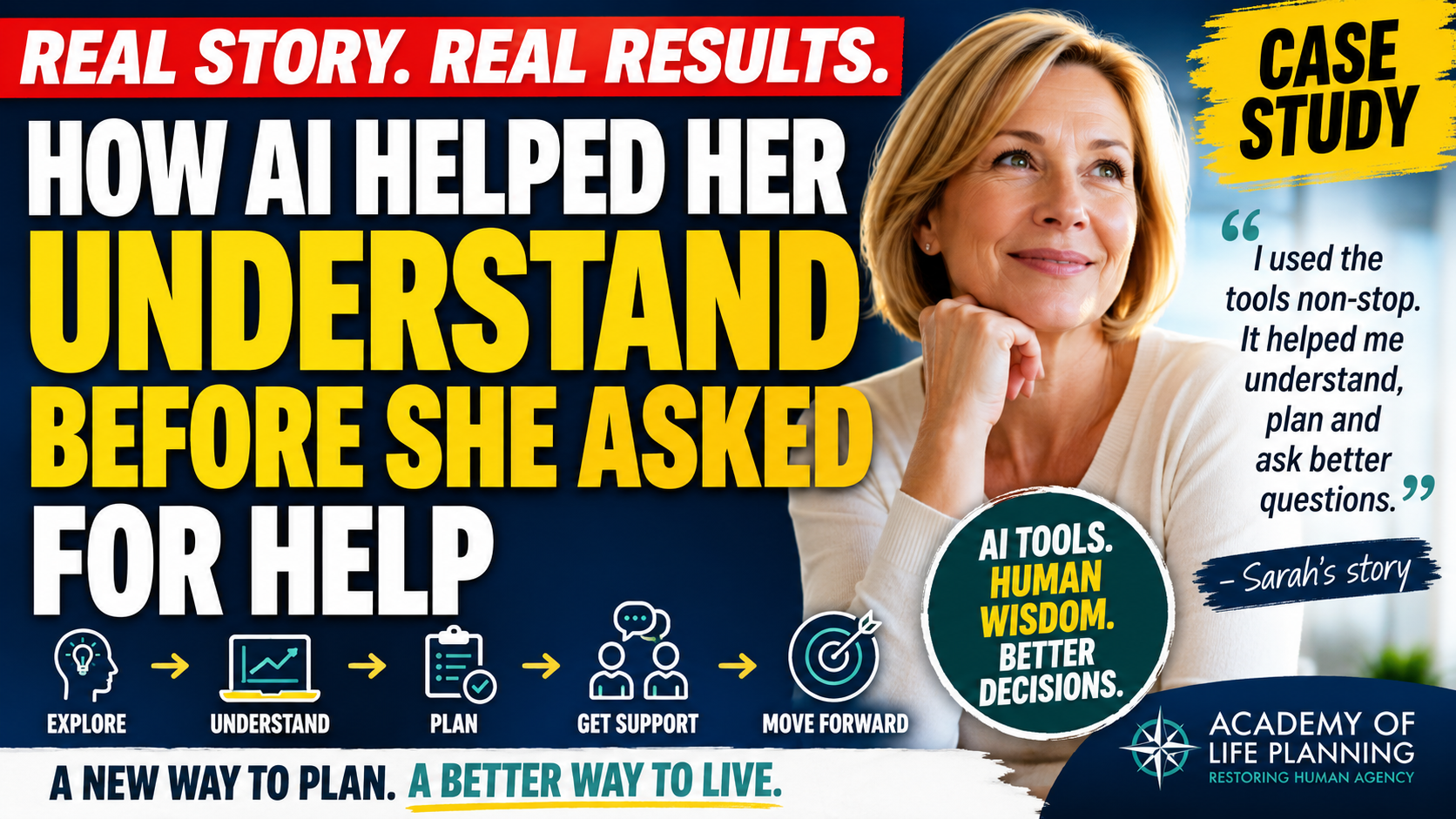
What happened when one person spent weeks exploring Academy OS before asking for human support.
For years, I’ve argued that artificial intelligence won’t eliminate the need for financial planners.
Instead, I believe it will change when people seek support, why they seek it, and what they expect from the conversation.
Recently, I saw that theory play out in real life.
To protect privacy, I’ll call her Sarah.
Her journey reinforced something I’ve suspected for some time: the future of planning may begin long before anyone books an appointment.
It started with curiosity
Sarah wasn’t looking for a financial planner.
She began by trying one of the Academy’s AI planning tools.
There was no commitment, no sales process and no pressure.
She simply wanted to explore a few ideas and understand her situation better.
Over the following weeks, she continued using Academy OS.
Not once.
Not casually.
Repeatedly.
Understanding before advice
At one point she wrote:
“I have been using the Total Wealth Plan pretty much non-stop to help me understand my pensions and running lots of ‘What if?’ scenarios. Such a useful tool!”
That sentence stopped me.
She wasn’t asking AI to tell her what to do.
She was using it to understand her options.
She explored different retirement dates.
She tested assumptions.
She organised information.
She developed her own thinking.
In other words, AI wasn’t replacing judgement.
It was strengthening it.
The conversation changed
Eventually she contacted me.
Not because the software had failed.
Because it had succeeded.
Her email didn’t ask for recommendations.
It said something much more interesting.
She wanted to confirm her thinking.
That is a very different starting point from the traditional advice model.
Instead of arriving confused and expecting someone else to solve the problem, she arrived informed, prepared and ready for a collaborative conversation.
Better questions create better planning
Before we met, Sarah had already:
- organised her finances
- built cashflow projections
- explored pension options
- identified assumptions
- prepared spreadsheets
- compiled questions she wanted to discuss
She wasn’t outsourcing responsibility.
She was inviting another perspective.
That’s exactly how I believe AI should be used.
Not to replace professionals.
To help people become better prepared before involving them.
The planner’s role changes
After our initial meeting she continued working independently.
She updated her plans.
Tested different scenarios.
Sent further questions.
Even suggested improvements to Academy OS itself.
The relationship wasn’t one of dependence.
It had become one of partnership.
The technology helped her think more clearly.
The planner helped her think more deeply.
Those are different things.
A different customer journey
Traditional financial planning often follows a familiar path.
Marketing.
Appointment.
Fact find.
Recommendation.
Ongoing relationship.
Sarah’s journey looked very different.
Curiosity.
Understanding.
Experimentation.
Capability.
Conversation.
Confidence.
Then back to independent planning.
That isn’t a sales funnel.
It’s a capability journey.
Proportional Planning in practice
This is exactly what I mean by Proportional Planning™.
Most decisions don’t require permanent professional involvement.
Many can be explored using structured tools that improve understanding and confidence.
When complexity increases, another human becomes valuable.
Not because they take over.
Because experience, perspective and judgement can improve the quality of the decision.
When clarity returns, agency returns fully to the individual.
Support is proportional to complexity.
Looking for more people like Sarah
This experience left me asking a different question.
Not:
“How do we persuade more people to hire financial planners?”
But:
“How do we help more people become capable enough to know when another human genuinely adds value?”
I suspect there are many people who don’t want permanent advice.
They want clarity.
They want confidence.
They want to understand enough to make good decisions—and they want access to experienced support when it genuinely matters.
If that’s you, I’d love to hear from you.
The future of financial planning may not begin with advice.
It may begin with understanding.
And perhaps that’s where restoring human agency really starts.
Explore the Academy of Life Planning – Start Here.

