
The growing momentum behind calls for reform of the UK’s financial regulatory system reflects a shared and increasingly urgent concern: the framework designed to protect consumers is not consistently delivering on its promise.
Recent discussions across parliamentary groups, industry forums, and advocacy bodies have rightly focused on questions of accountability, oversight, and enforcement. These are necessary conversations. They are grounded in real harm, real loss, and real frustration.
There is broad agreement on one point:
Something is not working.
But there is a deeper question emerging—one that may shape the next phase of this debate:
Are we seeking to improve how the system responds after harm occurs…
or are we ready to strengthen how harm is prevented in the first place?
The Limits of a Downstream System
The current regulatory model is, by design, reactive.
It intervenes:
- after advice has been given
- after products have been sold
- after losses have been incurred
At that point, the system attempts to:
- assess suitability
- determine liability
- provide redress
This is essential work. But it is also inherently late.
Even in the best-case scenario, outcomes are:
- slow
- uncertain
- emotionally and financially costly
For many individuals, the process itself becomes part of the harm.
A Complementary Layer: Upstream Protection
If we accept that regulation alone cannot eliminate harm, the question becomes:
What sits alongside it?
One emerging answer is consumer agency.
Not as a replacement for regulation—but as an additional layer of protection, operating before critical decisions are made.
This shifts the focus from:
- enforcement → prevention
- oversight → empowerment
- redress → avoidance of harm
What Consumer Agency Means in Practice
Consumer agency is not an abstract concept. It is the practical ability for an individual to:
- understand the implications of a financial decision
- interrogate the terms being presented
- identify potential risks or inconsistencies
- and act on that understanding in real time
Historically, this level of capability has been difficult to achieve at scale. Financial products are complex. Documentation is dense. Information asymmetry has been a defining feature of the system.
But that asymmetry is now beginning to shift.
The Role of AI: Augmentation, Not Replacement
During recent discussions, a valid concern was raised:
Can tools such as AI be relied upon in financial decision-making?
This question deserves careful consideration.
But it is important to clarify what is—and is not—being proposed.
This is not about:
- replacing human judgment
- delegating decisions to machines
- or introducing new forms of opaque influence
It is about augmenting human capability at the point of decision.
Consider a simple, familiar scenario:
A consumer is presented with a multi-page agreement—dense with terms, conditions, and embedded assumptions.
Traditionally, they have two options:
- accept without full understanding
- or attempt to interpret complex documentation under time pressure
Now imagine a third option:
The ability to:
- scan that document
- identify key risks, unusual clauses, or missing disclosures
- and receive a clear, structured summary within seconds
Not as advice—but as decision support.
The decision remains with the individual.
But the quality of that decision is materially improved.
From Dependency to Participation
At its core, this is a shift in the role of the individual within the system.
From:
- passive recipient
- reliant on interpretation by others
To:
- active participant
- capable of informed engagement
This does not diminish the role of advisers, regulators, or institutions.
It reframes them.
Advisers become:
- educators
- thinking partners
- supporters of client-led decisions
Regulation becomes:
- a safety net
- rather than the first and only line of defence
Why This Matters Now
The regulatory debate is, understandably, focused on:
- accountability
- fairness
- restoring trust
These are critical objectives.
But trust is not rebuilt solely through enforcement.
It is rebuilt when individuals feel:
- capable
- informed
- and in control of their decisions
As technology reduces barriers to understanding, the opportunity is not simply to regulate better—but to equip individuals more effectively.
Extending the Current Conversation
The work being undertaken across parliamentary and advocacy groups to address systemic failures is both necessary and commendable.
There is, however, an opportunity to extend that work.
To complement:
- downstream regulation
with:
- upstream empowerment
To consider not only:
- how we respond to harm
but:
- how we reduce its likelihood altogether
A System That Protects—Before and After
A future-ready model of consumer protection may therefore require two integrated layers:
1. Downstream Protection
- Regulation
- Oversight
- Redress
2. Upstream Protection
- Consumer agency
- Decision capability
- Real-time understanding
Neither replaces the other.
But together, they create a more complete system.
The Question Ahead
As discussions continue around reform, inquiry, and the future direction of financial regulation, one question may be worth holding:
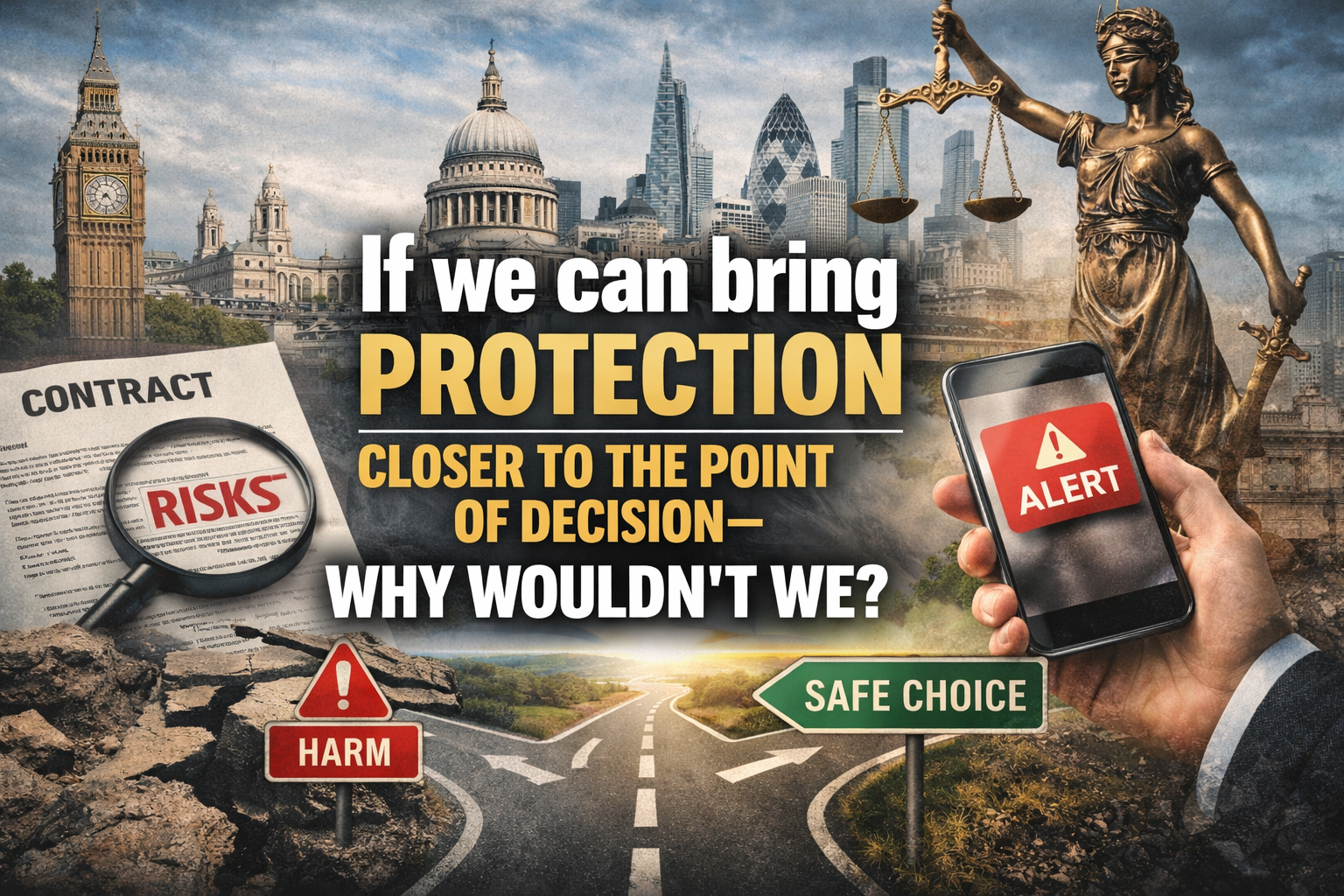
If we can bring protection closer to the point of decision—why wouldn’t we?
Closing Thought
Improving regulation is essential.
But empowering individuals may prove transformational.
The next evolution of consumer protection may not be defined solely by stronger rules—but by stronger decision-makers.
 Academy of Life Planning