
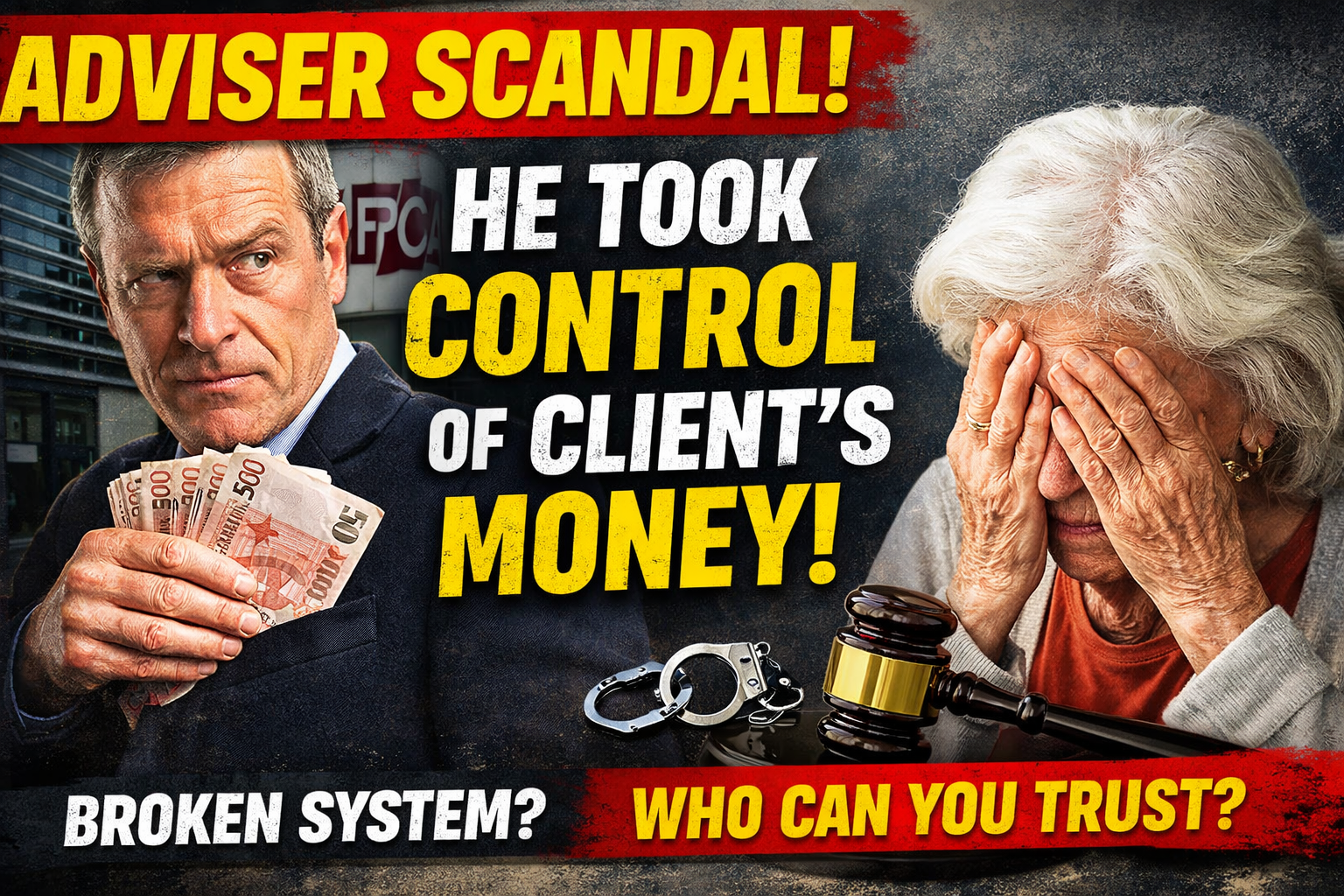
A former financial adviser is jailed.
£45,000 is taken from a vulnerable client.
The regulator bans him—years after the damage is done.
And the industry response is predictable:
“A bad actor. An isolated case. The system worked.”
But it didn’t.
Because the real question is not who committed the fraud.
It is this:
Why was the system designed in a way that made the fraud possible in the first place?
Case Note Summary: Financial Planning Today.
- Individual: Daniel Leon Williams (former FCA-approved financial adviser)
- Status: Banned by the FCA from all regulated activity
- Offence: Fraud by abuse of position (7 counts under Fraud Act 2006)
- Amount Misappropriated: Over £45,000 from a client
- Period of Misconduct: 2019–2021 (while at IPP Financial Services)
- Conviction: 6 February 2024, Manchester City Magistrates’ Court
- Sentence: 2 years 2 months’ imprisonment (Nov 2024, concurrent)
- FCA Action: Prohibition order effective 30 March 2026
Key Facts:
- The client was elderly and highly vulnerable, particularly during Covid isolation
- The adviser became a trusted support figure and exploited that relationship
- Funds were transferred directly into the adviser’s personal account
- The adviser had been FCA-approved for nearly 20 years prior
Key Insight:
- The case highlights a failure not just of individual conduct, but of control structures—where trust enabled effective access to client funds without timely detection or intervention.
The Hidden Assumption at the Heart of Financial Advice
Modern financial advice is built on an unspoken premise:
The client delegates.
The adviser acts.
Trust fills the gap.
That model has persisted for decades.
It feels efficient.
It feels supportive.
It feels professional.
But structurally, it contains a critical flaw:
It allows the person giving advice to become the person who can cause outcomes.
And once that happens, the system becomes trust-dependent.
The Case That Exposes the Structure
In the recent case, an experienced adviser:
- Built a relationship of trust with a vulnerable client
- Became a “support figure” during isolation
- Transferred client money into his own account
- Was only stopped after criminal conviction
This was not a failure of rules on paper.
It was a failure of control in practice.
Because at some point—formally or informally—the adviser had effective agency over the outcome.
And that is where the system broke.
The Real Distinction: Explanation vs Execution
To understand the failure, we need to separate two roles that are often blurred:
1. Epistemic Support (Understanding)
- Explaining options
- Clarifying consequences
- Modelling scenarios
- Improving the client’s thinking
2. Operative Agency (Action)
- Deciding what happens
- Initiating transactions
- Moving money
- Implementing outcomes
The industry frequently treats these as part of the same role.
They are not.
And they should never be.
The Structural Fault Line
The moment an adviser moves from:
“helping you understand”
to:
“causing something to happen”
the system crosses a line.
Because now:
- The client is no longer the sole decision-maker
- The client is no longer the sole actor
- The outcome depends on the adviser’s integrity
And therefore:
The system depends on trust, rather than control.
That is the definition of structural weakness.
Why This Matters More Than Ever
Historically, this model persisted because:
- Information was scarce
- Complexity was high
- Access to tools was limited
Clients needed intermediaries.
Today, that is no longer true.
With modern tools and AI:
- Information is abundant
- Scenarios can be modelled in real time
- Decisions can be tested before execution
The justification for transferring agency has eroded.
But the structure has not caught up.
A Clear Principle Emerges
If we strip this back to first principles:
A trustworthy system does not rely on trust at the point of action.
It ensures that:
- The person affected by the outcome
- Is the person who chooses
- Is the person who authorises
- Is the person who executes
Everything else is support.
Reframing the Role of the Adviser
This is not about removing advisers.
It is about restoring clarity to their role.
A properly defined adviser:
- Does not decide where money goes
- Does not execute transactions
- Does not hold control over outcomes
Instead, they:
- Improve understanding
- Challenge thinking
- Surface risks
- Help the client see clearly
In other words:
They illuminate.
They do not act.
The Academy of Life Planning Perspective
At the Academy of Life Planning, this leads to a different model entirely.
We do not start with products.
We do not start with recommendations.
We start with agency.
The client:
- Builds their own Total Wealth Plan
- Understands their own life and money
- Makes their own decisions
- Executes their own actions
The planner:
- Supports in moments of complexity
- Helps interpret when needed
- Acts as a guide—not a controller
And critically:
Agency never leaves the client.
The Deeper Insight
This case is not an anomaly.
It is a signal.
It shows what happens when:
- Trust is substituted for control
- Roles are blurred
- Agency is transferred without safeguards
The outcome is not surprising.
It is inevitable.
A System Worth Trusting
If the industry is serious about protecting clients, the answer is not:
- More rules
- More monitoring
- More retrospective enforcement
It is redesign.
A system worth trusting would ensure:
- No single individual can act unilaterally
- Every decision is visible before execution
- The client remains in control at all times
Because ultimately:
Trust is not a control mechanism.
Agency is.
Closing Thought
The lesson is simple, but profound:
The adviser may explain.
The adviser may challenge.
The adviser may support.
But:
Only the client should choose, authorise, and act.
Anything else is not advice.
It is delegated control.
And delegated control—no matter how well intentioned—is where structural risk begins.
 Academy of Life Planning