
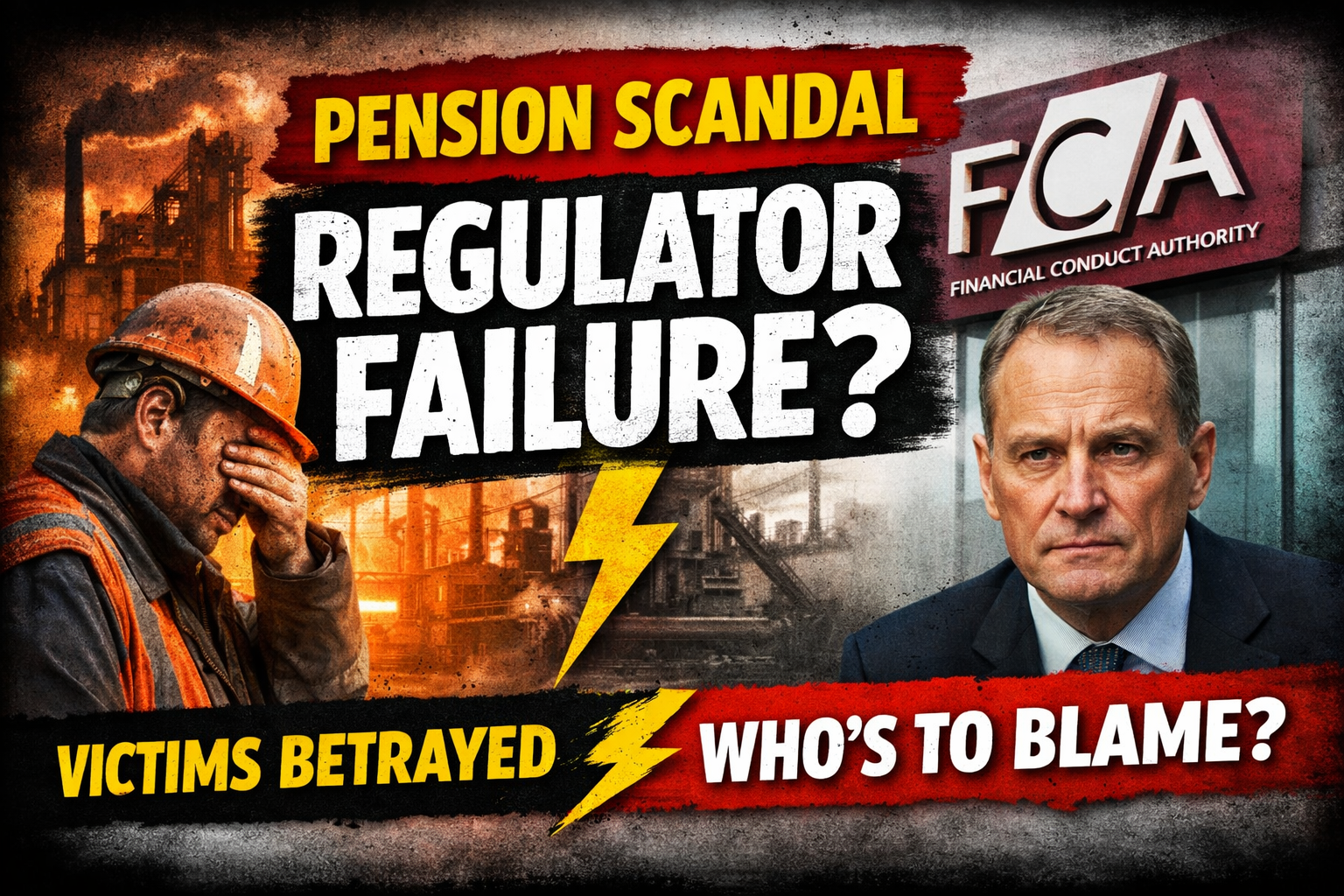
And the system still hasn’t learned the lesson.
The FCA says the system worked.
The Commissioner says it failed.
Both can’t be true.
For over 20 years, the UK regulator has known there is a problem in the defined benefit (DB) pension transfer market.
Not suspected.
Not emerging.
Known.
The original pension mis-selling scandal of the 1990s exposed it in plain sight:
- Consumers were advised to give up guaranteed, inflation-linked pensions
- Incentives were aligned to sell the transfer, not protect the outcome
- The long-term consequences were systematically underestimated—or ignored
Regulatory reforms followed.
And yet, decades later, we saw the same pattern repeat with the British Steel Pension Scheme (BSPS).
This wasn’t history repeating. This was history continuing.
Let’s be clear:
The BSPS scandal did not occur because the regulator didn’t know.
It occurred because the measures put in place after the 1990s were structurally inadequate—and allowed to persist.
That’s the uncomfortable truth.
The fundamental flaw: conflicts were never removed
The system attempted to manage conflicts.
It never removed them.
Even today, post-BSPS, we still see:
1. Partial fixes masquerading as solutions
- Contingent charging banned…
→ but product-linked charging still remains - Firms still able to charge:
- For reports where the conclusion is “do not transfer”
- Without delivering meaningful value
- Creating a perception (and sometimes reality) of “fees for no service”
2. Incentives still drive extraction
- AUM-based adviser fees remain standard
→ Encouraging asset gathering over client outcomes - Pension transfer specialists often sit within firms that:
→ Distribute investment products
This is the core contradiction.
You cannot claim to be an objective gatekeeper
while operating inside a model that profits from the gate being opened.
3. Regulatory blind spots still exist
Despite everything we’ve learned:
- Public sector → QROPS transfers are still permitted
- Flexi-access restrictions are still used as justification for transfers
- Insistent clients are still mishandled:
- Either refused entirely
- Or processed in ways that create legal ambiguity
And perhaps most critically:
4. Human capital is still ignored
The system continues to treat retirement planning as a financial capital problem only.
It fails to ask:
- Can this person generate income through skills, experience, or adaptation?
- Are there non-financial strategies that reduce reliance on pension extraction?
- Is the “need to transfer” actually a failure of life planning, not pension structure?
This is where the entire model breaks down.
Regulator vs Oversight: What’s Being Said Right Now
To understand where we are today, it’s important to separate independent scrutiny from the regulator’s own narrative.
The Commissioner’s key criticisms
Following a formal investigation into the handling of the BSPS crisis, the Complaints Commissioner identified several systemic failings:
- Delayed intervention
The FCA was too slow to act despite clear warning signs in the DB transfer market. - Failure to anticipate foreseeable harm
Known risks—particularly around adviser incentives and transfer volumes—were not addressed early enough. - Reactive rather than proactive supervision
The regulator responded after harm had materialised, rather than preventing it. - Insufficient use of available intelligence
Market signals and emerging patterns were not acted upon decisively. - Overall conclusion:
The FCA was effectively “behind the curve” throughout the lifecycle of the crisis.
This is not a critique of one decision.
It is a critique of systemic regulatory posture.
The FCA’s response
The FCA has formally rejected the suggestion that it failed in its duties.
Its position is:
- Actions were “reasonable and proportionate”
Given the information available at the time, the FCA believes its response was appropriate. - Existing rules already protected consumers
DB transfers were presumed unsuitable, and advisers were expected to act accordingly. - Significant remediation has taken place
- Thousands of cases reviewed
- Substantial redress paid
- Multiple firms and individuals sanctioned
- Reforms have since strengthened the system
- Ban on contingent charging
- Improved data monitoring
- Greater supervisory coordination
- Responsibility sits primarily with advisers
The FCA maintains that poor outcomes were driven by individual misconduct, not regulatory design failure.
Why this tension matters
What we are seeing is a fundamental divergence:
- Independent oversight:
“The system failed structurally.” - Regulator:
“The system worked, with improvements.”
This gap is not academic.
It determines whether:
- We make incremental adjustments, or
- We confront the need for structural change
⚠️ The uncomfortable reality beneath the headlines
When you step back, this is a classic institutional tension:
1. Regulator vs accountability
- The Commissioner says: systemic failure
- The FCA says: reasonable response
That gap is huge—and still unresolved.
2. Redress ≠ restoration
Even where compensation exists:
- Not all victims have been fully restored
- Some losses exceeded compensation limits
- Timing and methodology of redress have been questioned
3. Structural problem, not just bad actors
Yes, there were “unscrupulous advisers”…
But the Commissioner’s finding suggests:
- Failures in market oversight
- Weakness in early warning systems
- Conflicts (e.g. contingent charging) left in place too long
👉 That points to system design issues, not just individual misconduct.
💡 Why this matters (our lens)
This story goes right to the heart of our positioning.
It reinforces three critical truths:
1. Regulation is reactive, not protective
The FCA intervened after harm crystallised, not before.
2. “Advice” within a conflicted system is structurally fragile
Even with rules in place:
- Incentives drove behaviour
- Consumers bore the risk
3. The real gap is upstream: agency, not distribution
This is exactly our thesis:
The system keeps trying to improve distribution efficiency…
when the real failure is lack of user agency and understanding
🧭 Bottom line
This isn’t just a historical clean-up story.
It’s an active fault line:
- The regulator says the system works (with improvements)
- Independent oversight says the system failed structurally
- Consumers are still living with the consequences
The uncomfortable conclusion
After 30+ years of evidence, one thing is clear:
You cannot regulate your way out of a structurally conflicted system.
You can refine it.
You can supervise it.
You can discipline participants.
But if the incentives remain,
the outcomes will eventually repeat.
A practitioner’s perspective
I don’t say this from the outside.
I have been a pension transfer specialist since 1989.
During my FCA-regulated years in the 2010s, I held the relevant permissions to advise on these transactions.
I’ve seen:
- The original mis-selling wave
- The regulatory response
- The gradual re-emergence of the same risks
- And the BSPS crisis that followed
This is not theory.
This is lived professional experience across multiple regulatory cycles.
What needs to change (and hasn’t)
If we are serious about consumer protection, the shift required is not incremental.
It is structural.
1. Separate planning from product distribution
- Pension transfer specialists must not be:
- Investment managers
- Fund distributors
- AUM-based fee earners
This is the equivalent of separating:
Audit from sales
Anything less leaves the conflict intact.
2. Remove all product-linked charging
Not just contingent charging.
All of it.
- No percentage-based asset fees
- No product commissions (explicit or implicit)
- No revenue tied to implementation
Only then do you create:
A genuinely independent decision environment
3. Redefine suitability beyond financial capital
Every transfer analysis should include:
- Human capital strategy
- Lifestyle design
- Income adaptability
- Psychological readiness
Without this, the system is:
Optimising spreadsheets, not lives
4. Stop charging where no value is delivered
If the outcome is:
“Do not transfer”
Then the process must demonstrate clear, tangible value.
Otherwise:
- It erodes trust
- Reinforces perceptions of extraction
- And undermines the profession
The deeper issue: we’re solving the wrong problem
The industry continues to focus on:
- Distribution efficiency
- Compliance frameworks
- Product governance
But the real issue is upstream:
People lack agency, clarity, and structured thinking about their lives
Until that is addressed:
- Transfers will continue to be misused
- Advice will continue to be conflicted
- Regulation will continue to lag outcomes
The AoLP perspective
At the Academy of Life Planning, we take a different position:
- Plan the person first, not the product
- Treat financial capital as one tool among many
- Build decisions around human agency, not institutional frameworks
This is why we believe:
The future of financial planning is not better distribution.
It is the removal of unnecessary intermediation altogether.
Final thought
The BSPS story is not closed.
It is a signal.
A signal that:
- The system knew
- The system adjusted
- But the system did not fundamentally change
And until it does,
we should expect the pattern to repeat.
Curious how others see this.
 Academy of Life Planning