
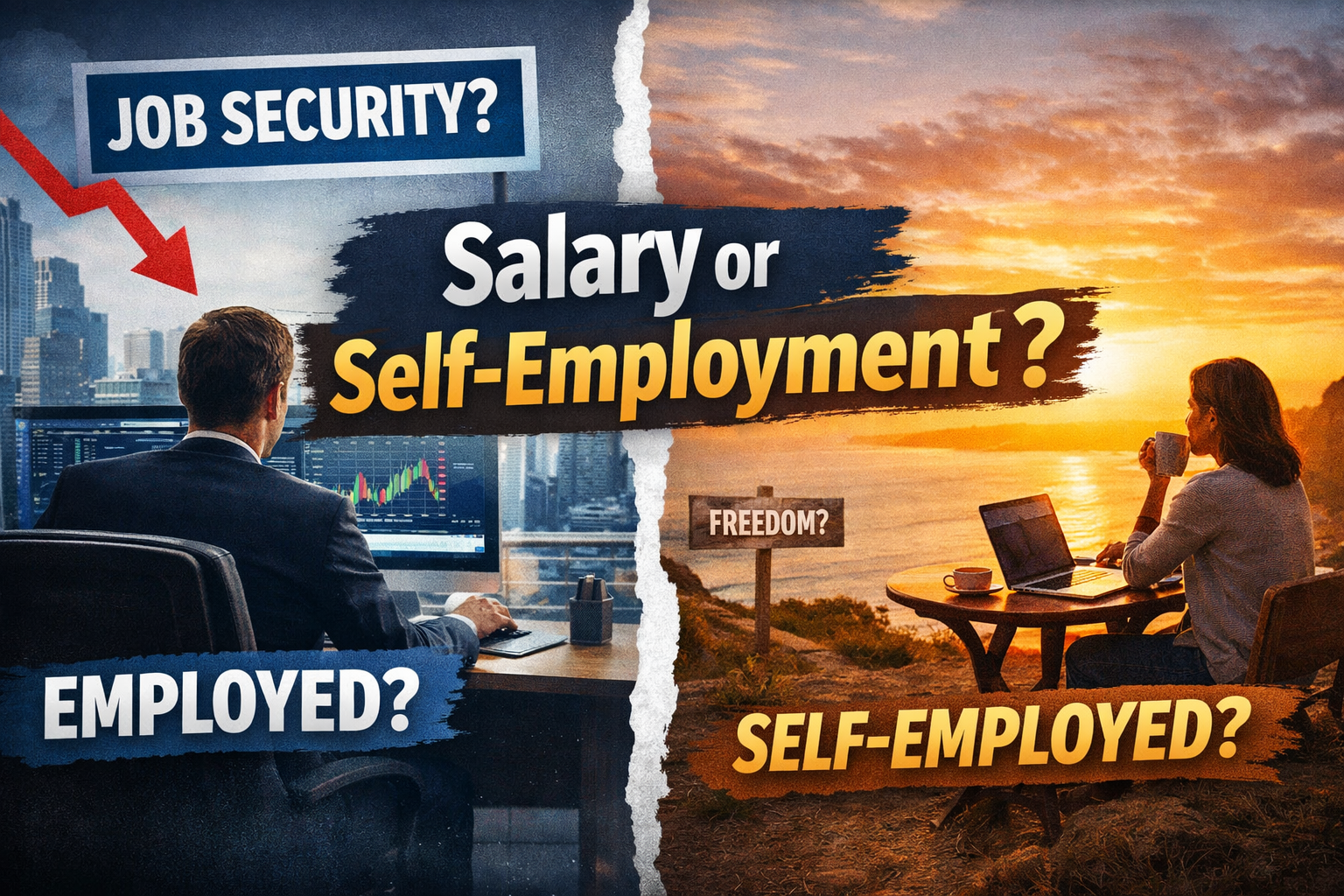
For new planners, which path is actually safer in the age of AI?
There is one objection that keeps coming up in conversations with Academy prospects:
“I’d love to become a Total Wealth Planner, but I need the security of a salary.”
It is a fair concern. It is also a revealing one.
Because behind it sits a deeper assumption:
salary = safety
self-employment = risk
That belief feels intuitive. Monthly pay arrives. The employer carries the infrastructure. Someone else appears to hold the risk.
But in 2026, that assumption needs re-examining.
Not because salaried work has no value. It often does.
But because the real question is no longer simply:
Should I take a salaried role or become self-employed?
The more important question is this:
Do I build my future inside a structurally untrustworthy system, or inside a structurally trustworthy one?
That is the question many new planners have not yet been invited to ask.
What do I mean by a “structurally untrustworthy” system?
This is not an attack on individuals. Many good, decent, intelligent people work inside systems that are bigger than them.
A system becomes structurally untrustworthy when its incentives are not cleanly aligned with the end client. In financial services, that often means a model where guidance, distribution, product economics, asset retention, referrals, and revenue extraction are mixed together. The adviser may care deeply. But the architecture still pulls toward implementation, not impartiality.
A structurally trustworthy system is different.
It separates planning from product pressure. It places the client’s life before the money. It treats the planner not as a distributor of financial products, but as a thinking partner helping a person make wiser life and money decisions.
That is the distinction at the heart of the Academy of Life Planning.
Why this matters more now
Because AI is changing the value equation of knowledge work.
The IMF says about 60% of jobs in advanced economies may be affected by AI, with roughly half of those exposed roles potentially benefiting from productivity gains and the other half facing downward pressure on labour demand, wages, or hiring.
The World Economic Forum reports that 86% of employers expect AI and information-processing technologies to transform their business by 2030.
That matters because many entry points into financial planning are built around tasks AI is increasingly capable of assisting with:
- information gathering
- report drafting
- scenario analysis
- summarising cases
- administrative and technical support
So when someone says, “I want a salary because it feels safer,” the right response is not dismissal.
It is to ask:
Safer than what?
The case for taking a salaried role
Let’s start with the strongest case for salary.
1. Predictable short-term cash flow
This is the clearest advantage. A salary provides regular income and reduces immediate pressure. For someone entering the profession, that can make a meaningful difference.
2. Structure, supervision, and exposure
Employment can give new planners access to systems, colleagues, compliance processes, real cases, and a rhythm of work that is hard to replicate alone.
3. Faster operational learning
Inside a firm, you may quickly learn pensions, reviews, service processes, documentation standards, and client-handling norms.
4. Lower immediate commercial pressure
You are not carrying the full emotional and financial weight of having to generate all revenue yourself from day one.
Those are real benefits. They should be acknowledged, not brushed aside.
The hidden downside of the salaried route
This is the part that many people skip.
1. You may be learning inside the wrong architecture
If the system is built around implementation, referrals, product economics, or asset retention, you are not simply learning “financial planning.”
You are learning a version of planning shaped by commercial misalignment.
That matters because early conditioning sticks. What you repeatedly do becomes what you think is normal.
2. Your income risk is concentrated
Salary feels safe because it is regular. But it is also concentrated in one institution.
If that employer restructures, automates parts of the workflow, cuts costs, or changes strategic direction, the income risk appears all at once. UK labour market data published in March 2026 showed unemployment at 5.2% for November 2025 to January 2026, up on the quarter and above the previous year. The same ONS release also showed payrolled employees down over the year.
So salaried work is not risk-free. It is simply a different risk pattern.
3. You can mistake institutional credibility for your own capability
A large part of the client’s trust in a salaried setting often comes from the badge, brand, process, and wrapper around you.
That can be helpful early on. But it can also delay the development of your own method, your own language, and your own direct value to the client.
4. AI may compress the value of routine knowledge work
If your role is heavily tied to processing, summarising, drafting, or standardised analysis, AI may not remove the role entirely, but it can reduce the scarcity premium attached to it. That is exactly the type of broad task exposure described by the IMF and WEF.
The case for self-employment inside a structurally trustworthy system
Now let’s turn to the other path.
This is not the heroic fantasy version of self-employment. This is the sober version.
1. Your incentives are cleaner
When your model is not dependent on product sales or implementation pressure, the relationship with the client can be more honest from the beginning.
That matters more than most people realise.
Trust is not just about personal ethics.
It is about whether the commercial structure supports or undermines those ethics.
2. You build the right muscles
A trustworthy planning model pushes you toward capabilities that are likely to grow in value, not shrink:
- listening
- judgement
- helping clients think clearly
- life-first planning
- human capital thinking
- behavioural and practical guidance
These are harder to commoditise than routine technical production alone.
3. You develop adaptability, not just dependency
The IMF’s work on AI and labour markets reinforces the idea that resilience increasingly depends on skill renewal and adaptation, not static role protection.
That supports a broader AoLP point:
long-term security is shifting from role security to capability security.
4. You avoid years of unlearning
One hidden cost of starting in a structurally untrustworthy system is that you may later need to unlearn the very habits and assumptions that helped you survive there.
That can take years.
The downside of self-employment
This part must be handled honestly.
The evidence does not support saying self-employment is automatically safer.
The OECD’s 2025 research on Europe found that the self-employed generally have somewhat poorer job quality than employees, and that solo self-employed workers tend to face poorer conditions than self-employed people with employees.
That means the risks are real.
1. Income volatility
This is the obvious one. Especially early on.
2. Weaker formal protections
Benefits and institutional safeguards are often thinner or uneven for the self-employed. OECD research makes this point clearly.
3. Greater need for self-management
Freedom without rhythm becomes drift. Self-employment demands discipline, structure, and emotional steadiness.
4. Poorly timed jumps can be damaging
Some people do not need to leave employment immediately. They need to build capability and confidence first.
So which path is safer?
Here is the most defensible answer:
If your time horizon is the next 6 to 12 months, salaried work is often safer.
Why? Because it usually provides more immediate cash-flow stability and lower short-term pressure.
But if your time horizon is the next 5 to 10 years, the answer becomes more nuanced.
Then the question shifts to:
- Are your skills becoming more or less valuable?
- Are your incentives aligned with trust?
- Are you building direct client value or borrowed institutional value?
- Are you dependent on one employer, or developing portable capability?
That leads to a more honest conclusion:
Salary may offer stronger short-term stability.
A trustworthy, self-directed model may offer stronger long-term alignment and adaptability.
Those are not the same thing.
The false binary that traps people
Many prospects unconsciously assume they have only two options:
- stay salaried forever
- leap blindly into self-employment
That is not the real choice.
For many people, the wisest path is a bridge:
- keep your income stability
- build trustworthy planning capability in parallel
- develop your own method
- test demand safely
- move only when the evidence supports it
This is one of the core reasons AoLP exists.
Not to push reckless leaps.
But to help people build the right architecture before making bigger moves.
Facts, myths, and distortions
Myth: Salary means safety.
Better framing: salary usually means short-term predictability, not immunity from restructuring, automation, or institutional fragility.
Myth: Self-employment is always more dangerous.
Better framing: solo self-employment often comes with greater income volatility and weaker protections, but that does not make a phased, structured transition irrational. It means it must be built carefully.
Myth: Starting inside a product-led system is the only way to learn properly.
Better framing: you may learn processes quickly, but you may also absorb misaligned incentives and distribution-first habits that later need unlearning.
Myth: The safest career is the one with the strongest institution behind it.
Better framing: in an AI-reshaped economy, long-term resilience increasingly depends on adaptable skills, trusted relationships, and the ability to create value beyond one employer.
My conclusion
If someone new to financial planning asked me which route to choose, I would not answer with a slogan.
I would answer with a sequence.
If you need immediate stability, a salary may be the right short-term move. But go in with your eyes open. You may be buying cash-flow stability while learning inside an architecture you later need to challenge.
If you care about long-term trustworthiness and alignment, build toward a self-directed, planning-led model. But do not romanticise it. Structure it. Test it. Phase it.
And if you want the wisest route of all:
Use salary for stability if you need it.
But do not mistake the employer’s system for your future identity.
Build your own trustworthy method in parallel.
That is the deeper truth.
The question is not simply who pays you.
The question is:
What kind of planner are you becoming?
Start with clarity
If this question is live for you right now, the most useful next step is not a leap. It is clarity.
That is exactly what the AI & Total Wealth Planning Strategy Session is for.
It is a focused one-to-one session designed to help you:
- review your current model
- assess where AI may change the value equation
- identify whether you are building inside a trustworthy or untrustworthy structure
- map a sensible bridge toward a more future-ready planning role
No pressure. No hard sell. Just a serious conversation about what your next chapter could look like.
If that feels timely, book a Strategy Session and let’s think it through properly.
 Academy of Life Planning