
Does an industry need to become a profession?
There is a quiet shift underway.
Not loud. Not yet fully visible.
But unmistakable once you see it.
It’s a shift in agency.
For decades, financial planning has been built on a simple premise:
The expert knows.
The client delegates.
That model made sense in a world where:
- Information was scarce
- Tools were complex
- Access was restricted
But that world is disappearing.
The Rise of Self-Direction
Today, something fundamentally different is happening.
People are no longer arriving at advice as blank slates.
They are:
- Modelling scenarios before meetings
- Exploring trade-offs in real time
- Asking better, sharper questions
- Challenging assumptions
Not because they’ve become experts…
…but because technology has lowered the barrier to thinking.
AI has not replaced the planner.
It has activated the individual.
And that changes everything.
From Delegation to Participation
When agency increases, behaviour changes.
Clients no longer want to:
- Be told what to do
- Be sold a solution
- Be positioned as passive recipients
They want to:
- Understand
- Participate
- Decide
This is not a marginal shift.
It is a structural rebalancing of power.
Where This Leaves the Industry
Here is the uncomfortable question:
If the client is thinking…
what is the role of the adviser?
If the model is still built on:
- Product distribution
- Asset gathering
- Controlled information
Then it begins to fracture under the weight of this new reality.
Because the system was never designed for:
empowered participants
It was designed for:
managed clients
Industry vs Profession
This is where the deeper question emerges.
What is financial planning, really?
Is it:
- An industry — optimised for growth, revenue, and distribution?
Or is it:
- A profession — grounded in ethics, judgement, and client interest?
The two are not the same.
An industry can:
- Scale efficiently
- Standardise behaviour
- Optimise outcomes for shareholders
A profession must:
- Exercise judgement
- Navigate complexity
- Place the client’s interest first — even when inconvenient
The Tension Is Now Visible
As agency rises, this tension becomes harder to ignore.
Because empowered individuals don’t just change behaviour.
They change expectations.
They begin to ask:
- “Whose side are you on?”
- “How are you paid?”
- “What happens if I do this myself?”
- “Do I need this at all?”
These are not technical questions.
They are questions of trust.
What Happens to Professional Bodies?
Professional bodies now sit at the centre of this shift.
Historically, their role has been to:
- Set standards
- Provide qualifications
- Represent the profession
But in practice, many have also:
- Supported existing industry structures
- Reinforced prevailing business models
- Defined competence within a product-led paradigm
So the question becomes:
Can a body represent a profession
if the underlying system behaves like an industry?
A Moment of Choice
This is not a criticism.
It is a moment of choice.
Professional bodies now have an opportunity to:
1. Defend the Existing Model
- Preserve current structures
- Incrementally adapt
- Frame change as evolution
Or…
2. Lead the Transition
- Redefine what “professional” means in an age of agency
- Expand beyond product and regulation
- Embrace human capital, life planning, and self-direction
- Place the individual — not the system — at the centre
What a True Profession Looks Like in 2026
If financial planning is to become a true profession in this new era, it will need to:
- Move from control → collaboration
- From answers → thinking partnership
- From financial capital → total wealth (including human capital)
- From product alignment → client alignment
And perhaps most importantly:
From intermediation
to
empowerment
The Role of the Planner
In this future, the planner does not disappear.
But the role changes.
From:
- Gatekeeper
- Expert authority
- Solution provider
To:
- Guide
- Interpreter
- Strategic thinking partner
Not for every decision.
But for the moments that matter most.
A Quiet Invitation
This is not about disruption for its own sake.
It is about alignment with reality.
Agency is rising — whether the system adapts or not.
The question is simply this:
Will financial planning evolve into a true profession…
or remain an industry under pressure?
And for those working within it:
Which side of that transition will you stand on?
The Academy’s Position
At the Academy of Life Planning, we see this as a natural evolution.
A movement:
- From dependence → self-direction
- From financial advice → life planning
- From industry structure → professional integrity
Not imposed.
But emerging.
The future of financial planning is not something to predict.
It is something to participate in.
A Small Story That Signals a Big Change
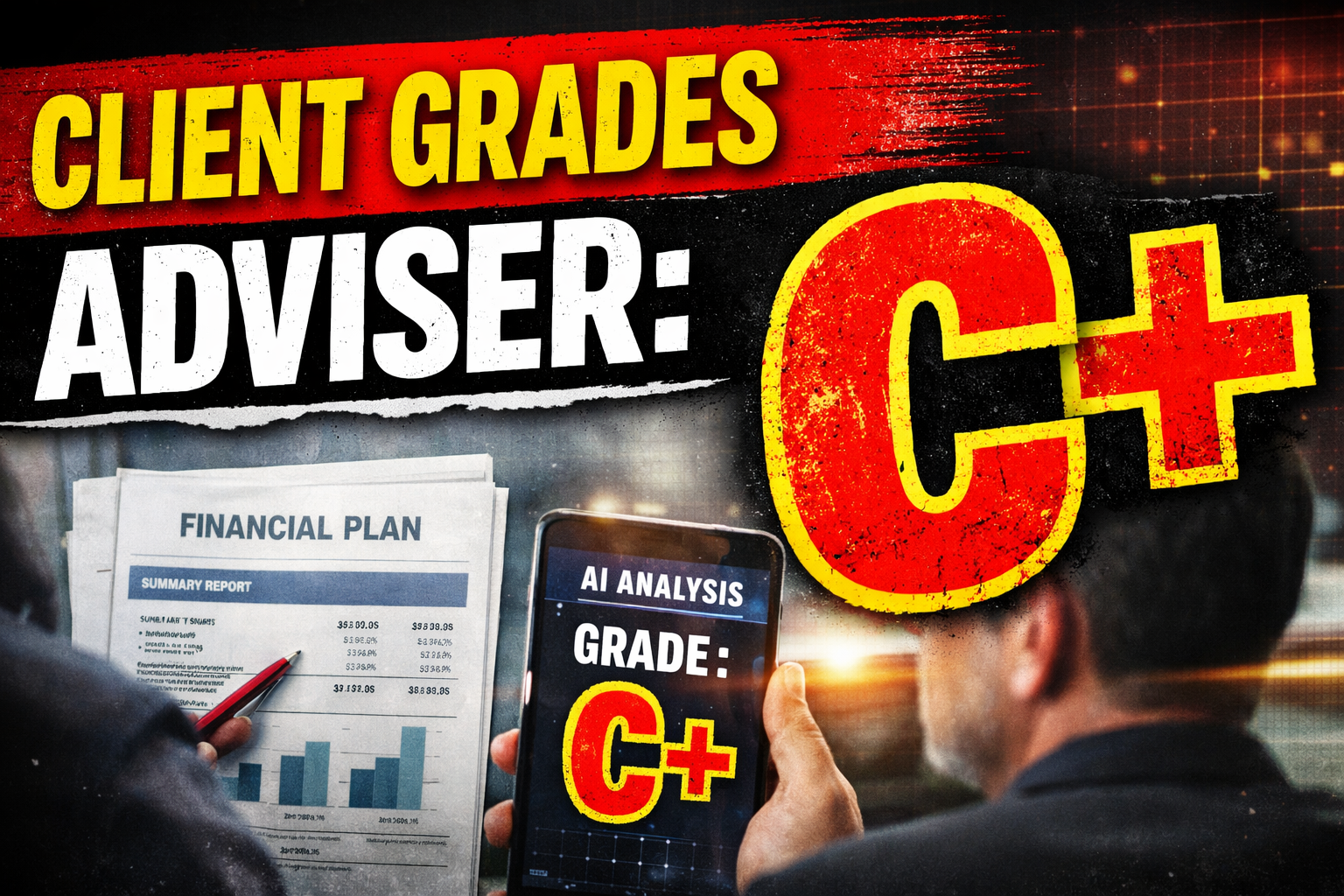
Recently, a planner shared something that would have been almost unthinkable just a few years ago.
A client received a full financial planning report from another firm.
Instead of simply accepting it…
they did something different.
They removed the names.
Uploaded the report into an AI tool.
And asked a simple question:
“Is this a good plan?”
The response?
A polite but clear assessment.
“C+ — satisfactory, but with gaps.”
The AI went further — identifying weaknesses, questioning assumptions, and suggesting where the plan could be improved.
Let that sink in.
This wasn’t a regulator.
Not a compliance team.
Not a second professional opinion.
This was the client, independently testing the advice they had been given.
 Academy of Life Planning