
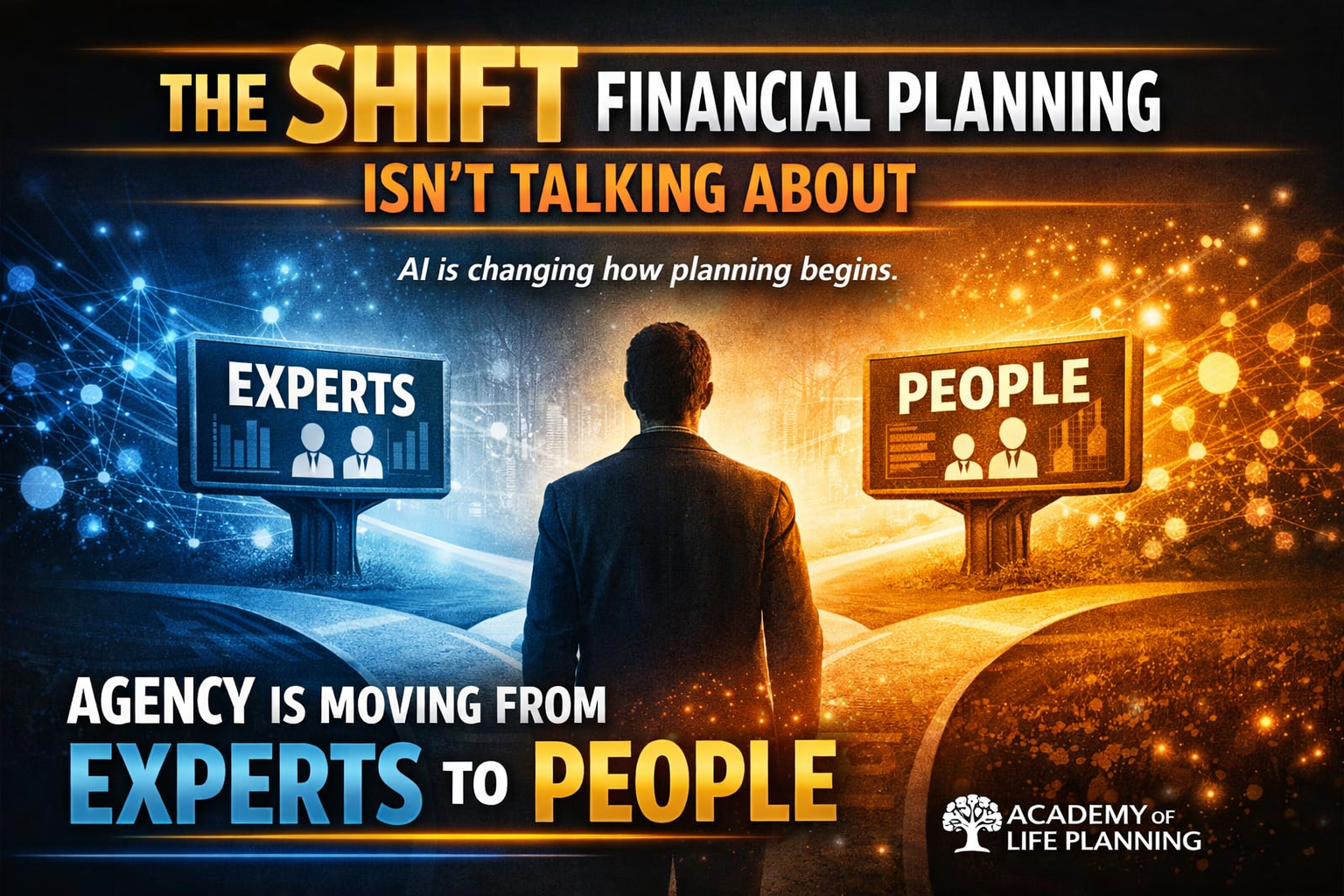
Agency Now Sits With People — Not Experts
For most of the past century, financial planning has operated on a simple assumption:
Experts decide. Clients follow.
The adviser analysed the numbers, produced the recommendation, and the client implemented it.
But quietly — and very rapidly — that assumption is breaking down.
Not because expertise has become irrelevant.
But because agency has shifted.
The ability to explore, test, and understand financial decisions is moving from the professional desk to the individual.
And that shift is being accelerated by AI.
The Evidence That Behaviour Is Already Changing
Recent research reveals something that should make every planner pause.
Nearly half of affluent investors now want to use AI-powered planning tools before speaking to an adviser.
Even more striking:
- 72% say they would use AI for basic financial planning tasks
- 63% have already considered AI-powered planning tools
In other words, the traditional discovery process is no longer the first step.
People want to think first, privately, before involving an expert.
There is a simple reason for this.
Exploration requires psychological safety.
When people are exploring their life goals, their fears about money, their hopes for the future, they often want space to think before presenting anything to a professional.
The traditional advice process rarely provides that space.
AI does.
The “Honesty Gap” Advisers Rarely See
Another research finding should concern the profession.
A significant number of clients admit they do not fully disclose information to their advisers, and many later act against the recommendations they receive.
This phenomenon has been called the honesty gap.
It happens for understandable reasons.
Clients may feel:
- embarrassed about past decisions
- unsure about their goals
- reluctant to challenge professional authority
- uncertain about how their values translate into financial choices
When planning begins inside an expert-led process, these tensions remain hidden.
When planning begins with personal exploration, something different happens.
People arrive at conversations with professionals clearer, calmer, and more engaged.
The New Role of the Planner
If agency shifts to individuals, where does that leave financial planners?
Not obsolete.
But elevated.
Instead of being the starting point for thinking, planners become something more valuable:
interpreters, guides, and partners in decision-making.
A good planner in the age of AI helps people:
- refine their thinking
- test assumptions
- pressure-test strategies
- navigate complexity
- implement decisions with confidence
The planner becomes a catalyst for clarity, rather than the sole source of answers.
Ironically, this often leads to better client relationships, not worse ones.
The Emergence of “Pre-Advice Planning”
One of the most interesting developments emerging from AI is the growth of what might be called pre-advice planning.
People want a place to:
- organise their thoughts
- explore life goals
- map financial possibilities
- understand trade-offs
before engaging with a professional adviser.
This is not a rejection of advisers.
It is preparation.
When clients arrive having already explored their situation, conversations with planners become:
- faster
- deeper
- more strategic
Practitioners testing this model are already reporting significant efficiency gains — in some cases saving 10 hours or more of discovery work per client.
Why We Built the Free Total Wealth Plan
At the Academy of Life Planning we have been observing this shift for years.
That is why we developed the Total Wealth Plan.
It is a free AI-powered planning tool designed to help individuals explore the big questions before speaking to a planner.
It allows people to:
- clarify life goals
- understand their human capital potential
- explore financial possibilities
- structure questions for advisers
Importantly, it does not replace professional advice.
It prepares people for it.
Think of it as the modern equivalent of drafting your ideas before meeting a lawyer or architect.
The conversation becomes far more productive when the thinking has already begun.
The Bigger Opportunity for the Profession
For planners willing to embrace this shift, the opportunity is enormous.
Instead of competing with AI, advisers can work alongside it.
The future planning journey may look more like this:
- Personal exploration (AI-assisted planning)
- Professional interpretation (planner discussion)
- Strategy design (collaborative planning)
- Implementation and review
This structure restores something financial planning has often struggled to maintain:
client ownership of the plan.
And when clients feel ownership, they are far more likely to follow through.
Planning in the Age of Human Agency
The deeper story here is not technological.
It is philosophical.
For decades, financial services have been built around expert authority.
But the future is being built around human agency.
People want to understand their lives.
They want to shape their futures.
They want tools that help them think clearly before making decisions.
The planner who understands this shift will thrive.
The planner who resists it may find their role gradually shrinking.
If You’re Curious to Experience the Shift
If you would like to see how planning looks when agency begins with the individual, you can explore the Total Wealth Plan here:
👉 [Try the Free Total Wealth Plan]
Many people use it simply to organise their thinking.
Some bring their outputs to a planner.
Others use it to begin designing a life plan independently.
There is no single correct path.
But the direction of travel is becoming clear.
The future of planning belongs to people who think for themselves — and the professionals who help them think better.
If you’re interested in evolving a traditional financial planning practice into a Total Wealth Planning business, the Academy of Life Planning can help guide that transition.
 Academy of Life Planning