
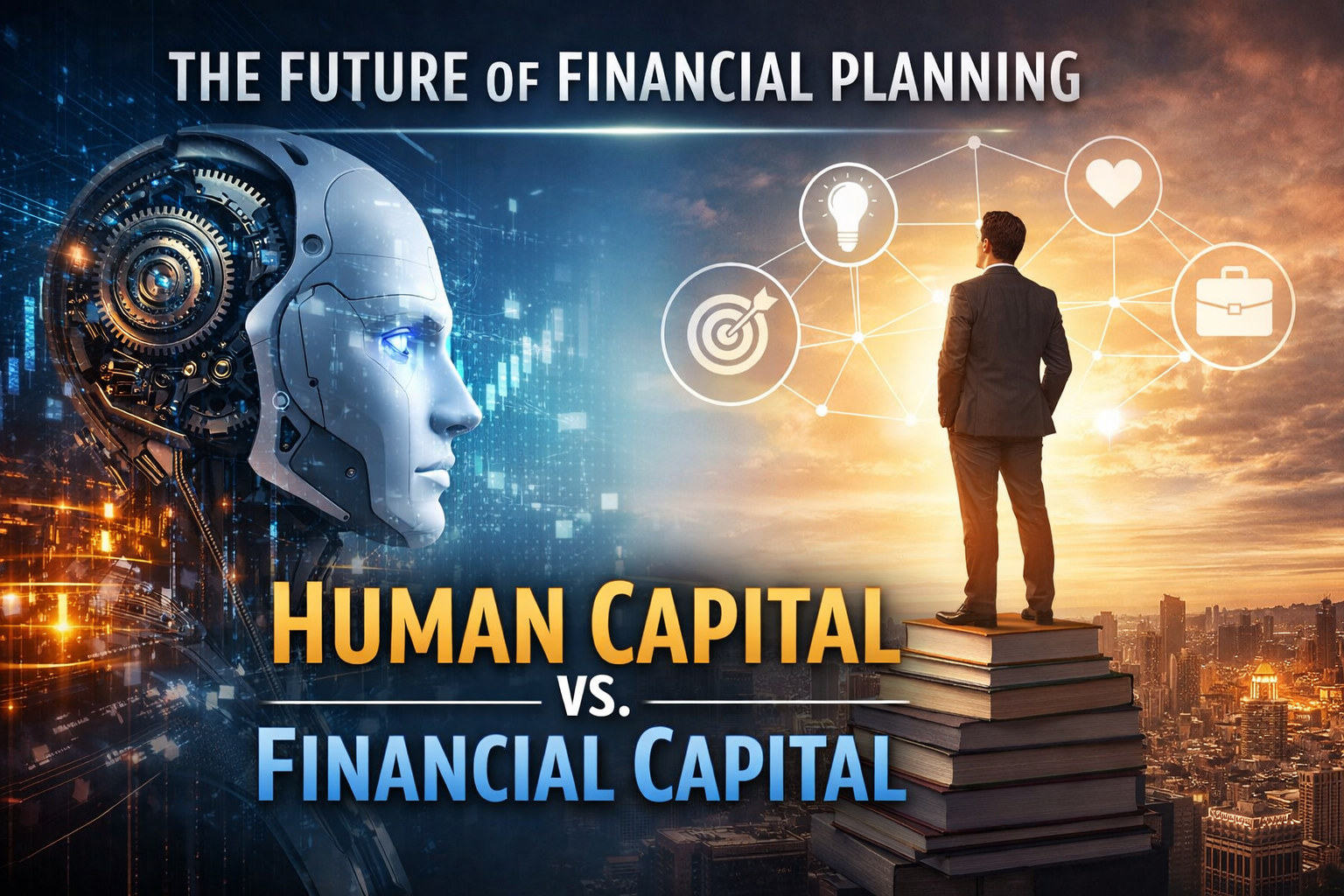
For decades, financial planning has been dominated by a simple idea:
Build financial capital so you can eventually stop working.
Portfolios.
Pensions.
Assets under management.
But something profound is changing.
In the age of artificial intelligence, automation, and longer working lives, the real driver of prosperity is no longer financial capital alone.
It is human capital.
And the research is clear: human capital has always been the dominant source of economic growth.
The financial planning profession is only just catching up.
Human Capital: The Original Source of Wealth
The concept of human capital is not new.
As early as Adam Smith in 1776, economists recognised that the real wealth of nations comes from the abilities, skills, and productivity of people.
Modern economic theory expanded this idea in the 1960s through the work of economists such as Theodore Schultz and Gary Becker, who described education, skills, and knowledge as forms of capital investment that generate future income.
Human capital includes:
- Education
- Skills and competencies
- Work experience
- Knowledge and creativity
- Health and longevity
- Attitudes and behaviours
These elements determine a person’s ability to generate income and contribute productively to society.
[Source: Developing human capital through education, By Ionela Gabriela Solomon.]
In other words:
People themselves are productive assets.
The Economic Evidence Is Overwhelming
Across multiple studies, the conclusion is remarkably consistent:
Investment in human capital drives economic growth.
Human capital formation improves labour productivity, innovation, and technological adoption, which in turn increases national income and economic output.
At the individual level, higher levels of education and skill development are strongly associated with:
- Higher lifetime earnings
- Greater employment opportunities
- Improved productivity
- Increased adaptability to technological change.
Economists have repeatedly demonstrated that the returns on education and skill development often exceed returns on physical capital investments.
Yet most financial plans barely address it.
The Blind Spot in Traditional Financial Planning
Most financial planning models focus on accumulating financial assets.
But from a life-cycle perspective, the largest asset most people ever possess is their human capital.
Consider a typical professional in their 30s or 40s.
Their future earnings potential over the next 25–35 years may easily exceed:
£2 million to £5 million.
Yet the financial plan often focuses almost entirely on:
- Pension contributions
- Investment portfolios
- Tax wrappers
While the income-producing engine itself receives little strategic attention.
This is like focusing on the dividends from a company while ignoring the business that generates them.
The Age of AI Changes Everything
Artificial intelligence is accelerating a shift that was already underway.
For many professionals:
Routine analytical work will increasingly be automated.
But human capital will not disappear.
Instead, the nature of valuable human capital will change.
Future economic value will increasingly come from capabilities such as:
- Judgment
- Creativity
- Emotional intelligence
- Strategic thinking
- Relationship building
- Ethical decision-making
In other words:
uniquely human capabilities.
The planners who thrive in the next decade will be those who help clients develop and deploy these capabilities, not just invest their surplus income.
From Financial Planning to Human Capital Planning
This is where the profession is evolving.
The future planner is not simply a portfolio manager.
They are a human capital strategist.
That means helping clients think about:
Career Capital
- Skills development
- Professional positioning
- Future employability
Learning Capital
- Continuous education
- Reskilling for technological change
Health Capital
- Longevity planning
- Energy management
Network Capital
- Relationships
- Social capital
Financial capital becomes the by-product of a well-designed human capital strategy.
The Opportunity for Financial Planners
Many planners feel threatened by AI.
But the real opportunity is much bigger.
Technology can automate calculations.
It cannot replace meaningful life design conversations.
Clients increasingly need help answering questions like:
- Should I retrain or pivot careers?
- How do I stay relevant in a changing industry?
- When should I slow down or redesign my working life?
- What investments in myself will produce the greatest return?
These are human capital questions.
And they sit at the heart of modern financial planning.
The Future of Planning
The profession is standing at a crossroads.
One path continues the traditional model:
Portfolio management, product distribution, and incremental efficiency gains from AI.
The other path recognises a deeper truth:
Financial capital is only one form of wealth.
Human capital is the engine that creates it.
The planners who understand this shift will not be replaced by AI.
They will be amplified by it.
A New Generation of Planner
At the Academy of Life Planning we believe the next generation of professionals will move beyond product-led advice and toward Total Wealth Planning.
Planning that begins with:
Life → Human Capital → Financial Capital
Not the other way around.
Because when human capital is developed intentionally, financial outcomes tend to follow.
And in the Age of AI, helping people become the author of their own life and economic future may be the most valuable service a planner can offer.
 Academy of Life Planning