
Why Financial Advisers Must Become Guides, Interpreters, and Trusted Thinking Partners
A simple poll can sometimes reveal more about the future of an industry than a thousand white papers.
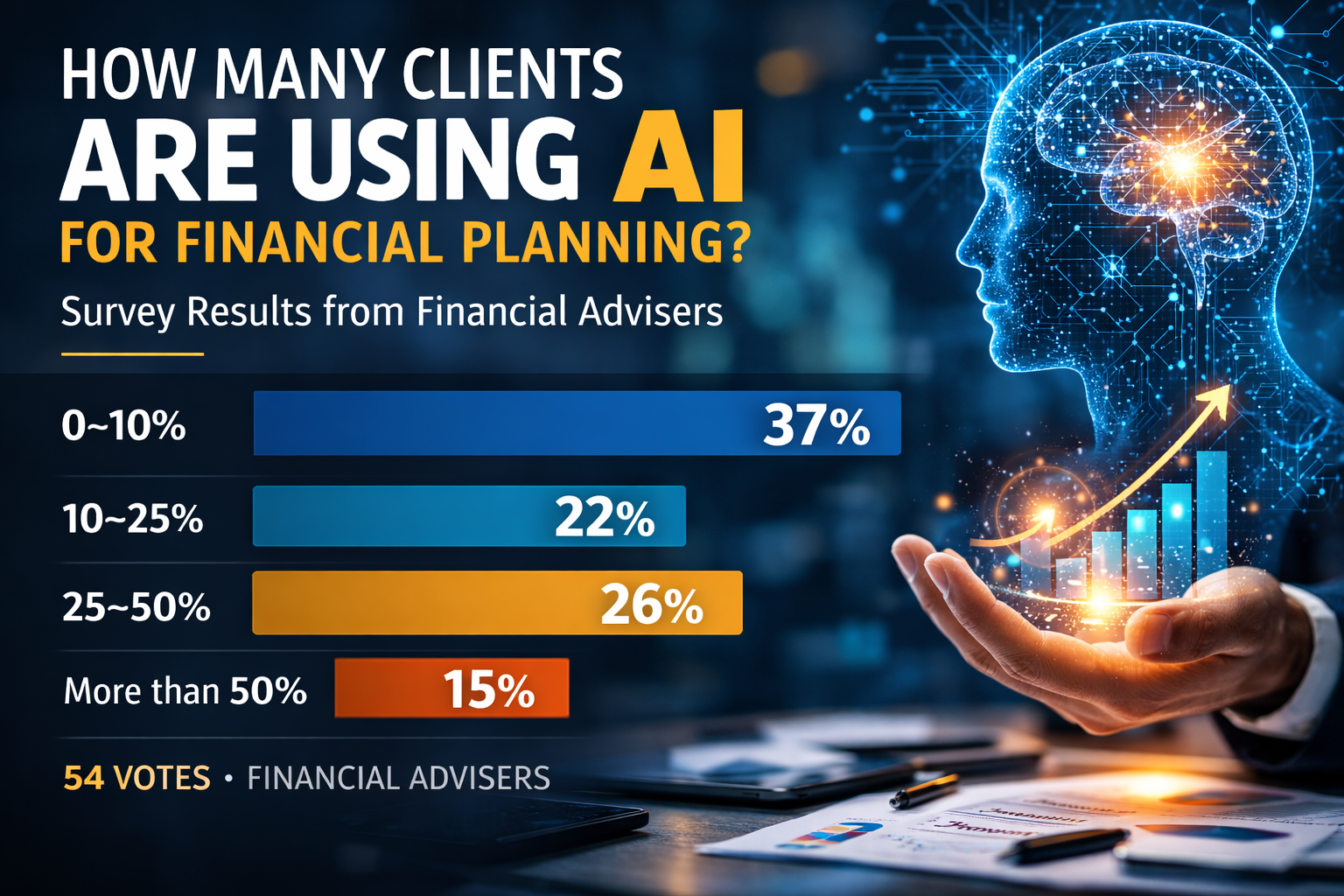
Earlier this week I asked a straightforward question to advisers on LinkedIn:
“What percentage of clients already use AI tools for financial planning or financial questions?”
The results were fascinating.
- 37% believe fewer than 10% of clients use AI
- 22% believe 10–25% do
- 26% believe 25–50% do
- 15% believe more than half already do
In other words:
63% of advisers now believe at least one in ten clients are already using AI for financial questions.
And 41% believe that as many as a quarter to half of clients may already be doing so.
This is remarkable.
Not because it proves exactly how many clients use AI.
But because it reveals something far more important:
The profession can already feel the ground shifting beneath it.
The Quiet Behavioural Shift Happening Right Now
For decades the structure of financial advice looked like this:
Client → Adviser → Software → Answer
The adviser owned the model.
The client received the output.
The client depended on interpretation.
But AI has quietly changed the starting point.
Increasingly the process now looks like this:
Client → AI → Understanding → Planner for judgement
Clients are beginning to:
- ask AI to explain pension rules
- interpret investment performance
- compare financial strategies
- understand tax implications
- model scenarios before meeting an adviser
They arrive at conversations more informed than ever before.
This does not eliminate the need for planners.
But it changes the nature of the relationship.
AI Doesn’t Replace Planners. It Changes Their Role.
Financial planning has always contained two very different activities.
Calculation.
And judgement.
Historically these were bundled together.
Planning software handled the calculations.
The adviser explained the outputs.
But AI now performs much of the mechanical analysis instantly.
Which means the real value of the planner shifts to something deeper.
The future planner is not primarily a calculator.
The future planner becomes:
• a guide through complex decisions
• an interpreter of financial information
• a capability builder helping clients think clearly
• a trusted thinking partner in moments that matter
In other words, the planner moves from operator to mentor.
The Rise of the Total Wealth Planner
This shift is exactly what the Academy of Life Planning has been preparing for.
Total Wealth Planning begins from a different premise.
Planning life comes before planning money.
Instead of starting with products or portfolios, we start with the person.
Their goals.
Their capabilities.
Their human capital.
Their choices.
AI can assist with calculations.
But it cannot replace the human work of helping someone navigate:
- life transitions
- career choices
- purpose and fulfilment
- financial resilience
- the trade-offs that shape a life
Those conversations require wisdom, empathy, and judgement.
Why Many Advisers Feel the Tension
Many professionals sense something changing but struggle to articulate it.
That tension often appears in questions like:
- “Will AI replace financial advisers?”
- “Will clients still need us?”
- “How do we compete with AI tools?”
But these questions misunderstand the shift.
AI is not replacing the planner.
AI is removing the dependency on calculation.
Which creates space for the planner to move into their highest value role.
Helping people think.
Helping people decide.
Helping people live well.
The Bridge to the Future of Financial Planning
For advisers currently operating within traditional advice models, this transition can feel daunting.
Which is why the Academy created a bridge.
A practical pathway for advisers who want to evolve their role without abandoning their professional experience.
In 90 days, advisers can reposition themselves as:
• Guides
• Interpreters
• Capability builders
• Trusted thinking partners
The technical knowledge they already possess remains valuable.
But it is applied differently.
Instead of managing assets alone, planners help clients build agency.
Instead of delivering answers, planners help clients develop capability.
Instead of selling products, planners help clients design their lives.
The Next Chapter of Financial Planning
The poll results show something subtle but important.
The profession already senses that client behaviour is changing.
AI is simply accelerating a deeper shift that has been building for years.
People increasingly want:
- understanding rather than dependency
- partnership rather than instruction
- agency rather than delegation
The planners who thrive in the coming decade will be those who embrace this transformation.
Those who move beyond the role of financial technician.
And step fully into the role of life-centred guide.
A 90-Day Bridge for Advisers Ready to Evolve
At the Academy of Life Planning we help advisers make this transition.
Not through theory.
But through a practical programme that enables professionals to reposition themselves in just 90 days.
The result is a new professional identity:
A Total Wealth Planner.
A guide who helps people align their finances with their lives.
A professional who uses technology intelligently but remains deeply human.
And a trusted partner for clients navigating the most important decisions they will ever make.
If you sense the shift happening in the profession, you’re not alone.
You can explore the pathway here:
 Academy of Life Planning