
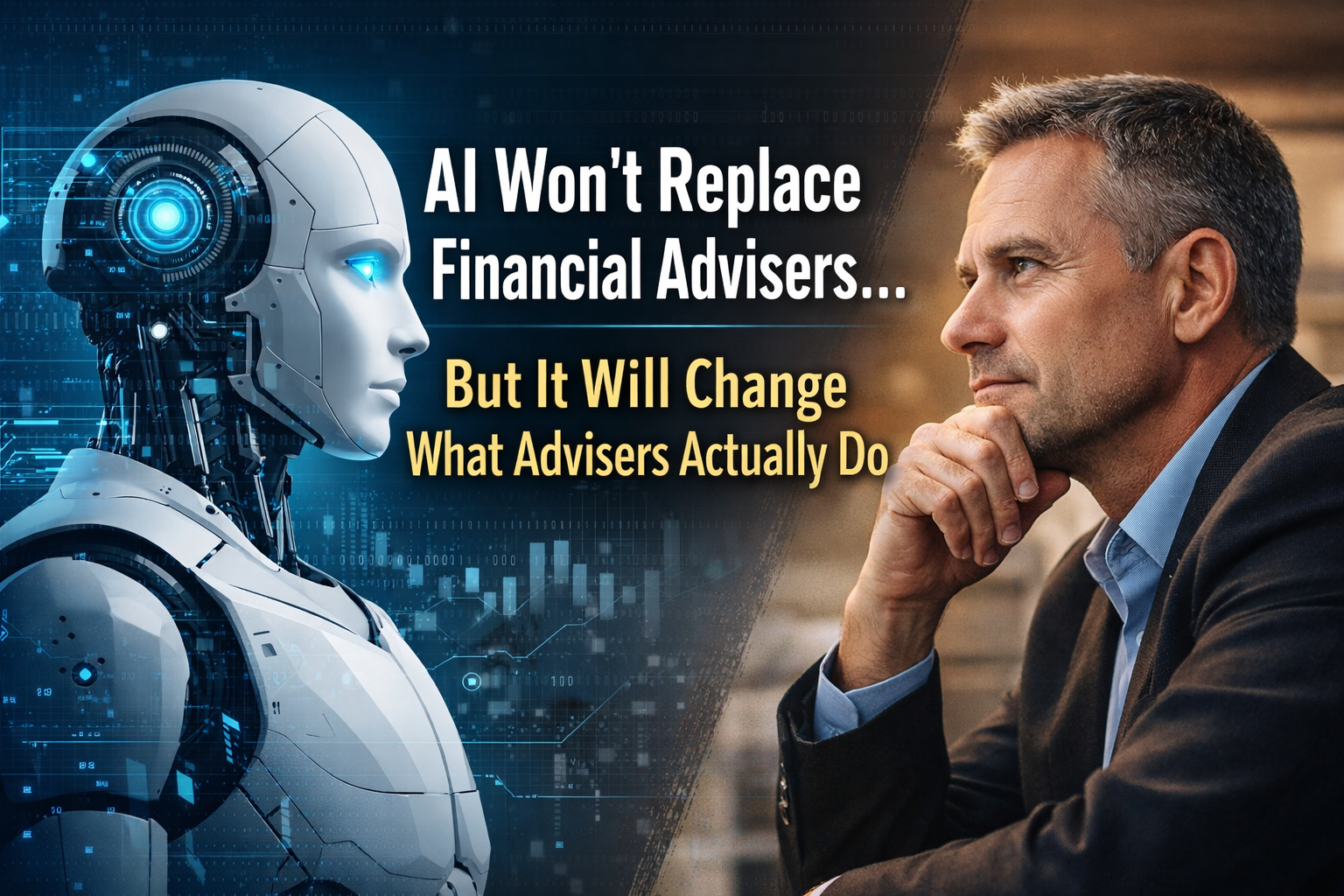
But It Will Change What Advisers Actually Do
A financial adviser told me something interesting this week.
He said AI won’t replace advisers.
An executive from the company behind Claude had said the same thing.
He looked relieved.
But the conversation that followed made me realise something much more important.
AI may not replace advisers.
But it may replace most of the work advisers currently do.
This week I had an interesting conversation with a traditional financial adviser inside one of the UK networks.
We talked about the future of the profession.
He mentioned something he had recently heard — that AI would never replace financial advisers.
The comment came from an executive at Anthropic, the company behind Claude.
For many advisers, that statement is reassuring.
It suggests the profession will continue much as it always has.
And in one sense, it’s probably true.
Financial advisers are unlikely to disappear.
But something far more interesting is happening.
The Work Is Changing
When people talk about AI replacing advisers, they usually imagine a robot sitting across the table from a client.
That’s not how disruption works.
What actually changes first is the work itself.
For decades, much of the adviser’s time has been spent on tasks like:
• analysing pension statements
• building cashflow models
• exploring retirement scenarios
• comparing investment portfolios
• explaining tax rules
• preparing planning reports.
These tasks require expertise.
They also require time.
Today, AI tools can already assist with many of them.
Not perfectly.
But often fast enough to change expectations.
Clients can now explore financial questions themselves before they even meet a professional.
The Quiet Shift in Agency
This is where the real change begins.
Historically, financial planning tools were owned by advisers.
Clients rarely saw the model.
They received the conclusion.
AI flips that structure.
Individuals can now ask questions directly:
What happens if I retire earlier?
What happens if I change careers?
What happens if markets fall?
They can explore possibilities in minutes.
This doesn’t remove the need for professional guidance.
But it does change something fundamental:
who owns the thinking process.
The Real Value of a Professional
If AI can help with analysis and modelling, what remains uniquely human?
In my experience, the most valuable work advisers do has never been about spreadsheets.
It happens in moments like these:
• when someone sells a business and doesn’t know what comes next
• when a family is navigating inheritance and responsibility
• when someone realises they are financially secure but emotionally uncertain
• when life changes faster than financial plans.
Those conversations are not really about investments.
They are about life direction.
And they require something no algorithm can provide:
human judgement.
The Profession May Be Expanding, Not Shrinking
This is why the future of financial planning may actually be larger than the traditional advice model suggests.
For decades, the industry has focused heavily on financial capital.
But most people’s lives are shaped just as much by:
• human capital (skills, careers, earning power)
• time capital
• health
• relationships
• purpose.
When you view wealth through that wider lens, investment portfolios become only one part of the picture.
An important part.
But not the whole story.
The Bridge
Some advisers sense this shift already.
They feel that the profession is evolving.
That the most valuable work they do is not product selection or portfolio management.
It is helping people think clearly about their lives.
At the Academy of Life Planning we describe this emerging role as a Total Wealth Planner.
Someone who helps individuals navigate the full landscape of wealth — financial, human, and personal.
Investment advice remains part of that picture.
But it no longer defines the profession.
So Was Peter Nolan Right?
In one sense, yes.
Financial advisers are unlikely to be replaced by AI.
But the profession is entering a period of transformation.
The technical work will increasingly be assisted by technology.
The human work will become more important.
And the advisers who thrive will be those who embrace that shift early.
The future may not eliminate financial advisers.
But it will almost certainly redefine what it means to be one.
 Academy of Life Planning