
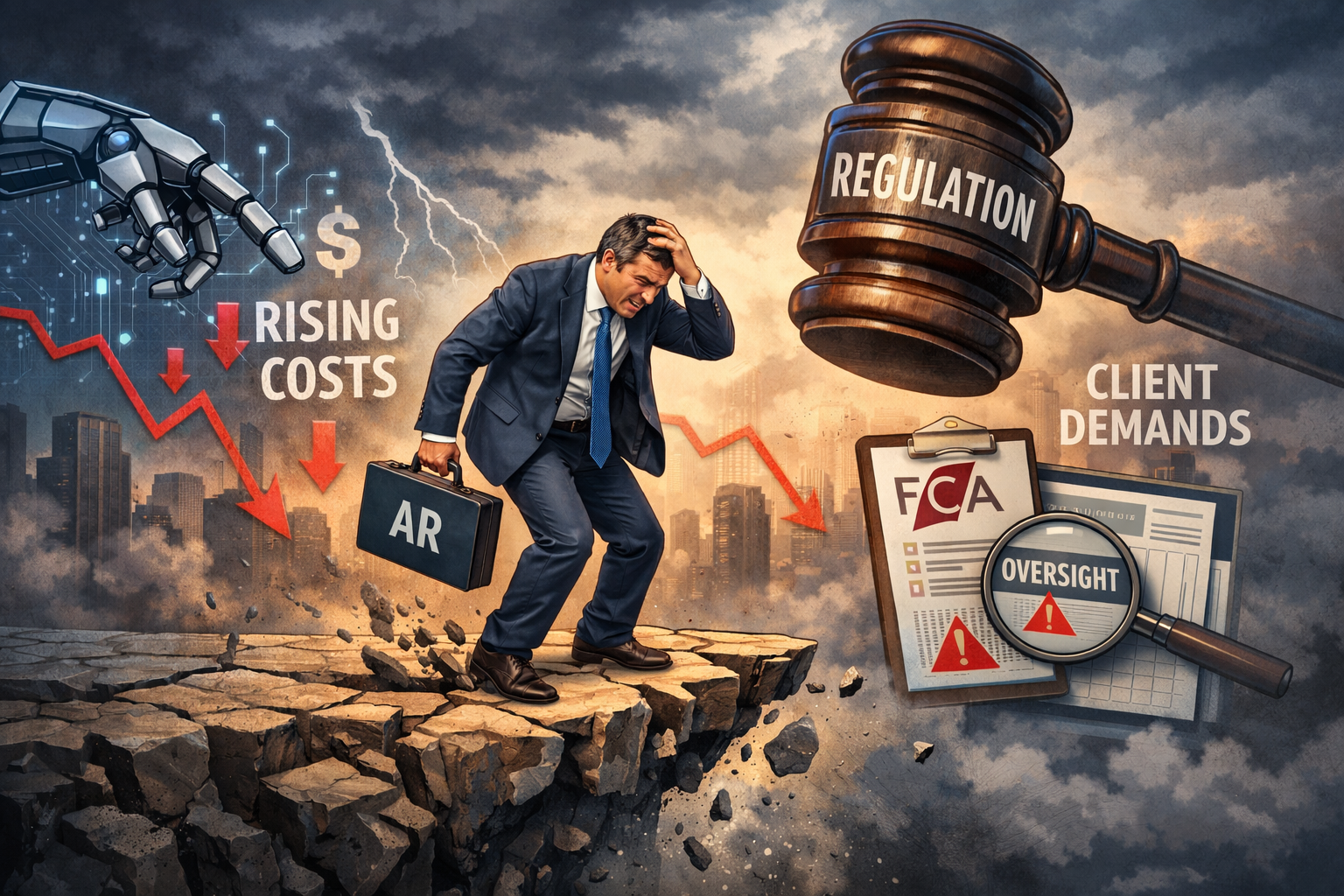
The regulatory landscape has shifted again — and this time, it’s structural.
The recent announcement from HM Treasury confirming consultation on a tougher regime for 34,000 appointed representatives is not just another compliance update. It is a directional signal about where the profession is heading and what kind of planner will thrive in the next era.
For those currently operating as ARs and quietly sensing that change is coming, this moment matters.
What’s Actually Happening
The proposed reforms would:
- Require principal firms to take greater responsibility for supervising ARs
- Extend the remit of the Financial Ombudsman Service directly to AR firms
- Bring ARs into the Senior Managers & Certification Regime
- Require principal firms to obtain permission from the Financial Conduct Authority before appointing ARs
Legal commentary notes this closes a long-recognised accountability gap — one where consumer harm often arises at AR level but responsibility historically sat elsewhere.
In simple terms:
Responsibility is moving closer to the individual.
Why This Matters More Than It Looks
Many ARs initially chose that route because it offered:
- Faster entry to market
- Lower regulatory burden
- Administrative support
- A ready-made compliance structure
But regulatory regimes evolve toward their pressure points. The AR model has been one of those pressure points for years.
When regulators tighten frameworks, they rarely reverse direction. They are signalling the future architecture of the profession.
And that future is pointing toward three defining characteristics:
- Direct accountability
- Personal professional identity
- Transparent client alignment
The Real Question Facing AR Planners
The issue is not whether the rules will tighten.
The real question is:
Do you want your future defined by someone else’s regulatory permission — or by your own professional architecture?
Many planners standing at this point feel an internal tension:
- appreciation for the support structure they have had
- awareness that dependence limits autonomy
- curiosity about what a more independent model could look like
That tension is not uncertainty.
It is transition.
The Market Is Changing at the Same Time
The timing of this regulatory shift is not random. It is happening alongside broader industry forces:
- AI transforming advice delivery
- Rising compliance costs
- Shrinking margins on traditional models
- Clients demanding transparency
- Growing scepticism about product-led planning
When regulation tightens and technology accelerates simultaneously, professions tend to bifurcate:
Those who adapt early become architects.
Those who delay become passengers.
What the Bridge Represents
For many AR planners, the next chapter is not about leaving the profession.
It’s about evolving within it.
That evolution may mean:
- redefining your role from distributor to planner
- moving from product dependency to planning independence
- building a model aligned with your values, not just permissions
The bridge is not a leap into the unknown.
It is a transition into authorship.
A Quiet but Powerful Shift
Historically, the industry rewarded scale, distribution, and compliance navigation.
The emerging environment rewards:
- clarity
- trust
- human-centred planning
- professional autonomy
This is not rebellion.
It is maturation.
Your 12-Week Window of Opportunity
Moments like this rarely come with a clear timeline.
But right now, one exists.
Financial planners who want to step into a future-ready role can transition to Total Wealth Planner accreditation in just 12 weeks through the Academy’s Fast-Track pathway — enabling you to:
- redefine your professional identity
- operate with greater independence
- serve clients holistically
- build a planning-led practice rather than a product-led one
This is not about abandoning experience.
It is about upgrading its architecture.
A Thought for Those Standing at the Threshold
Regulation does not create change.
It reveals it.
If you are an AR sensing that your future might lie beyond the traditional framework, you are not late. You are early to awareness.
The planners who shape the next decade will not be those who wait for permission to evolve.
They will be those who recognise the moment they are living in — and cross the bridge while it is still quiet.
The bridge is not closing.
It is appearing.
 Academy of Life Planning