
Recent market tremors tell a revealing story. When news broke that Altruist launched an AI-driven planning engine capable of generating personalised strategies in minutes, investors reacted instantly. Share prices across major wealth firms — including St James’s Place, AJ Bell, and Quilter — fell sharply.
The market’s response wasn’t about one tool.
It was about what that tool represents.
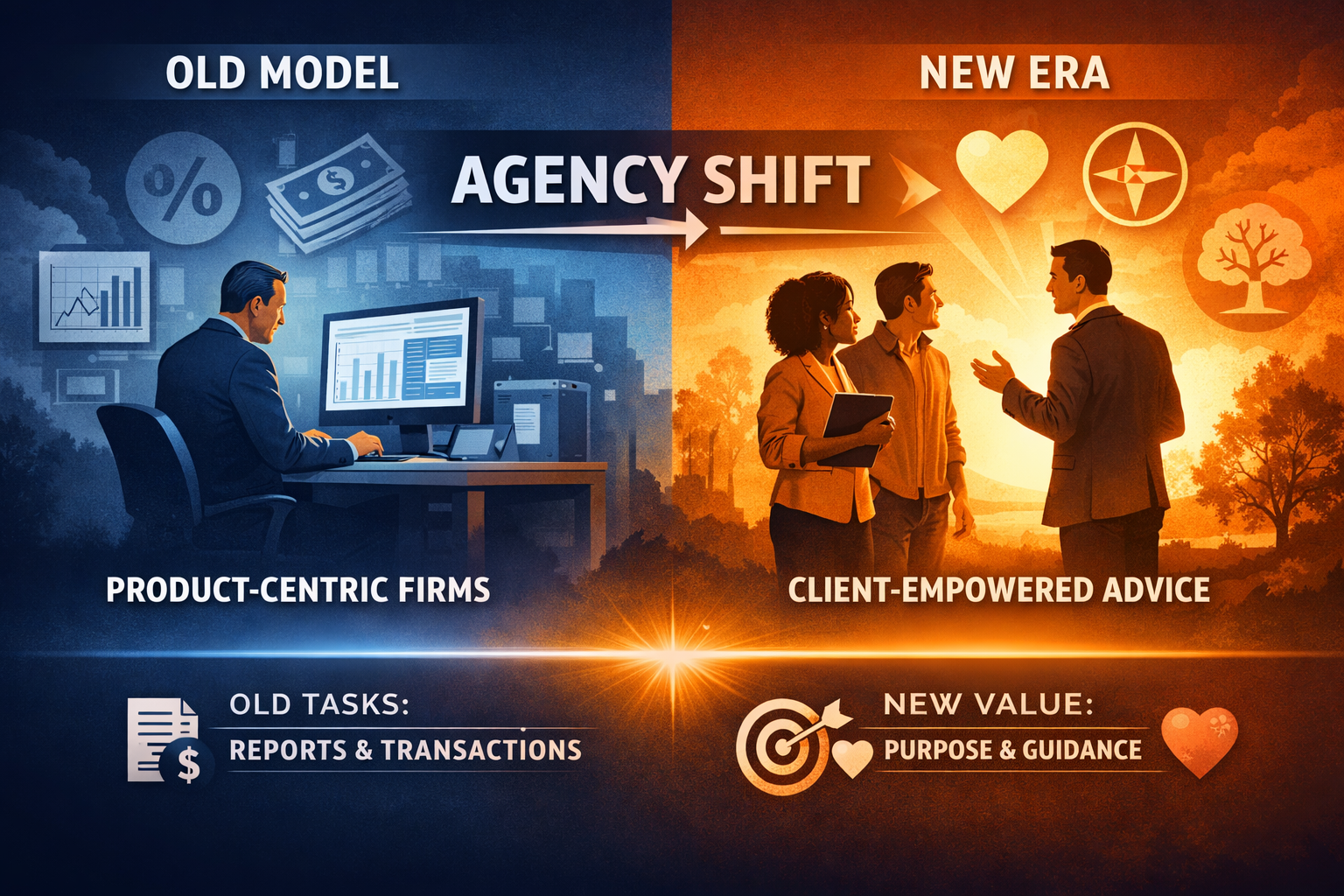
Agency is shifting.
Not from advisers to machines.
But from institutions to individuals.
And that changes everything.
The Real Signal Investors Just Spotted
For decades, most financial technology has focused on one goal:
Make planners more efficient.
Better CRM systems.
Faster portfolio analytics.
Automated compliance workflows.
Useful? Yes.
Transformational? No.
Because those tools optimise the adviser’s workflow — not the client’s autonomy.
The new generation of AI tools flips that model.
Instead of asking:
“How can we help advisers process data faster?”
They ask:
“Why can’t individuals analyse their own data directly?”
That shift removes a layer of dependency.
The Mistake Fintech Is Still Making
Many developers still believe the competitive battlefield is:
Adviser vs Adviser, powered by better software.
But the real battlefield is now:
Institution vs Individual Agency.
If technology merely makes advice firms more efficient, it strengthens existing structures.
If technology empowers end users directly, it changes the structure.
Those are completely different futures.
The 90/10 Model: Where Evolution Is Already Happening
The Academy’s Total Wealth Plans initiative reflects this structural transition.
The 90/10 framework recognises a simple truth:
- 90% of planning tasks can be done by individuals using intelligent tools.
- 10% require human judgement, empathy, and contextual interpretation.
That 10% is where professionals become more valuable — not less.
AI doesn’t remove advisers.
It purifies their role.
Routine analysis → automated
Scenario modelling → instant
Portfolio diagnostics → self-service
Which leaves human planners focused on:
- life transitions
- behavioural coaching
- strategic judgement
- complex decision architecture
- meaning, purpose, and alignment
That’s not disintermediation.
That’s role elevation.
Why Markets Reacted So Strongly
Investors saw something industry insiders often miss:
AI doesn’t need permission from legacy business models.
The reaction wasn’t based on proven disruption. It was based on anticipated margin compression.
When analysis becomes abundant, fees tied to analysis decline.
When insight becomes accessible, fees tied to access decline.
What remains valuable is what cannot be automated:
Trust
Interpretation
Perspective
Wisdom
The £8–£10bn Question Nobody Wants to Ask
A large portion of traditional advice revenue comes from periodic reviews.
But when individuals can paste portfolio data into AI and instantly receive:
- risk analysis
- diversification diagnostics
- scenario modelling
- allocation insights
… the economic justification for routine review fees becomes harder to defend.
This isn’t a threat narrative.
It’s a market-structure reality.
Technology is not attacking advisers.
It is removing friction.
And friction has historically been monetised.
The Future Belongs to Firms That Understand This One Principle
Technology that empowers clients will always outcompete technology that protects institutions.
The firms that thrive won’t be those with the best internal systems.
They’ll be the ones who:
- give clients tools
- teach clients understanding
- support clients selectively
- charge only where human value exists
That is precisely the philosophy behind badgeable Total Wealth Plans for planning firms.
Not software as control.
Software as liberation.
The Next Phase of the Profession
The question is no longer:
Will AI change advice?
It already has.
The real question is:
Who will redesign their model around empowered clients first?
Because in the emerging landscape:
- Efficiency is expected
- Transparency is demanded
- Agency is non-negotiable
And professionals who align with that shift will not lose relevance.
They will become the interpreters of a new era.
Final Thought
What investors interpreted as a threat signal is actually a transition signal.
AI isn’t here to replace planners.
It’s here to remove everything that was never truly planning in the first place.
Those who understand that distinction won’t be disrupted.
They’ll lead.
Talk to the Academy about our 12-week transition programme.
 Academy of Life Planning