
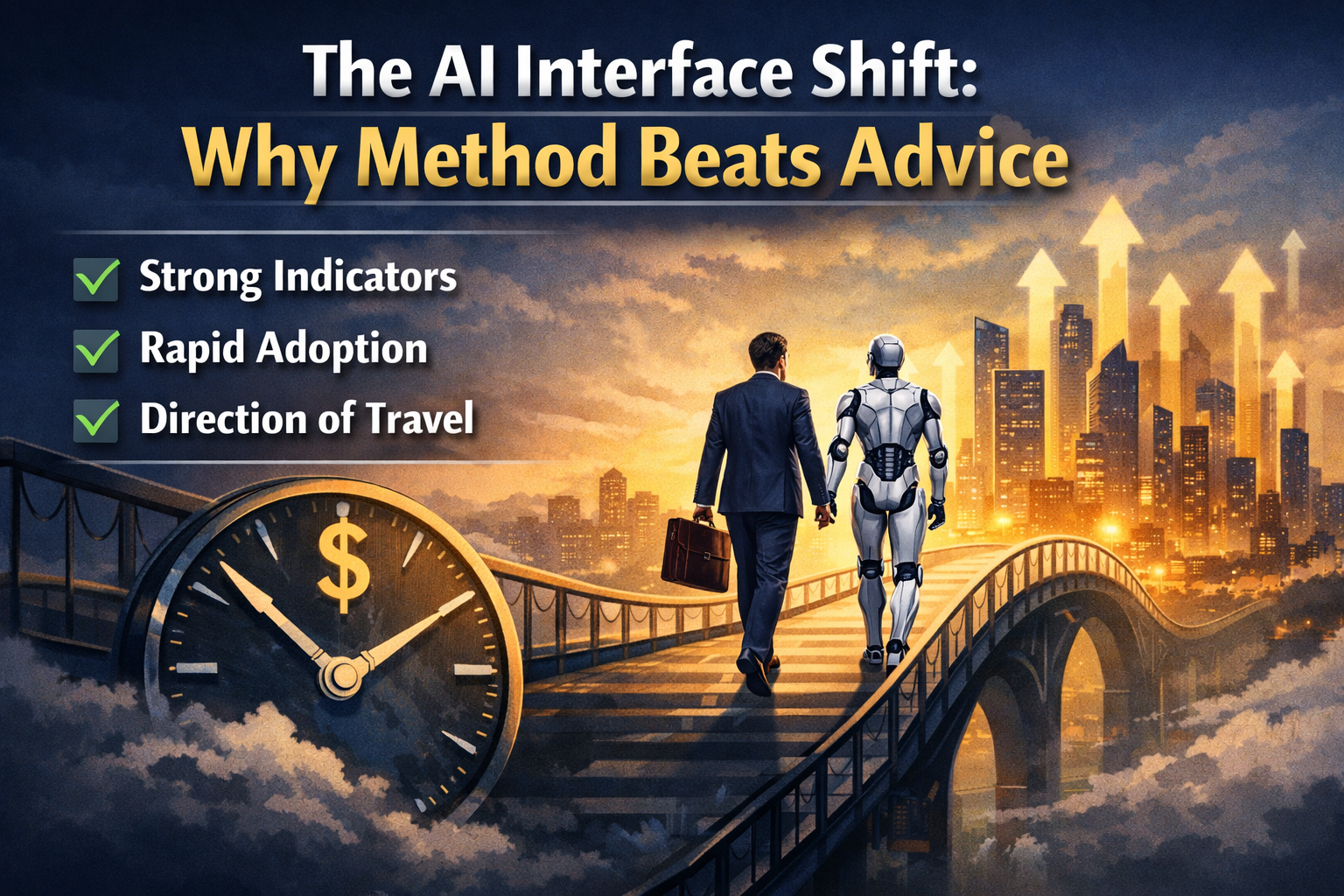
(And why time is now your biggest risk)
The financial planning profession isn’t being disrupted by better advice.
It’s being displaced by a new interface.
Increasingly, people don’t start with advisers, websites, or apps.
They start with AI.
They ask questions.
They test ideas.
They model scenarios.
They explore options — instantly.
This is not a future prediction.
It’s a strong indicator of where behaviour is already heading.
The signal that matters most: behaviour has shifted
Across consumer and professional markets, we’re seeing rapid adoption of AI for:
- Financial decision-making
- Life organisation
- Scenario modelling
- “What should I do next?” questions
This isn’t about whether AI gives perfect answers.
It’s about where people go first.
And increasingly, they go to AI before they go anywhere else.
That creates a simple reality for planners:
If your value is advice-as-information,
you are competing with a zero-cost, instant interface.
That is the direction of travel.
Time is no longer neutral — it’s money and risk
In slow markets, learning slowly is survivable.
In fast markets, delay compounds risk.
Right now:
- Capability upgrades happen in weeks, not years
- Tools iterate faster than qualifications
- Client expectations are shifting mid-conversation
Every extra month spent:
- “Waiting to see how this plays out”
- “Clinging on to legacy models”
- “Trying to defend the old perimeter”
…is a month of lost opportunity and rising irrelevance.
Not because advisers are failing —
but because the environment has changed.
Those who move early don’t just learn faster.
They start earning sooner, while others are still debating.
Why method beats advice in an AI-first world
Advice tells someone what to do.
A method shows them how to think, decide, and act — repeatedly.
That distinction now matters more than ever.
AI is exceptionally good at:
- Information
- Options
- Calculations
- Scenarios
What it does not reliably provide — on its own — is:
- Coherent life priorities
- Trade-off decisions
- Behavioural follow-through
- Ethical framing
- Accountability over time
This is where method-led planning wins.
The GAME Plan works with AI, not against it:
- Goals: Clarifying what actually matters
- Actions: Turning insight into decisions
- Means: Aligning financial and human capital
- Execution: Reviewing, adapting, and staying on track
AI accelerates the process.
The method keeps it safe, coherent, and human.
Earn while others are still learning
There are two broad responses we’re seeing among planners:
Group one is still trying to protect the old model:
- Defending advice as a product
- Adding more complexity
- Slowing down to feel safe
Group two is doing something different:
- Adopting AI as the default interface
- Using a clear, ethical method
- Operating outside product dependency
- Starting to earn while capability compounds
They’re not waiting for certainty.
They’re responding to direction of travel.
And they’re discovering something important:
You don’t need to abandon professionalism
to move faster.You need a method that scales.
This isn’t about jumping — it’s about testing
You don’t need to “cross the bridge” today.
But in fast-moving markets, standing still is still a decision.
That’s why the Academy invites you to experience the difference first.
No sales pressure.
No commitment.
No leap of faith.
Try the Total Wealth Plan — free
Before you decide your next chapter as a planner:
- Experience an AI-assisted, method-led planning journey
- See how human capital, life goals, and money integrate
- Compare it directly with traditional advice-led models
Explore fit.
Ask better questions.
See what’s missing — and what’s possible.
Try the Total Wealth Plan for free.
Then decide whether this direction of travel is one you want to be part of.
Appendix: 10 Lessons for Total Wealth Planners
From The Future of Banks 2040 by Matthew Griffin*
(Reframed for planners, not banks)
1. The interface has changed — permanently
People increasingly access financial insight through AI conversation, not advisers, apps, or websites.
Implication for planners:
If you are not visible through AI, you are invisible to the client.
2. Advice-as-information is being commoditised
AI delivers instant answers, scenarios, and explanations at near-zero cost.
Implication:
Your value is no longer “knowing things” — it is method, judgement, and safe execution.
3. Behaviour has already shifted
Large and growing numbers of consumers — including high-net-worth individuals — are using AI for financial and life decisions.
Implication:
This is not speculative. It is a strong indicator of long-term direction of travel.
4. Time has become a risk factor
In fast-moving markets, delay compounds opportunity cost.
Implication:
Planners who wait for certainty will be overtaken by those who adopt good-enough clarity early and iterate.
5. Speed now beats perfection
AI-enabled capability upgrades happen in weeks, not years.
Implication:
A 12-week operational transition beats a 12-month theoretical one — especially when earning begins during learning.
6. Method outlasts tools
Tools, platforms, and interfaces will be copied, replaced, or absorbed.
Implication:
A clear, transferable planning method (like the GAME Plan) becomes the enduring asset — not the tech stack.
7. Trust and safety are becoming premium services
As AI scales, fraud, misinformation, and poor decision-making scale with it.
Implication:
Planners who can frame, filter, document, and safeguard decisions increase in relevance, not decrease.
8. Boundaries are blurring — clarity is power
The lines between banking, technology, guidance, and advice are eroding.
Implication:
Planners who understand — and can clearly explain — what sits inside and outside the regulatory perimeter gain trust and confidence.
9. Clients don’t want products — they want progress
The future is not “better portfolios”, but better life decisions, made consistently.
Implication:
Total Wealth Planning aligns with where value is migrating: behaviour, trade-offs, priorities, and follow-through.
10. Those who move early earn while others debate
Every major shift creates a window where early adopters compound advantage.
Implication:
Planners who embrace AI with a method don’t wait for the future — they build income and identity inside it.
What this means for the Academy
The Academy of Life Planning is not reacting to the future.
It is structurally aligned with it:
- Method-led, not product-led
- AI-enabled, not AI-dependent
- Human-centred, not machine-replaced
This appendix doesn’t predict what might happen.
It explains why Total Wealth Planners are already positioned for what’s happening now.
Visit the acedmyoflifeplanning.com for more information.
 Academy of Life Planning