
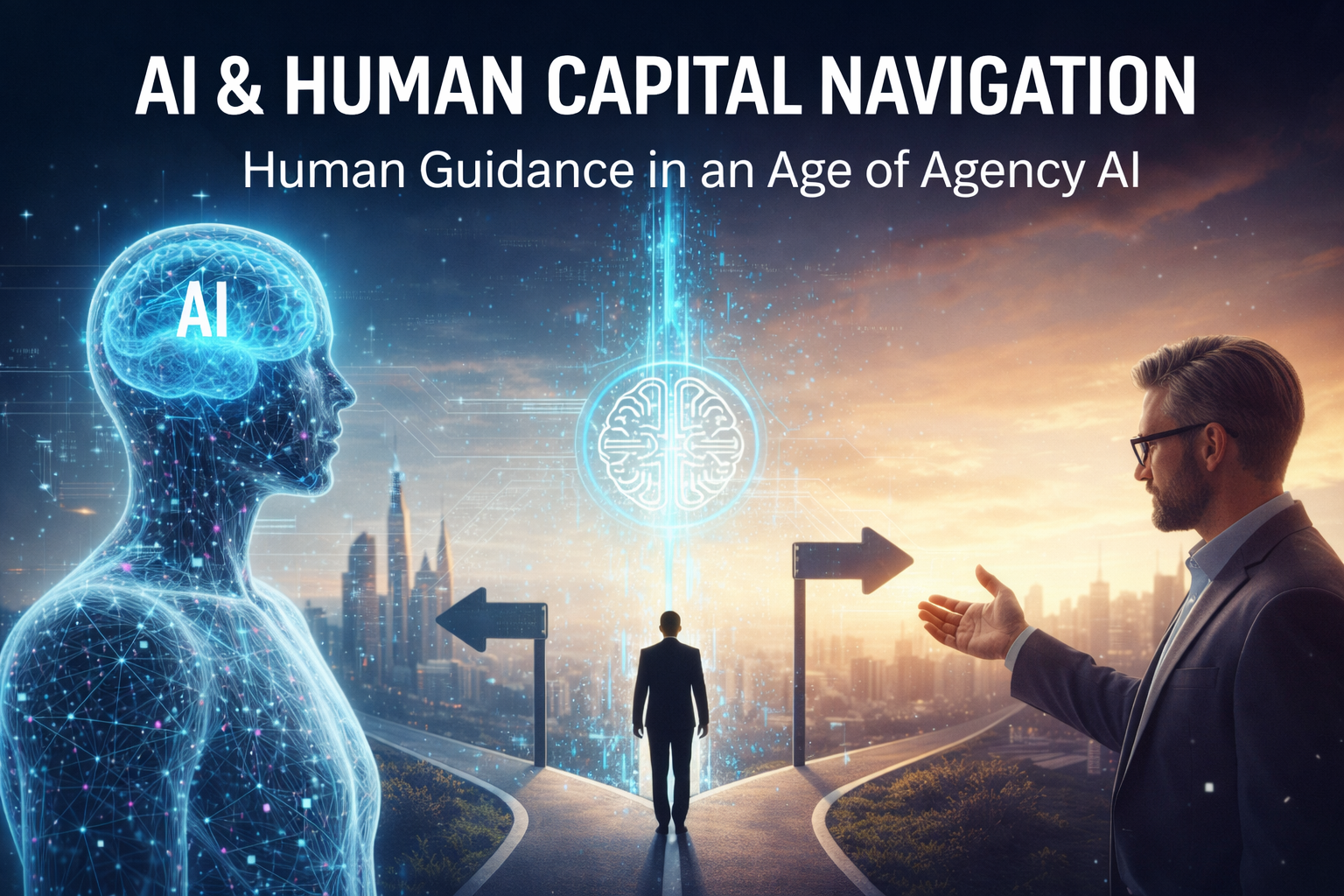
The debate about AI, work, and Universal Basic Income is accelerating.
Government briefings. Think-tank papers. Media panic cycles.
This week, the Institute of Economic Affairs reported that ministers are again exploring Universal Basic Income (UBI), driven by fears that AI will lead to mass unemployment. As Kristian Niemietz rightly points out, history doesn’t support that fear.
Technological progress doesn’t destroy work.
It reorganises value.
But here’s the part missing from almost every public debate:
Even if jobs remain, lives don’t automatically reorganise themselves.
That gap is where people fall through.
The Real Risk Isn’t Job Loss. It’s Direction Loss.
AI is already doing what previous technologies only hinted at:
- Compressing career timelines
- Fragmenting identity-based professions
- Decoupling income from traditional progression
- Exposing how fragile “career ladders” really were
In theory, the market adjusts.
In practice, people don’t.
They experience:
- Loss of confidence
- Decision paralysis
- Financial anxiety without immediate insolvency
- A sense that “the rules changed, but nobody explained the new ones”
This is not a welfare problem.
It’s a human capital navigation problem.
Why Universal Basic Income Misses the Point
UBI assumes the core risk of AI is income disruption.
That’s too shallow.
The deeper risk is agency erosion.
When income is disconnected from purpose, planning, and market relevance:
- People may stay busy
- But drift away from contribution
- And lose feedback loops that build competence and confidence
As Niemietz argues, UBI severs the link between activity and demand.
What it also severs—quietly—is self-authorship.
A society buffered by income but starved of direction doesn’t become resilient.
It becomes dependent.
Human Capital Is the Missing Infrastructure
What AI actually creates is a permanent transition economy.
Not a one-off shock.
An ongoing condition.
In that world, the most valuable asset is not:
- A job title
- A pension projection
- Or a static financial plan
It’s the ability to:
- Re-orient goals
- Re-deploy skills
- Re-design income paths
- Make sense of uncertainty without panic
That is human capital strategy.
And almost nobody is trained to deliver it.
A New Role Is Emerging (Quietly)
Here’s the opportunity most planners haven’t clocked yet:
The future professional is not an intermediary to products.
They are a guide through transition.
AI doesn’t replace this role.
It requires it.
People don’t need more forecasts.
They need:
- Structured reflection
- Coherent life-first planning
- Safe spaces to make decisions
- Tools that restore agency, not dependency
This is where the AI GAME Plan changes the equation.
The AI GAME Plan: From Disruption to Direction
The AI GAME Plan was not built as a financial tool.
It was built as a navigation system for an age where:
- Careers are non-linear
- Income is multi-source
- Identity is no longer anchored to employers
- And planning must start with life, not money
AI doesn’t replace the human.
It scaffolds the process—so humans can think clearly again.
For individuals, it restores agency.
For planners, it opens a solopreneur pathway that is:
- Product-agnostic
- Regulation-light
- Deeply human
- Future-proof by design
Not advice.
Not welfare.
Orientation.
A Quiet Truth for Planners Reading This
The question isn’t whether AI will change your profession.
It already has.
The real question is:
Will you help people adapt to the new terrain—
or remain tied to a map that no longer matches reality?
The Fast-Track isn’t about selling software.
It’s about crossing a role boundary.
From technician → guide
From intermediary → ally
From explaining products → enabling agency
The demand already exists.
The language just hadn’t caught up yet.
Until now.
Next breadcrumb
Human capital strategies aren’t a theory problem anymore.
They’re an execution problem.
And execution, in an AI age, needs a new kind of planner.
(More to follow.)
 Academy of Life Planning