
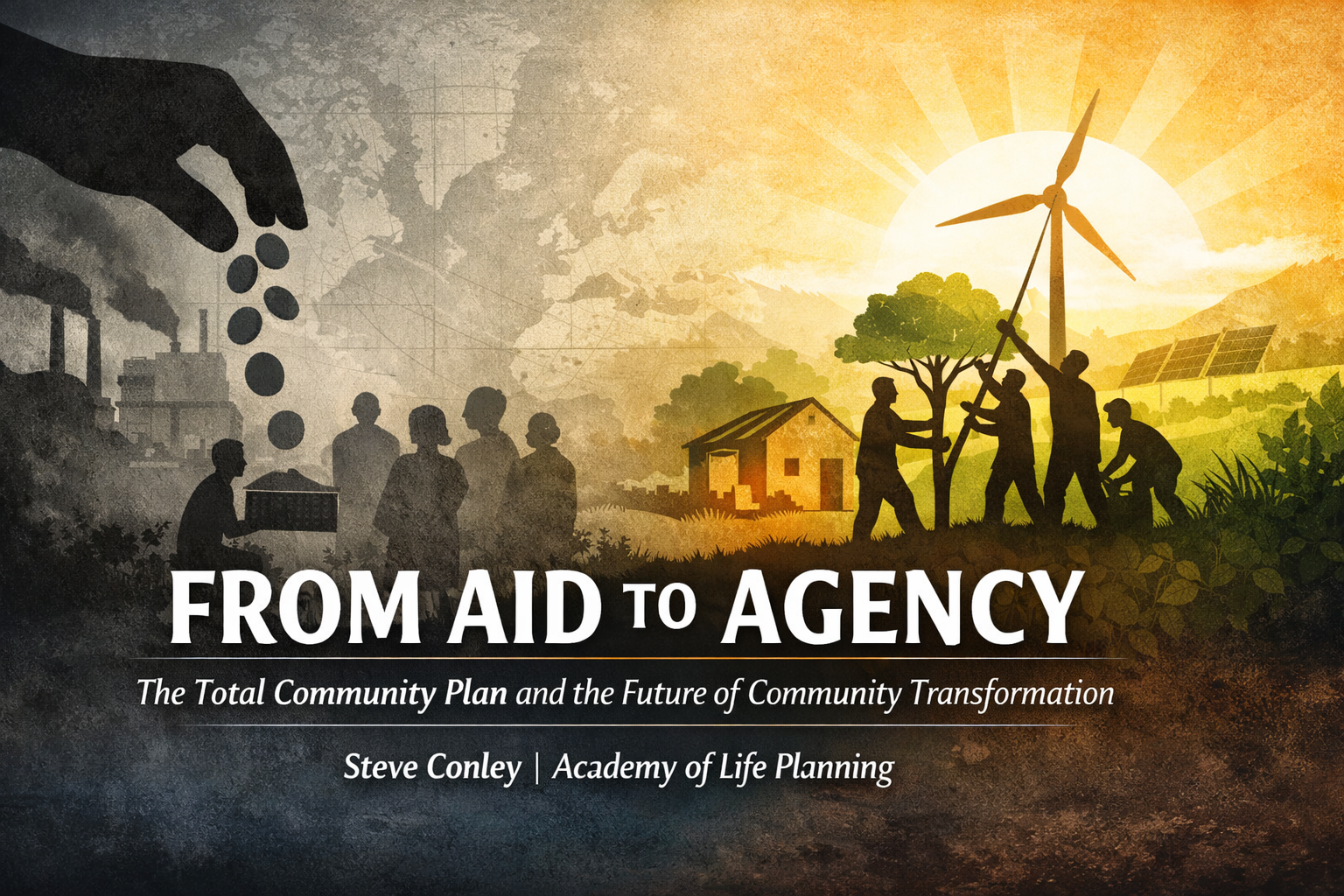
The Total Community Plan and the Future of Community Transformation
By Steve Conley
Founder, Academy of Life Planning
For decades, efforts to address poverty, injustice, and environmental degradation have followed a familiar pattern.
Resources flow in. Programmes are delivered. Outcomes are measured.
And yet, in many communities, the underlying conditions remain unchanged.
Not because people lack resilience.
Not because communities lack potential.
But because the system itself has been designed around external intervention, rather than internal activation.
What if the problem is not a lack of resources—
…but a lack of agency?
The Structural Limitation of Aid
Traditional development models, however well intentioned, often begin from a deficit:
- What is missing?
- What is broken?
- What needs to be fixed?
From there, solutions are designed externally and delivered into the community.
This creates an unintended consequence:
The more help a community receives, the less it is positioned as the agent of its own change.
Over time, this erodes something far more valuable than capital:
- Decision-making confidence
- Local ownership
- Collective identity
In short, it erodes decision capital.
A Different Starting Point
The Academy of Life Planning has spent over a decade developing a framework built on a simple but radical premise:
Plan life first. Build from what already exists. Restore agency at the point of decision.
This philosophy, expressed through the GAME Plan, has been applied successfully at the individual level—helping people align their goals, actions, means, and execution around a life of purpose and coherence.
The question now is:
What happens when you apply the same logic to a community?
Introducing the Total Community Plan™
The Total Community Plan™ is the application of the GAME Plan framework at collective scale.
It substitutes the individual with the community as the subject of the plan.
The result is a structured, repeatable process through which communities:
- Discover what they already have
- Define what they stand for
- Confront what stands against them
- Build sustainable livelihoods from within
Grounded in an asset-based methodology, the approach is guided by three enduring mandates:
1. Eliminate Poverty
Not through redistribution alone, but through the activation of human capital, enabling communities to generate sustainable livelihoods.
2. Challenge Injustice
By naming and confronting the structures that create vulnerability, exploitation, and exclusion.
3. Safeguard Creation
Embedding environmental stewardship into the economic and social life of the community.
From Framework to Operating System
What distinguishes the Total Community Plan is not simply its philosophy, but its execution.
It is not a programme.
It is an operating system.
At its core is a four-stage cycle:
Goals
Communities articulate their story, values, assets, and shared purpose.
Actions
They identify obstacles, generate project ideas, and define priorities.
Means
They map their human capital and develop pathways to sustainable livelihoods.
Execution
They establish governance, accountability, and a 90-day cycle of action and review.
This structure transforms abstract intention into practical, localised action.
The Asset-Based Shift
Central to this approach is a decisive shift in perspective:
The community is not a deficit to be fixed.
It is a reservoir of gifts waiting to be activated.
Rather than waiting for external funding or intervention, communities begin with:
- Skills already present
- Relationships already formed
- Resources already accessible
- Knowledge already held
This is not idealism. It is pragmatism.
Because what is already present is what can be mobilised immediately.
Restoring Decision Capital at Scale
At the heart of the Total Community Plan is the restoration of decision capital.
Communities move from:
- Passive recipients → Active designers
- Isolated individuals → Coordinated actors
- External dependency → Internal capability
This shift is not cosmetic. It is structural.
It changes not just what communities do—
but how they see themselves.
The Role of AI: Scaling Without Losing Agency
In parallel with this methodology, the Academy has developed an AI-enabled system to support delivery.
This is not AI as authority.
It is AI as facilitator.
The Total Community Planner AI:
- Guides communities through each stage of the process
- Surfaces insights from their own inputs
- Structures conversations and captures outputs
- Supports iteration over 90-day cycles
Crucially, it does not replace human judgement.
It strengthens it.
In doing so, it enables a model that is both:
- Deeply human
- Globally scalable
Download The Total Community Planner AI set-up tool.
A New Role: The Total Community Planner
To support this work, a new role emerges:
The Total Community Planner™
Not a consultant.
Not a programme manager.
But a facilitator of agency.
Their role is to:
- Ask the right questions
- Hold the process with integrity
- Enable the community to discover its own answers
In many ways, this mirrors the evolution already underway in financial planning:
From advice → to agency
From intermediation → to empowerment
A Natural Alignment with Vision 36
The Anglican Alliance’s vision—
a world free of poverty and injustice, with creation safeguarded—
finds a natural expression in this model.
[Source: https://anglicanalliance.org/who/vision/]
The Total Community Plan does not replace that vision.
It provides the mechanism through which it can be realised:
- Locally
- Practically
- Sustainably
It bridges mission and method.
From Intervention to Transformation
We are entering a period of profound change.
AI is accelerating capability.
Institutions are being questioned.
Communities are searching for new models of resilience.
In this context, the question is no longer:
How do we help communities?
But:
How do communities help themselves—at scale?
The answer lies not in more intervention,
but in better systems of agency.
Conclusion: A Return to First Principles
At its core, the Total Community Plan is a return to something simple:
- People have value
- Communities have assets
- Change begins from within
What has been missing is not belief in these ideas—
…but a system to operationalise them.
That system now exists.
The Invitation
For those working in community development, faith networks, and social impact:
The question is not whether change is needed.
It is whether we are prepared to shift from:
- Delivering solutions
- To enabling agency
The Academy of Life Planning invites you to explore this model, test it in your context, and participate in building a future where:
Communities are not managed—
but empowered to become the architects of their own flourishing.
Call to Action
Explore the Total Community Plan™
Train as a Total Community Planner™
Or pilot the model within your own community
The future of community transformation will not be delivered.
It will be built—from within.
Contact Steve at the Academy of Life Planning for more details. Email steve.conley@aolp.co.uk and quote Total Community Plan™.
 Academy of Life Planning