
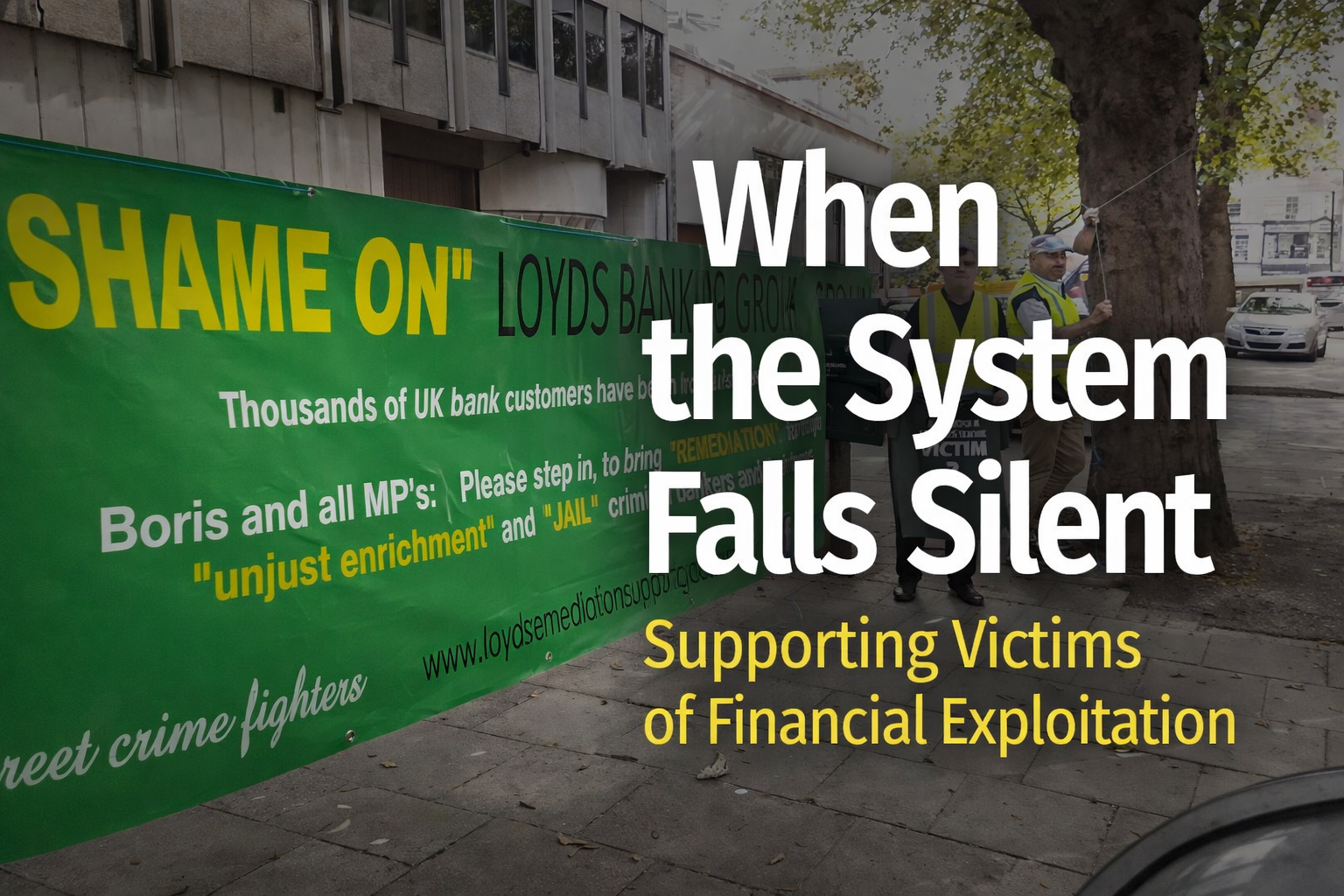
By Steve Conley – Get SAFE (Support After Financial Exploitation)
There is a moment, rarely spoken about, that sits quietly at the edge of financial harm.
It is not the moment of loss.
Not the complaint.
Not even the rejection.
It is the moment when a person concludes:
“There is nowhere left to turn.”
From that point on, behaviour changes.
Not because the person is irrational.
But because the system has stopped responding in a way that feels human.
The Pattern We Can No Longer Ignore
Across multiple cases—some public, some private—we see the same trajectory unfold.
A capable individual, often with a successful business or professional background, encounters a financial event that destabilises their position. Loans are restructured. Facilities withdrawn. Complaints dismissed. Narratives reframed.
What follows is not immediate collapse.
It is a prolonged process:
- Attempts to engage
- Evidence submitted
- Appeals made
- Time invested
- Identity slowly eroded
Eventually, something shifts.
The individual is no longer operating within a system of resolution.
They are operating within a system of endurance.
And when endurance replaces resolution, escalation begins.
When the Body Becomes the Message
Hunger strikes are often misunderstood.
They are seen as dramatic, extreme, or even irrational acts.
History tells a different story.
From Mahatma Gandhi to Bobby Sands, from suffragettes to modern political prisoners, hunger strikes have emerged in one consistent condition:
When voice has failed.
They are not the first act of protest.
They are the last.
They occur when:
- Dialogue has been ignored
- Complaints have been dismissed
- Evidence has been rejected
- Institutions have become unresponsive
At that point, the individual is left with one remaining lever:
Their own body.
It is not a strategy of aggression.
It is a signal of exhaustion.
The Financial Exploitation Parallel
In the context of financial harm, we are now seeing the same pattern emerge.
Individuals who:
- Have lost businesses
- Face bankruptcy or repossession
- Feel misrepresented or unheard
- Encounter procedural dismissal
begin to exhibit identical escalation behaviours.
They speak of:
- “having no other option”
- “being forced into this position”
- “needing to be heard at any cost”
This is not coincidence.
It is structural.
The Asymmetry No One Talks About
There is a fundamental imbalance at the heart of these situations.
Institutions can:
- Delay
- Deflect
- Absorb pressure
- Continue operating
Individuals cannot.
They have:
- finite time
- finite resources
- finite emotional capacity
- finite health
This creates a dangerous dynamic:
The longer the process continues, the more the individual pays the price.
Not just financially.
Psychologically. Physically. Socially.
And, in some cases, fatally.
When Escalation “Works”—But Doesn’t Resolve
There are instances where extreme actions appear to achieve progress.
Meetings are granted. Conversations begin. Attention is drawn.
But this raises a critical question:
What happens next?
Without structure, escalation achieves access—but not resolution.
And even where engagement occurs, the underlying harm often remains unresolved.
The cost, however, has already been paid.
In stress. In health. In relationships. In identity.
The Silent Aftermath
One of the most difficult truths is what happens after the spotlight fades.
When cases remain unresolved, the burden does not disappear.
It is internalised.
Over time, the narrative can shift:
- from systemic failure
- to personal responsibility
Families, unable to process prolonged stress and uncertainty, may reinterpret events through a simpler lens:
“He chose this.”
This is not cruelty.
It is a coping mechanism.
But it compounds the harm.
What This Means for Get SAFE
These patterns make one thing clear:
By the time someone considers extreme action, the system has already failed them.
Get SAFE exists to intervene before that point.
Not to replace the legal system.
Not to challenge institutions directly.
Not to promise outcomes we cannot control.
But to restore something far more fundamental:
A sense that there is still a next step.
Our Role: Stabilise, Structure, Surface Options
The work of Get SAFE sits in a critical window:
Between harm and escalation.
In that space, three things matter.
1. Stabilisation
We create a calm, human environment where individuals can pause.
Not to suppress action—but to prevent irreversible decisions being made under pressure.
2. Structure
We help organise information, evidence, and timelines.
Clarity replaces overwhelm.
Facts replace confusion.
3. Options
We identify what can still be done.
Not hypothetically—but practically.
Even small, incremental steps restore movement.
Rebuilding the “Armoury”
Many individuals describe reaching a point where they feel they have “nothing left”.
This is a powerful insight.
Because escalation often occurs when a person’s armoury is empty.
Our role is to rebuild that armoury:
- understanding
- sequencing
- tools
- perspective
- support
Not to fight on their behalf—but to ensure they are not fighting blind.
A Different Kind of Intervention
Get SAFE is not a campaigning organisation.
It is not a legal service.
It is not a media platform.
It is something quieter—but no less important:
A stabilisation layer in a system that does not always respond in time.
We operate before escalation becomes the only perceived option.
We help people stay in the space of agency—rather than moving into the space of sacrifice.
The Principle We Must Hold
If there is one lesson that emerges from all of this, it is this:
No one should feel that harming themselves is the only way to be heard.
And yet, too often, that is exactly where people arrive.
Not because they are weak.
But because every other pathway has been exhausted.
A Final Reflection
The pursuit of justice is often framed as a matter of persistence.
But persistence alone is not enough—especially when the system can outlast the individual.
What matters is how that pursuit is carried out.
At Get SAFE, our focus is simple:
To ensure that people do not lose themselves in the process of seeking resolution.
Because once that happens, the cost of the journey becomes greater than the harm that started it.
And that is a price no one should have to pay.
Get SAFE (Support After Financial Exploitation)
Restoring clarity, dignity, and next steps when it matters most.
If You’d Like to Help This Work Continue
Get SAFE exists because people choose to stand quietly alongside those facing financial harm.
There is no pressure to give.There is no “target thermometer.”There is no guilt-based appeal.
But if this story resonates with you — and you believe no one should have to face financial trauma alone — your support helps keep this work available to the next person who reaches out in panic, confusion, or despair.
Every £50 provides a bursary for one person to access:
• Trauma-informed recovery support
• Guided self-advocacy tools
• Evidence-structuring templates
• Life-stabilisation planning
• Fellowship peer support
• Secure testimony preservation
That support can mean the difference between someone breaking down in isolation — and someone finding clarity, steadiness, and dignity again.
If you’d like to contribute, you can do so here:
[Scan for the Support Get SAFE on Crowdfunder]

Whether you give, share, or simply hold this work in goodwill — thank you for being part of a more humane response to financial harm.
 Academy of Life Planning