
“I can choose. I can choose well. I act on my choices.”
There is a quiet assumption underpinning modern life.
That if people are given enough information…
enough access…
enough choice…
They will make good decisions.
It is an assumption that sits beneath financial planning, public policy, education, and now—artificial intelligence.
And yet, the evidence of lived experience tells a different story.
The Illusion of Choice
We are surrounded by options.
Investment platforms.
Pension freedoms.
Endless financial products.
AI tools capable of answering almost any question.
From the outside, it appears that human agency has never been stronger.
But look more closely.
Many individuals feel:
- Overwhelmed rather than empowered
- Reactive rather than intentional
- Dependent rather than autonomous
The issue is not the absence of choice.
It is the absence of something far more fundamental.
The Missing Asset: Decision Capital
At the Academy of Life Planning, we define:
Decision Capital as the accumulated capacity to make clear, aligned, and effective decisions over time.
It is not taught explicitly.
It is rarely measured.
And yet, it determines almost everything.
Not just financial outcomes—but life outcomes.
Because life does not respond to what we know.
It responds to the decisions we make.
Three Layers of Human Agency
If we strip this back to first principles, we arrive at a simple progression:
1. I can choose
This is agency in its purest form.
The recognition that one is not entirely bound by circumstance.
It is the foundation of freedom.
2. I can choose well
This is where most systems quietly fail.
Because choosing well requires:
- Clarity under pressure
- Emotional stability
- The ability to weigh trade-offs
- The discipline to pause when necessary
Without these, choice becomes illusion.
3. I act on my choices
This is where intention meets reality.
Execution.
The point at which decisions shape outcomes.
Where It Breaks Down
In moments of stress, loss, or complexity, Decision Capital can degrade rapidly.
Options narrow.
Thinking becomes urgent.
Identity fuses with a single outcome.
We see this in financial crises, in life transitions, and increasingly in a world saturated with information and noise.
The paradox is striking:
The more complex the world becomes, the more Decision Capital matters—
and the more vulnerable it becomes to erosion.
The Role of AI: Amplifier, Not Answer
Artificial Intelligence introduces a new dynamic.
It can:
- Expand access to information
- Accelerate analysis
- Reduce friction in decision-making
But it cannot replace Decision Capital.
In fact, without it:
AI risks accelerating poor decisions—faster, and with greater confidence.
The future will not belong to those with the most tools.
It will belong to those who can use them wisely.
A New Direction for Financial Planning
Traditional financial planning has focused on:
- Products
- Portfolios
- Performance
Important, yes.
But secondary.
Because behind every portfolio is a person.
And behind every outcome is a series of decisions.
At AoLP, we are interested in a different question:
What is the quality of the decisions shaping your life?
Building a Life Through Decisions
A life is not built in a single moment.
It is built:
- Decision by decision
- Day by day
- Often quietly, without notice
And over time, those decisions compound.
Not just financially.
But emotionally, relationally, and spiritually.
A Simple Reflection
Before any significant decision, consider:
- Am I calm enough to decide?
- Do I have more than one option?
- Will this preserve or reduce my future choices?
If the answer is unclear, the decision may not be the problem.
The state from which it is being made might be.
Closing Thought
We are entering an age where:
- Information is abundant
- Tools are powerful
- Systems are increasingly automated
But none of these restore human agency on their own.
That comes from something deeper.
The ability to choose.
The ability to choose well.
And the courage to act on those choices.
This is Decision Capital.
And it may prove to be the most important asset we ever build.
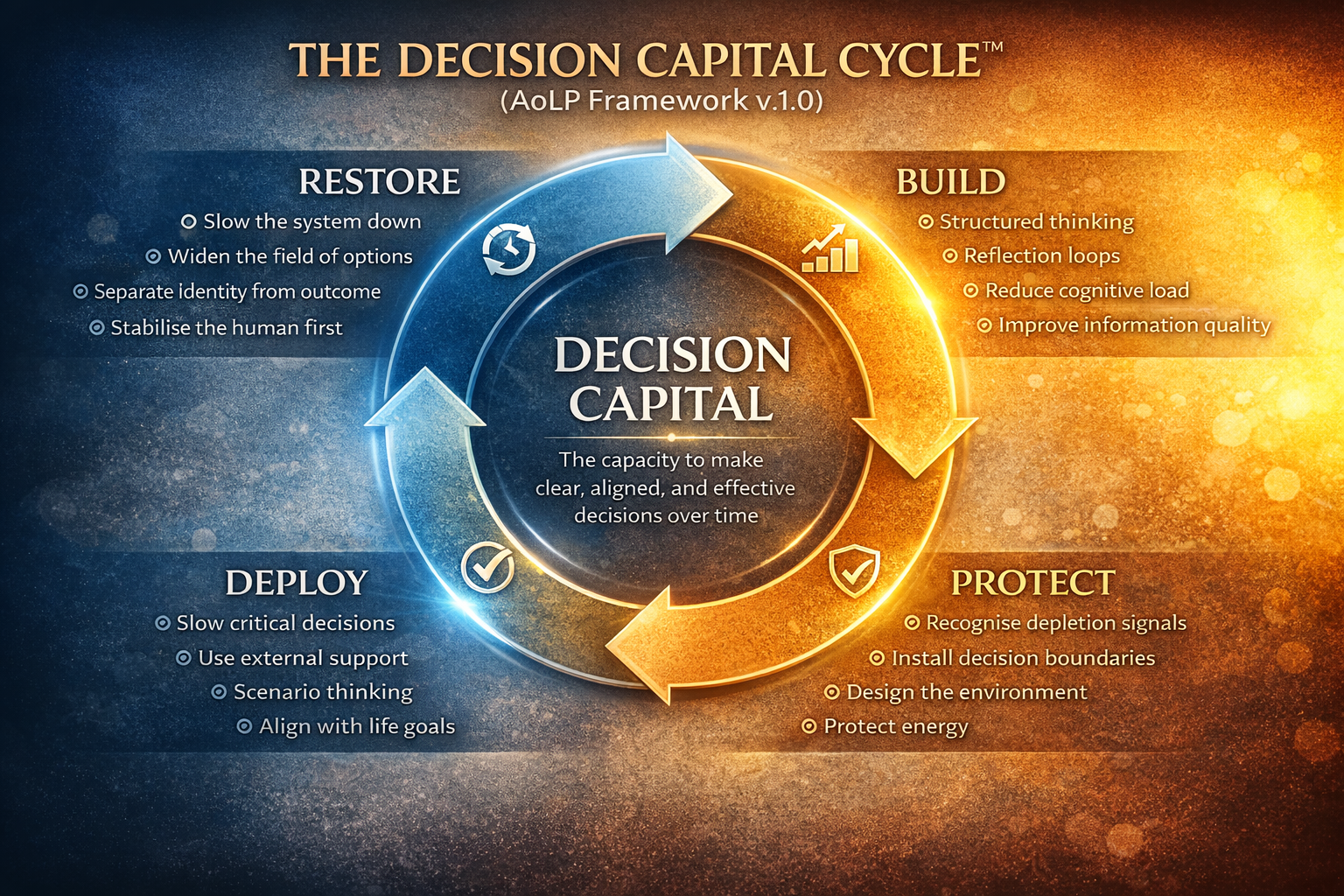
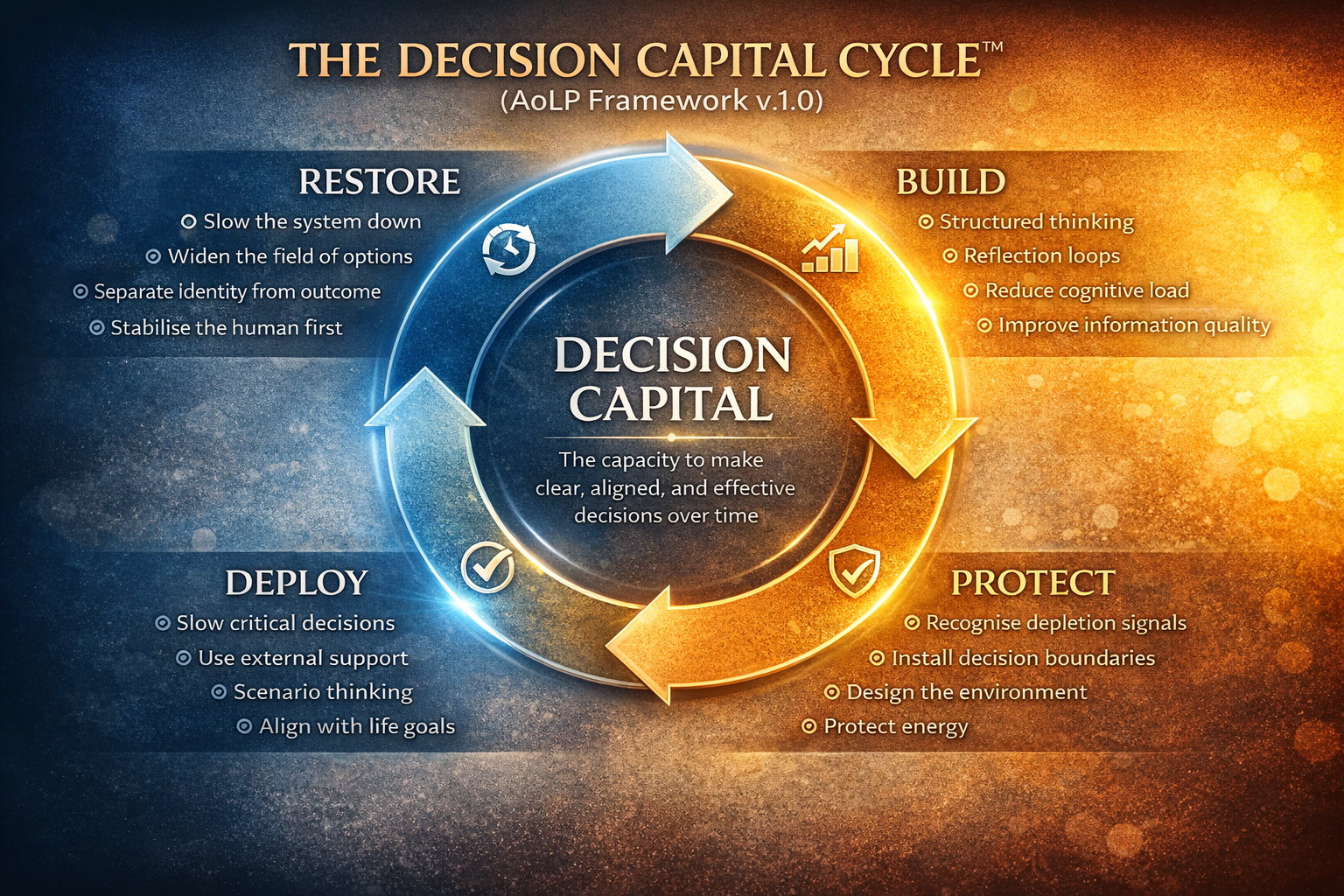
The Decision Capital Cycle™ (AoLP Framework v1.0)
Restore → Build → Protect → Deploy
Each stage solves a different problem.
1. RESTORE (When Decision Capital is Depleted)
Primary context: Get SAFE / crisis / overwhelm
🎯 Objective:
Return someone from collapsed → functional decision state
🔍 What it looks like:
- “There’s only one option”
- Obsession, urgency, escalation
- Emotional overload
- Poor sequencing (revenge before recovery)
🛠️ How to Restore Decision Capital
A. Slow the System Down
- Reduce urgency (“This doesn’t all need solving today”)
- Create time between stimulus and response
B. Widen the Field of Options
- Gently surface alternatives
- Move from “only one path” → “there are choices”
C. Separate Identity from Outcome
- “You are not your case”
- Reduce fusion with a single narrative
D. Stabilise the Human First
- Sleep, nutrition, connection
- (Not framed as “mental health”—framed as capacity)
🔑 Core Principle:
You cannot make good decisions in a collapsed state.
2. BUILD (Growing Decision Capital Over Time)
Primary context: Total Wealth Planning (TWP)
🎯 Objective:
Increase baseline capacity to make clear, aligned decisions
🛠️ How to Build Decision Capital
A. Structured Thinking (GAME Plan)
- Goals → Actions → Means → Execution
- Planning life before money
B. Reflection Loops
- What worked? What didn’t? Why?
- Turn experience into learning
C. Reduce Cognitive Load
- Simplify finances and life structure
- Eliminate unnecessary complexity
D. Improve Information Quality
- Better questions > more information
- Filter noise (media, sales, AI hallucinations)
🔑 Core Principle:
Decision Capital grows through structured reflection and simplified environments.
3. PROTECT (Preventing Depletion)
Primary context: Everyday life + high-stakes moments
🎯 Objective:
Avoid erosion of decision quality under pressure
🛠️ How to Protect Decision Capital
A. Recognise Depletion Signals
- Urgency
- Emotional spikes
- “I must act now”
B. Install Decision Boundaries
- “No major decisions under stress”
- “Pause before irreversible actions”
C. Design the Environment
- Reduce exposure to manipulation (sales pressure, toxic inputs)
- Build supportive networks
D. Protect Energy
- Decision-making is energy-dependent
- Fatigue = poor decisions
🔑 Core Principle:
Decision Capital is lost faster than it is built—protection is critical.
4. DEPLOY (Using Decision Capital Effectively)
Primary context: “1 in 10” life moments
🎯 Objective:
Make high-quality decisions when it matters most
🛠️ How to Deploy Decision Capital
A. Slow Critical Decisions
- Time to think = better outcomes
B. Use External Support Wisely
- Total Wealth Planner = decision partner, not decision maker
C. Scenario Thinking
- “If I choose this, what happens next?”
- Explore second-order consequences
D. Align with Life Goals
- Decisions anchored in purpose, not reaction
🔑 Core Principle:
The value of Decision Capital is realised at the point of decision.
🧭 The Integration (Our Big Idea, Made Simple)
You can express the entire AoLP model as:
Life Outcomes = Decisions × Decision Capital
Or more powerfully:
Better lives are not built by better products—
but by better decisions, made consistently over time.
⚠️ Why This Matters (Commercial + Mission)
For AoLP:
- Defines a new category
- Positions us beyond traditional financial planning
For Clients:
- Moves them from dependency → capability
For Get SAFE:
- Gives a clear intervention model:
- Not fixing cases
- Restoring decision capacity
🔑 A Simple Teaching Tool (For Immediate Use)
You can give people this:
Ask 3 questions before any major decision:
- Am I calm enough to decide?
- Do I have more than one option?
- Will this preserve or reduce my future choices?
If the answer is “no” to any:
Pause. Decision Capital is compromised.
Final Thought
What we’ve built is not just a philosophy.
It’s a human operating system:
Restore clarity
→ Build capability
→ Protect capacity
→ Deploy wisely
And at its core:
You’re not helping people make decisions.
You’re helping them become people who can.
Explore the Academy of Life Planning to go deeper into Decision Capital and Total Wealth Planning.
 Academy of Life Planning