
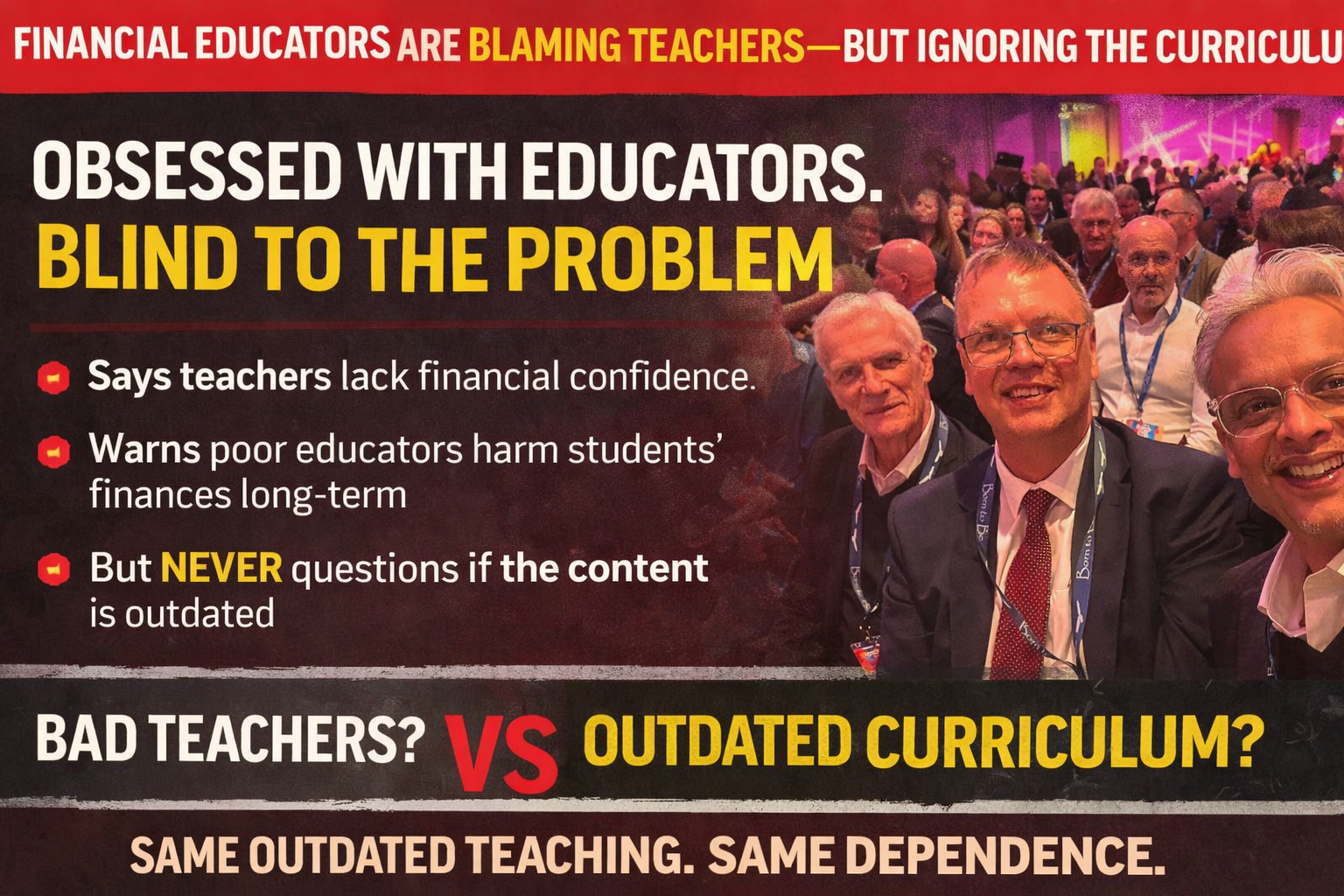
Let’s say this clearly
Some of the most widely used financial education frameworks today
openly criticise educators.
They say:
- teachers lack confidence
- financial professionals can’t teach
- volunteers don’t understand the subject
They even warn that poor educators can cause long-term financial harm.
All of that may be true.
But it misses the real issue entirely.
Because the problem isn’t the teacher
It’s the curriculum.
You can have:
- better-trained educators
- stronger delivery
- higher standards
And still produce the same outcome:
- financially literate
- structurally dependent
- system-compliant individuals
Because what’s being taught hasn’t changed.
The quiet assumption underneath it all
These frameworks are built on a single, unchallenged premise:
The financial system is the fixed environment.
The individual must learn to operate within it.
So the focus becomes:
- budgeting
- credit management
- investing
- choosing financial products
- selecting financial professionals
It’s a curriculum designed to help people:
participate more effectively in the system
Not question it.
Not redesign their relationship with it.
Not reduce dependence on it.
That’s not neutral
Even when presented as “unbiased” education,
the structure tells a different story.
The framework itself is:
- built with industry experts
- designed to improve “financial capability”
- aligned to measurable outcomes within the existing system
That’s not a conspiracy.
But it is a bias.
It prepares citizens for the system — not for themselves.
And this is where trust breaks
Because a structurally trustworthy model would:
- start with the individual’s life
- treat income and capability as the primary asset
- build independence before engagement
- reduce reliance on intermediaries over time
Instead, what we see is:
- early introduction to financial products
- emphasis on selecting professionals
- normalisation of complexity
👉 Even the “advanced” stages involve:
- building portfolios
- aligning investments with goals
- engaging financial services
That’s not empowerment.
That’s onboarding.
The contradiction at the heart of financial education
It criticises:
“unqualified educators”
But never asks:
What if the content itself is outdated?
Because you can improve the teacher…
…but still be teaching people how to:
- manage scarcity
- navigate complexity
- depend on systems they don’t control
And here’s why this matters now
Because the world has moved.
AI is here.
Information is abundant.
People can think, model, and plan independently.
The question is no longer:
“Who can teach me about money?”
It’s:
“How do I design my life — and use money as a tool?”
What citizens actually need
Not:
- better financial education
But:
- better life architecture
A framework that:
- starts with Goals (life first)
- builds Actions (capability and direction)
- develops Means (resources, including money)
- leads to Execution (real-world outcomes)
Not fragmented topics.
A system.
Let’s be honest about the shift
Financial literacy creates:
informed participants
Total Wealth Planning creates:
self-directed individuals
That’s a completely different outcome.
This isn’t an attack on educators
It’s a call to evolve the model.
Because right now, we are:
- improving delivery
- refining standards
- training instructors
…while leaving the underlying paradigm untouched.
And that paradigm no longer serves citizens.
The question worth asking
If financial education:
- still produces dependence
- still centres the system
- still delays true agency
Then we have to ask:
Who is it really serving?
Closing
The future of financial planning won’t be defined by:
- better teachers
- better content
- better distribution
It will be defined by one shift:
From teaching people about money…
to helping people take control of their lives.
 Academy of Life Planning