
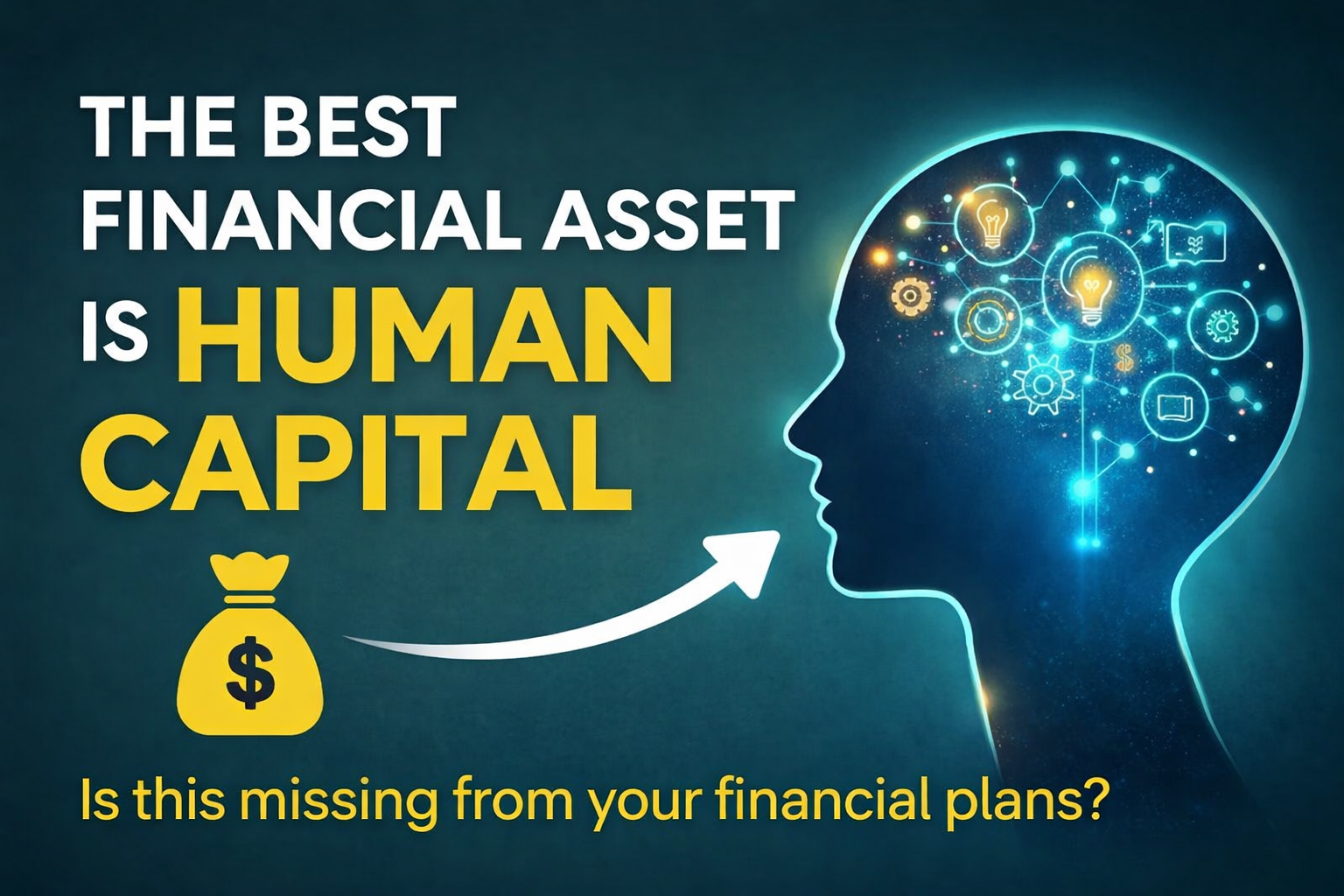
Most financial plans model assets.
Few model the asset that drives them all.
If you are approaching the bridge from traditional advice into Total Wealth Planning, this is one of the most important structural shifts you will make:
Human capital is not a soft add-on. It is the primary productive asset.
And the academic foundation for this is not new.
What the Study Confirms
The attached paper Role of Human Capital Formation and Manpower in Economic Development makes a clear, evidence-based case:
- Human resources are the active factor of production
- Physical capital is passive without human capability
- Economic growth depends materially on education, skills, health, and training Role_of_Human_Capital_Formation…
- Investment in people determines how effectively capital is utilised
Earlier economists such as Adam Smith and Alfred Marshall recognised that “the most valuable of all capital is that invested in human beings”.
Modern development economics reinforces the same truth:
Without human capital, physical capital underperforms.
Machines break down.
Resources are wasted.
Output declines.
Now translate that into your client’s life.
What This Means for Financial Planners
In traditional planning, we:
- Model pensions
- Project investment returns
- Calculate drawdown sustainability
- Stress test markets
But what drives the inflows?
- Skills
- Health
- Energy
- Entrepreneurial capacity
- Adaptability
- Motivation
- Education
- Networks
The study explicitly links human capital formation to:
- Health investment
- Education
- On-the-job training
- Adult learning
- Mobility and adaptation
These are not “lifestyle” issues.
They are economic multipliers.
Why This Is Critical in Today’s Environment
The paper highlights a structural issue in underdeveloped economies:
Physical capital cannot be absorbed effectively without sufficient human capital Role_of_Human_Capital_Formation…
In wealth planning terms:
- Inherited capital without capability erodes
- Liquidity without competence dissipates
- Opportunity without skill fails
Even in advanced economies, we see:
- Educated unemployment
- Skill mismatches
- Underutilised talent
Clients may appear “asset rich” and yet:
- Underdeveloped in earning resilience
- Underprepared for reinvention
- Under-skilled for future economic shifts
A financial forecast that excludes human capital is forecasting with a blind spot.
The HDI Parallel: A Broader Definition of Wealth
The study outlines the Human Development Index (HDI) — a composite of:
- Life expectancy
- Literacy
- Income Role_of_Human_Capital_Formation…
Even at national level, wealth is not measured by income alone.
Why then do we continue to plan for individuals using almost exclusively financial capital metrics?
If governments measure development through health, education, and productivity — why wouldn’t planners?
The Bridge Shift: From Asset Allocation to Capability Allocation
Approaching the bridge means moving from:
“How should we invest your money?”
to
“How should we invest in you?”
Total Wealth Planning integrates:
- Human capital (skills, earning capacity, vitality)
- Financial capital (investments, pensions, liquidity)
- Social capital (relationships, networks)
- Intellectual capital (knowledge, adaptability)
- Emotional capital (resilience, motivation)
The research reinforces that:
Human capital mobilises all other resources
In planning terms:
- It drives income
- It determines longevity of strategy
- It affects risk tolerance
- It influences succession
- It shapes lifestyle sustainability
The Risk of Ignoring It
The study also identifies structural problems when human capital is underdeveloped:
- Skill shortages
- Brain drain
- Underemployment
- Misallocation of labour
At an individual level, that translates to:
- Career stagnation
- Burnout
- Redundancy risk
- Early obsolescence
- Forced retirement
A drawdown model will not solve that.
A Total Wealth Plan might.
Practical Implications for Planners
If you are crossing the bridge, ask yourself:
- Do you quantify earning capacity trajectory?
- Do you assess client skill development strategy?
- Do you evaluate health as an economic asset?
- Do you plan for retraining in mid-life?
- Do you incorporate entrepreneurial optionality?
- Do you include non-financial asset resilience in forecasting?
Human capital is not just pre-retirement income.
It is:
- Adaptability capital
- Reinvention capital
- Stability capital
And increasingly, in an AI-disrupted world, it is survival capital.
The Strategic Opportunity
The study concludes that:
Investment in human development must increase for sustained growth
For financial planners, this is not abstract.
It is commercial.
When you incorporate human capital:
- You move upstream from product advice
- You reduce client fragility
- You deepen engagement
- You expand scope of value
- You future-proof your relevance
This is not abandoning financial planning.
It is completing it.
Final Reflection
Physical capital is passive.
Human capital is active.
A financial plan that ignores the active driver of all economic outcomes is structurally incomplete.
As you approach the bridge, the question is not whether to include human capital.
The question is:
Can you afford not to?
If you’re exploring how to practically integrate human capital into a structured, client-ready Total Wealth Plan, the Academy of Life Planning exists precisely to support that transition.
Register for your FREE Total Wealth Plan experience, today!
 Academy of Life Planning