
Why incumbents should be wary — and why citizens should be cautious
In 2012, I left banking.
Not because I fell out of love with financial planning — quite the opposite — but because the banks had fallen out of love with advice.
The exit of the major banks from bancassurance following the Retail Distribution Review (RDR) wasn’t philosophical. It was accounting-driven. Wealth was viewed through the rear-view mirror:
a zero-sum game of mis-selling risk, remediation costs, and regulatory capital drag.
Lending, by contrast, looked clean. Profitable. Scalable.
So the banks exited advice — and I founded the Academy of Life Planning to explore a different model: human-centred, product-agnostic, life-first planning.
Now, more than a decade later, the banks are back.
The question is: what’s really changed?
Déjà Vu: Asset Hoovering Disguised as Advice
The acquisition of Evelyn Partners by NatWest Group for £2.7bn is being framed as a bold strategic return to advice.
But scratch beneath the surface and the logic looks familiar:
- Fee-based income to offset margin pressure elsewhere
- Access to mass-affluent assets at scale
- Centralised control of distribution
- Heavy use of segmentation, triage, and “support” models
This is not a renaissance of advice.
It is asset hoovering.
The market reaction matters here. NatWest’s share price fell on the announcement — a subtle signal that traders may see the same risks the banks once ran from, simply repackaged.
Angle 1: What This Means for Incumbent Advisers
For independent advisers and planning firms, the immediate impact is intensified competition for AUM.
Expect:
- Banks targeting “clean” clients with:
- Simple needs
- Low volatility
- High asset retention
- Heavier marketing spend and embedded distribution advantages
- Cross-subsidisation from banking balance sheets
But here’s the asymmetry:
Banks don’t want complexity.
They don’t want vulnerability.
They don’t want life transitions that don’t fit a model.
That leaves independent advisers holding:
- Emotional labour
- Long-tail complexity
- Clients needing judgement, not triage
This will squeeze margins unless advisers evolve their value proposition away from AUM dependency and toward Total Wealth Planning — integrating human capital, life design, and agency.
Angle 2: What This Means for Citizens
This is where the risks deepen.
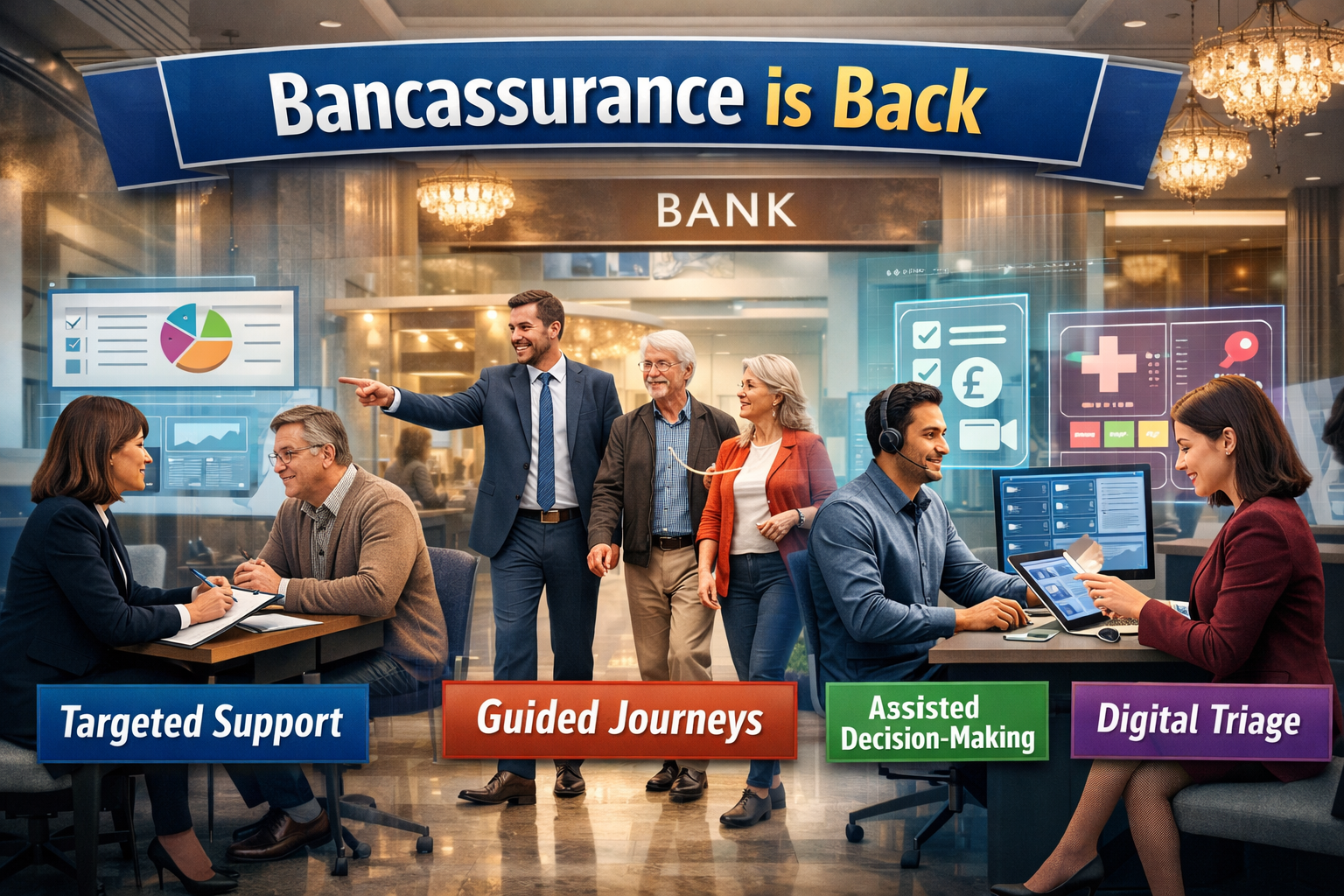
Banks are no longer talking about “advice” in the traditional sense. They are talking about:
- Targeted support
- Guided journeys
- Assisted decision-making
- Digital triage
These models are:
- Lighter on risk to banks
- Heavier on risk to consumers
Why?
Because they subtly shift responsibility away from the institution and onto the individual, while retaining control of product ecosystems and asset flows.
We’ve seen this before — not just in advice, but in lending.
The last decade of profitability in banking was fuelled by:
- Securitised lending structures
- Poor forbearance practices
- Coercive repossessions
- Asymmetric power between institution and citizen
Much of that may yet prove to be retrospectively zero-sum as scrutiny, complaints, and redress catch up.
There is little evidence that the underlying vision of the banks has changed — only the packaging.
The Structural Problem Remains
Advice fails when it is:
- A distribution function
- A compliance artefact
- A balance-sheet optimisation exercise
It works when it is:
- Human-centred
- Life-led
- Product-agnostic
- Designed to build agency, not dependency
That is the fault line opening now.
Banks are returning to advice without addressing the cultural, ethical, and structural reasons they exited in the first place.
The AoLP View
At the Academy of Life Planning, we see this moment clearly.
- Advisers must decouple their worth from AUM alone
- Citizens must be equipped to self-direct where possible
- Complexity must be met with human judgement, not algorithms
- Trust must be structural — not promised
This is why we focus on:
- Total Wealth Plans
- Human capital
- Done-by-you and done-with-you models
- Education before intermediation
Banks are back.
But unless something fundamental has shifted, the risks are too.
 Academy of Life Planning