
Why Human Capital Is Pulling Financial Planning Beyond Its Old Limits
Most financial planners were trained in a world where capital meant money, assets, and structures.
But a growing body of research — including a widely cited study on the Significance of Human Capital for Economic Growth — points to a quieter truth:
Financial capital does not create value on its own.
People do.
This insight doesn’t undermine financial planning.
It completes it.
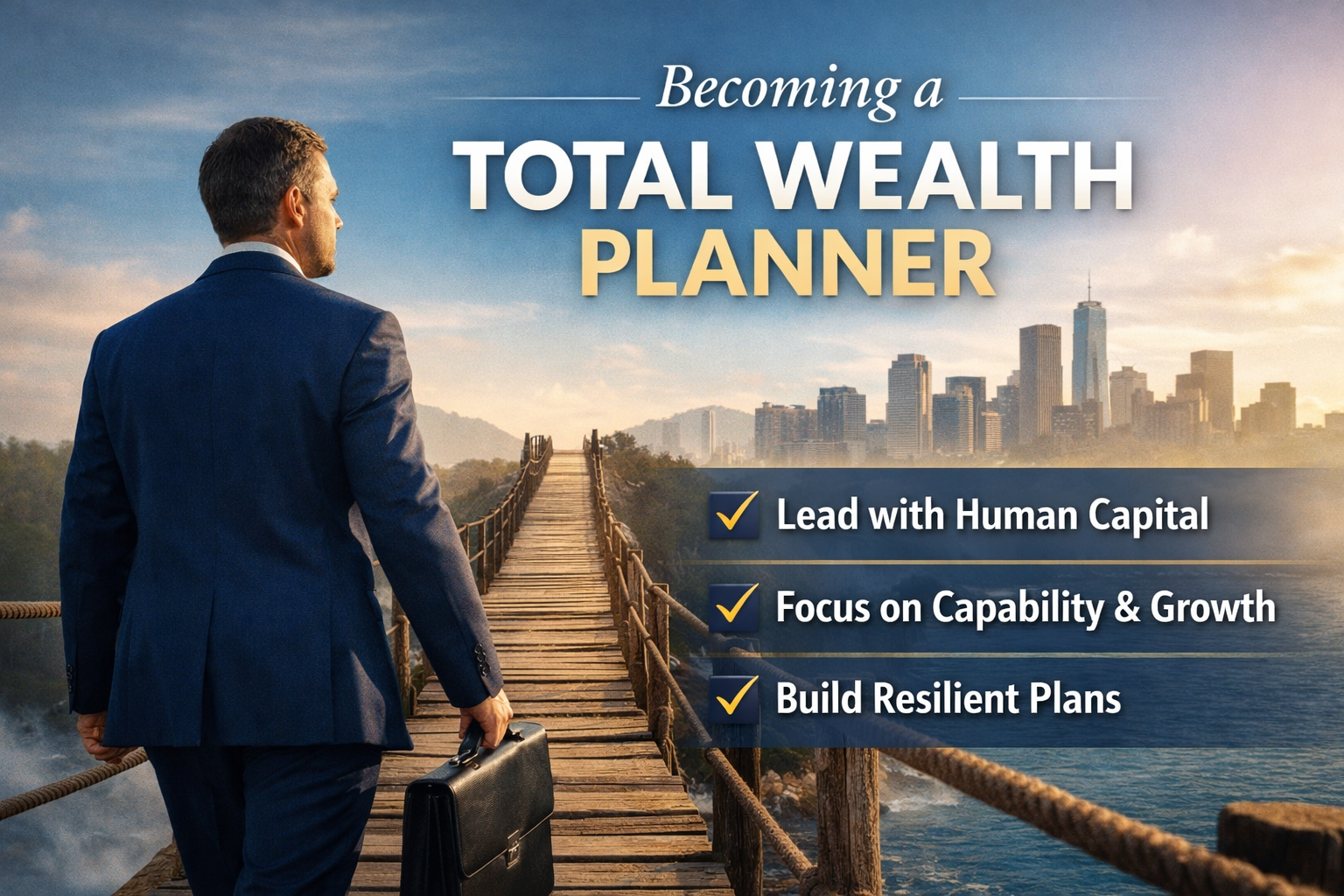
And it helps explain why so many planners now find themselves standing at a bridge — sensing that the old frame no longer fits the realities clients are living.
What the Study Really Says (Beyond the Economics)
The study’s central claim is simple but profound:
Human capital — education, skills, experience, health, confidence, dignity — is the active agent of economic growth, while financial and physical capital are passive tool.
In other words:
- Money doesn’t grow economies
- People do — when they are equipped, confident, and able to act
The implications reach far beyond national policy.
They land directly in the client meeting.
The Blind Spot in Traditional Financial Planning
Traditional financial planning is excellent at structuring financial capital:
- Investments
- Tax wrappers
- Pensions
- Risk management
But the study highlights something planners see every day:
When human capital is depleted — through stress, loss, poor health, lack of confidence, or transition — financial capital underperforms.
Clients don’t fail because the numbers are wrong.
They struggle because their capacity to act is compromised.
No spreadsheet fixes that.
Human Capital Is Not “Soft” — It’s Foundational
The study demonstrates that investment in human capital consistently delivers higher long-term returns than investment in physical capital alone, particularly when people are supported to develop skills, agency, and direction.
Translated into planning terms:
- A confident client makes better decisions
- A self-directed client stays engaged
- A supported client sustains progress
- A purposeful client uses money more effectively
This is not lifestyle coaching.
It is structural planning — just at the human layer.
Why Total Wealth Planning Is Emerging Now
Total Wealth Planning starts where the study begins:
With the person, not the product.
It recognises that:
- Financial capital serves human capital
- Planning must account for capacity, not just capital
- Wealth includes skills, time, health, purpose, resilience, and agency
In practice, this means:
- Planning with clients, not just for them
- Supporting decision-making before optimisation
- Treating education, clarity, and confidence as investable assets
This is exactly the shift the research points toward — even if it never uses the language of “financial advice”.
The Bridge Most Planners Are Already On
Many advisers are already part-way across this bridge:
- Spending more time on client conversations than models
- Acting as translators, stabilisers, and guides
- Helping clients navigate uncertainty, not just returns
The discomfort comes from trying to do human-capital work inside a financial-capital-only framework.
Total Wealth Planning simply gives that work:
- Language
- Structure
- Legitimacy
- Professional support
Crossing the Bridge Is an Expansion, Not an Exit
This is not about abandoning technical excellence.
It’s about placing it where it works best.
On the far side of the bridge:
- Financial expertise is still essential
- But it is no longer doing all the work alone
- Clients are more engaged, capable, and resilient
As the study makes clear, sustainable growth — personal or economic — only happens when human capital is developed alongside financial capital.
A Gentle Invitation to Explore Your Pathway
At the Academy of Life Planning, we support planners who recognise this shift and want to explore it professionally.
There is no single leap — only pathways:
- Done-by-you learning and accreditation
- Done-with-you mentoring and practice transition
- Fast-track and staged options, depending on where you stand today
All grounded in:
- Ethical independence
- Human-capital-first planning
- Professional credibility
- A community of peers already walking this path
🌉 Explore the Total Wealth Planner Pathways
If this study resonates — not just intellectually, but in your lived experience as a planner — it may be time to look more closely at what lies across the bridge.
👉 Explore the Academy of Life Planning pathways into Total Wealth Planning
No pressure. Just clarity, structure, and choice.
 Academy of Life Planning