
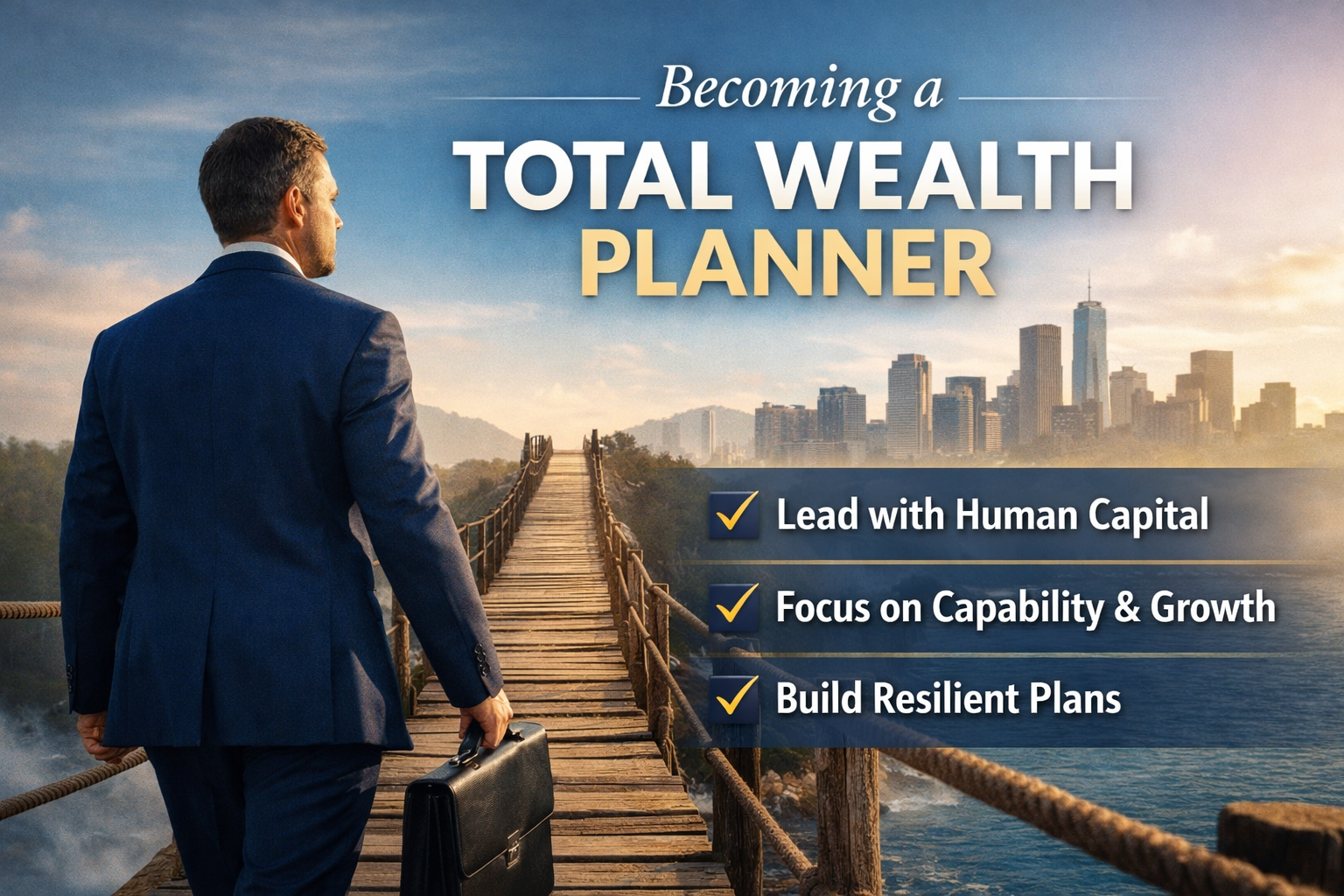
Lessons for Financial Planners Aspiring to Become Total Wealth Planners
For decades, financial planning has been built around financial capital: portfolios, products, performance and projections.
Yet one of the most consistent findings in economic research tells a different story.
Human capital—not financial capital—is the primary driver of long-term prosperity.
A 2012 study published in the British Journal of Humanities and Social Sciences reinforces what many planners are now discovering in practice:
wealth outcomes are shaped far more by skills, knowledge, health, adaptability and agency than by money alone.
For planners looking to evolve into Total Wealth Planners, this research carries several powerful lessons.
1. Financial Capital Is Passive. Human Capital Is Active.
The study makes a critical distinction:
- Physical and financial capital are passive
- Human capital is the active agent that creates, deploys and regenerates wealth
Education, training, experience and decision-making capacity are what determine whether money compounds—or disappears.
Lesson for planners:
If your advice begins with products instead of people, you are optimising the wrong variable.
Total Wealth Planning starts with:
- capability
- resilience
- decision quality
- adaptability across a lifetime
2. Returns on Human Capital Exceed Returns on Financial Capital
Across both developed and developing economies, the research shows that:
- Investment in human capital consistently delivers returns above the cost of capital
- In many contexts, returns exceed those of physical capital investment
In other words:
The most reliable “asset class” is the individual’s ability to learn, adapt and apply judgement over time.
Lesson for planners:
Cashflow modelling without capability modelling is incomplete planning.
Total Wealth Planners help clients:
- increase earning capacity
- navigate career transitions
- recover after disruption
- redeploy skills when markets, health or circumstances change
3. Education Is Not Just Knowledge — It Is Agency
The study emphasises that education’s value is not merely informational.
It shapes:
- attitudes
- confidence
- problem-solving ability
- long-term decision behaviour
Critically, even when economists debate how education works, the evidence remains clear:
those with stronger human capital consistently outperform over a lifetime.
Lesson for planners:
The planner’s role is not to replace client judgement — but to develop it.
This marks the shift from:
- dependency → agency
- intermediation → empowerment
- “done-for-you” → “done-with-you / done-by-you”
4. Lifetime Wealth Is a Flow Problem, Not a Stock Problem
The paper reinforces a vital insight often missed in traditional advice models:
Wealth is generated across a lifecycle, not at a single point in time.
Human capital compounds through:
- learning
- experience
- health
- opportunity recognition
Financial capital merely stores the surplus produced.
Lesson for planners:
Retirement-only planning is structurally outdated.
Total Wealth Planning integrates:
- life design
- work optionality
- phased transitions
- purpose, contribution and dignity across later life
5. Planning That Ignores Human Capital Creates Fragility
The study warns—implicitly but clearly—that economies (and individuals) that under-invest in human capital suffer:
- lower resilience
- weaker growth
- higher inequality
- greater vulnerability to shocks
This applies at the personal level too.
Lesson for planners:
A plan that looks “accurate” but leaves the client dependent, anxious or inflexible is not a good plan.
Total Wealth Planners design plans that:
- remain valid when life changes
- support autonomy under stress
- adapt across uncertainty
What This Means for the Future of the Profession
The evidence is clear.
The planners of the future will not be:
- product allocators
- portfolio technicians
- or retirement forecasters alone
They will be:
- human capital architects
- life transition guides
- decision-quality partners
- builders of agency, not dependency
That is the essence of Total Wealth Planning.
And the research has been telling us this all along.
If you’re a financial planner sensing that the old model no longer fits the world your clients are living in, this shift isn’t optional. It’s already underway.
The question is whether you cross the bridge deliberately — or get pulled across by events.
If you’re ready to step beyond product-led advice and into true Total Wealth Planning, the Academy of Life Planning exists to support that transition.
We help financial planners evolve into human-capital-led professionals who build agency, resilience, and lifelong value for their clients — using practical frameworks, peer learning, and AI-enabled tools that fit the real world. This isn’t about abandoning your experience; it’s about upgrading it for the world your clients now live in. Cross the bridge with purpose. Build a practice that reflects who you are — and where planning is going.
 Academy of Life Planning