
There is a pattern that almost no one names, but every long-term victim of financial wrongdoing eventually feels in their bones.
When an institution knows it has caused serious harm — and knows that fully acknowledging it would expose regulatory failure, legal liability, or reputational collapse — it does not rush to correct the wrong.
It shifts into containment mode.
Not justice mode.Not truth mode.Containment mode.
And in containment mode, the system’s unspoken objective is not to defeat you in court.
It is to outlast you.
The Silent Strategy: Attrition, Not Truth
Most victims assume that if they just gather enough evidence… write one more letter… find the right department… escalate to the right regulator… or endure one more procedural hoop…
…the system will eventually have to respond.
But what actually happens is something much darker and more mechanical.
Institutions faced with credible, inconvenient claims typically deploy the same quiet playbook:
- Delay responses by months
- Fragment responsibility across departments
- Change personnel so no one “owns” the case
- Demand repeated resubmission of the same evidence
- Narrow the scope of what they will consider
- Reframe criminal issues as “civil disputes”
- Label persistent victims as “vexatious”
- Offer procedural apologies without accountability
- Exhaust you emotionally, financially, and psychologically
None of this looks like malice when viewed in isolation.
Together, it functions as a slow erasure machine.
Not erasure of the facts. Erasure of the person bringing them.
The Cruellest Part: Victims Are Pulled Into Their Own Erasure
Here is the part that is hardest to say out loud.
The system doesn’t just erase victims. It recruits them into participating in their own erasure.
Not because they are weak. Not because they are foolish. But because trauma, injustice, and moral injury create a psychological trap.
When everything else has been taken — money, safety, reputation, trust, future plans — the fight for justice becomes the last remaining structure of meaning.
It becomes identity. Dignity. Proof that what happened mattered.
So victims do what any sane human would do:
They escalate harder. They write longer letters. They gather more documents. They refuse to stop. They sacrifice sleep, relationships, health, and stability. They pour their remaining life force into a system that is quietly designed to outlast them.
From the outside, this looks like courage.
From the inside, it feels like survival.
But structurally, it is exactly what containment systems rely on.
Because the longer the fight drags on:
- The more exhausted the victim becomes
- The more their credibility is questioned
- The more their mental health deteriorates
- The more their financial position collapses
- The easier it becomes to dismiss them as unstable or irrational
- The more likely they are to die, give up, or disappear
And when that happens?
The system never has to admit anything.
This Is Not a Conspiracy Theory. It Is a Structural Reality.
No secret meeting is required for this to happen.
It emerges naturally when:
- Institutions face massive liability
- Regulators fear admitting past failures
- Legal departments prioritise risk containment over justice
- Bureaucratic incentives reward delay, not resolution
- Individual officials are shielded from consequences
The result is an ecosystem where:
Truth is not directly denied. It is procedurally smothered.
And the people who refuse to go away are quietly reclassified as “the problem.”
Why Get SAFE Exists: Not to Win Wars — but to Stop the Erasure
Get SAFE was not created to be another campaigning organisation. It was not created to “take on the system.” It was not created to promise justice we cannot deliver.
It was created for one brutal, simple reason:
Too many victims are being psychologically and physically destroyed long before any form of justice becomes possible.
So our mission is different.
We exist to:
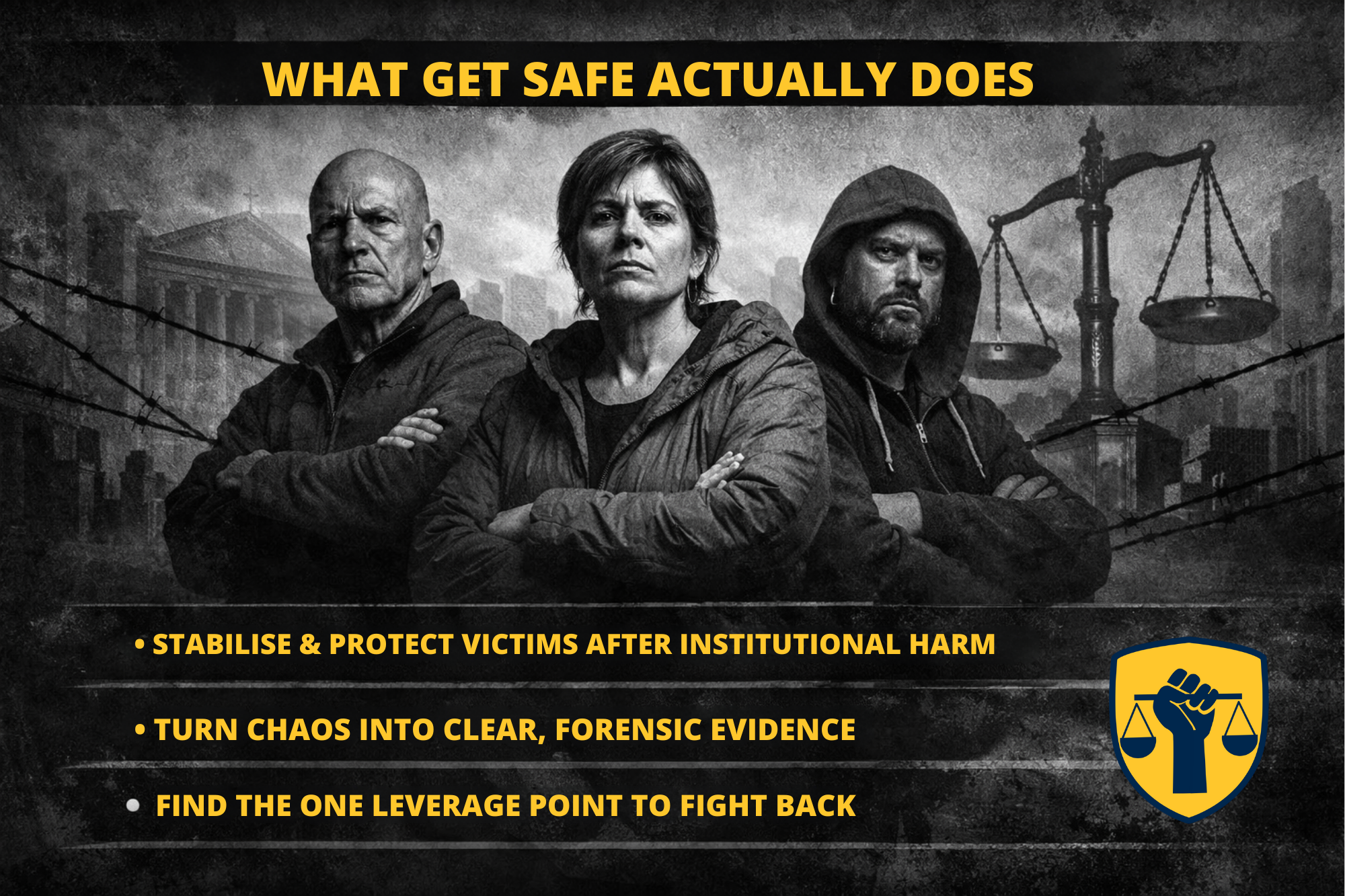
- Stabilise people after institutional harm
- Interrupt self-destructive escalation loops
- Restore procedural agency
- Preserve their evidence in a form that cannot be erased
- Protect their health as a strategic priority
- Help them find one realistic leverage point
- And keep them alive long enough for the truth to still matter
We are not here to tell people to give up.
We are here to stop people from dying for a system that is quietly waiting them out.
The Reframe That Changes Everything: From Open-Ended War to Strategic Custody
Most victims are stuck in what we call open-ended war mode:
- Multiple regulators
- Multiple legal theories
- Endless correspondence
- Constant escalation
- No time boundaries
- No energy boundaries
- No clear end conditions
That mode feels like strength.
In reality, it is a slow suicide pact with bureaucracy.
Get SAFE works to shift people into custodian mode instead.
That means:
- Turning years of pain into a clean, bounded evidence pack
- Distilling thousands of emails into a short forensic chronology
- Mapping legal duty failures in plain English
- Identifying where the system is actually weak — not just where it is loud
- Choosing one lane at a time, not ten
- Putting time limits on escalation phases
- Preserving the case so it can outlive the person
- Decoupling identity from self-destructive persistence
This is not surrender.
It is force preservation.
It is the difference between running into a concrete wall for ten years… and quietly looking for the hairline crack that might actually bring it down.
The Truth About Justice: It Rarely Comes From Where You Expect
Here is another uncomfortable reality.
Justice almost never arrives through the channel victims are told to use.
It comes from:
- A single overlooked procedural breach
- A buried document that changes jurisdiction
- A conflict of interest no one disclosed
- A limitation period miscalculated
- A duty of care wrongly assumed not to exist
- A regulator failing its own statutory code
- A data protection violation triggering disclosure
- A criminal threshold crossed unintentionally
- A whistleblower inside the system
- A journalist finally seeing the pattern
- A court realising it was misled years earlier
In other words:
Justice rarely comes from more volume.
It comes from better leverage.
And leverage is almost impossible to find when someone is exhausted, traumatised, and trapped in permanent fight-or-flight mode.
The Get SAFE Method: Stabilise → Structure → Surface One Leverage Point
We operate on a deliberately narrow, survivable model:
1) Stabilise
Before anything legal or strategic happens:
- We slow the escalation
- We reduce incoming institutional harm
- We validate the person’s reality
- We interrupt panic-driven decision-making
- We protect health as a non-negotiable asset
Because dead victims don’t get justice. And burned-out victims don’t find leverage.
2) Structure
We then turn chaos into something usable:
- A short factual timeline
- A clean list of duty breaches
- A mapping of who knew what, when
- A forensic summary of the harm
- A small annex of key documents
- A record that cannot be dismissed as “noise”
This does two things at once:
- It restores the victim’s agency
- It creates a truth artefact that outlives them
Once something is structured, it cannot be quietly erased.
3) Surface One Leverage Point
Not ten. Not everything. Not a crusade.
One.
The one place where:
- The law is actually weak for the institution
- The regulator has no procedural defence
- A court might set aside a past ruling
- A criminal threshold might be crossed
- A disclosure obligation might be triggered
- A reputational risk might finally outweigh silence
This is where effort becomes proportional again.
Not endless effort. Not heroic suffering. Just enough pressure, in the right place, to change the game.
Why Story Preservation Is a Form of Justice in Itself
Even when institutions never admit fault, something else still matters deeply:
The story cannot be erased.
Get SAFE preserves:
- Individual case histories
- Forensic chronologies
- Pattern evidence across cases
- Structural failure maps
- Institutional behaviour records
So that:
- Regulators cannot pretend these cases never existed
- Journalists can find them later
- Lawyers can use them as precedent
- Inquiries can’t claim ignorance
- History can’t be rewritten
- And victims are not reduced to “unreliable narrators”
Erasure only works when stories stay fragmented and private.
Once they are structured, archived, and shared — even quietly — the system loses its most powerful weapon: silence.
The Quiet Hope: One Small Thing Can Still Turn the Tables
Here is the part that still matters.
Even in the bleakest cases… even after years of denial… even when regulators have closed ranks…
There is often still one overlooked detail.
One misstep. One contradiction. One buried admission. One jurisdictional crack. One procedural failure.
And because Get SAFE uses:
- Forensic analysis
- Pattern recognition
- AI-assisted document review
- Legal logic mapping
- Cross-case comparison
- Plain-English duty modelling
…we sometimes find that one thing.
Not always.
But often enough to justify the work.
And always enough to justify keeping people alive long enough to look.
The Line We Hold
Get SAFE does not promise justice.
We promise something more basic — and more honest.
We promise to:
- Believe you
- Stabilise you
- Structure your truth
- Protect your health
- Preserve your story
- Reduce your exposure to institutional harm
- Help you find one realistic next step
- And refuse to let the system erase you quietly
We are not here to turn victims into martyrs.
We are here to stop the machine from consuming them.
Because justice delayed is bad enough.
Justice erased is something else entirely.
And staying alive, lucid, and structurally anchoredis not weakness.
It is resistance.
If You’d Like to Help This Work Continue
Get SAFE exists because people choose to stand quietly alongside those facing financial harm.
There is no pressure to give.There is no “target thermometer.”There is no guilt-based appeal.
But if this story resonates with you — and you believe no one should have to face financial trauma alone — your support helps keep this work available to the next person who reaches out in panic, confusion, or despair.
Every £50 provides a bursary for one person to access:
• Trauma-informed recovery support
• Guided self-advocacy tools
• Evidence-structuring templates
• Life-stabilisation planning
• Fellowship peer support
• Secure testimony preservation
That support can mean the difference between someone breaking down in isolation — and someone finding clarity, steadiness, and dignity again.
If you’d like to contribute, you can do so here:
[Scan for the Support Get SAFE on Crowdfunder]

Whether you give, share, or simply hold this work in goodwill — thank you for being part of a more humane response to financial harm.
 Academy of Life Planning
Addendum: When the Fight for Justice Becomes a Death Ground
There is a part of this conversation that cannot be softened or avoided.
Not everyone who is harmed by financial exploitation can be stabilised.
Not everyone can be reframed.
Not everyone can be brought back from the edge by structure, validation, or strategic containment.
Some people reach a psychological place that ancient strategists called “death ground.”
It is the place where:
In this state, the pursuit of justice is no longer about outcomes.
It becomes about ending intolerable internal pain.
And no amount of logic, evidence, encouragement, or procedural planning can reliably reach someone who is already there.
This is not weakness.
This is not moral failure.
This is not a character flaw.
It is what prolonged trauma, institutional gaslighting, financial ruin, and moral injury can do to a human nervous system.The Hard Ethical Line Get SAFE Will Not Cross
Get SAFE exists to stabilise people after financial exploitation.
We are not:
And we will not pretend to be.
That boundary is not bureaucracy.
It is ethics.
Because trying to “hold” people who are in active suicidal ideation or full death-ground psychology would be unsafe for them and unethical for us.
It would risk:
So Get SAFE operates on a strict safeguarding principle:
We do not attempt to carry people who are in active suicidal crisis.
We refer immediately to specialist services.Our Safeguarding Protocol (Non-Negotiable)
When someone shows signs of being on death ground — or expresses suicidal ideation — our response is not escalation, strategy, or justice work.
It is immediate referral to professional support.
Our standard procedural safeguarding approach is to direct people to:
Samaritans
24-hour emergency helpline: 116 123
Website: samaritans.org
CALM (Campaign Against Living Miserably)
Suicide prevention helpline: 0800 585858
Website: thecalmzone.net
Mind
Mental health support and local services
Website: mind.org.uk
We do not treat this as a soft suggestion.
We treat it as a safety requirement.
Because no justice outcome is worth a human life.What Get SAFE Can Still Do — Without Causing Harm
Even in proximity to death-ground cases, Get SAFE still has a narrow, ethical role.
Not to rescue.
Not to persuade.
Not to replace clinical care.
But to do three bounded things:1) Not Accelerate Collapse
We refuse to feed:
We do not romanticise suffering.
We do not glorify endurance.
We do not turn victims into symbols.
Because that is how well-meaning advocacy becomes lethal.2) Preserve the Story Even If the Person Can’t Carry It Anymore
When someone is psychologically collapsing, one thing still matters deeply:
Their truth should not disappear with them.
Get SAFE helps externalise their case into:
This is not about litigation.
It is about preventing erasure.
Because even if a person cannot survive the fight, their story still deserves to survive the system that tried to bury it.3) Force Preservation for Those Who Are Near the Edge — Not Over It
Most victims are not fully on death ground.
They are oscillating near it.
They are exhausted.
They are despairing.
They are rage-driven.
They are morally injured.
They are close to collapse.
This is where Get SAFE’s stabilise → structure → one-leverage-point model can still make a life-saving difference.
This is where:
…can still pull someone back from the brink.
That is the narrow human window we exist to protect.The Uncomfortable Truth No One Likes to Say
There are cases that will end badly no matter what we do.
Not because the truth isn’t real.
Not because justice isn’t deserved.
Not because the system is right.
But because prolonged institutional cruelty can permanently fracture a human being.
We do not pretend otherwise.
What we do commit to is this:
And we will not allow the system to quietly erase people without at least preserving their truth.Why This Boundary Matters
There is a seductive lie in justice work:
“If we just care enough, try hard enough, escalate far enough — no one has to die.”
That is not true.
What is true is this:
Without clear ethical boundaries, justice movements become extraction machines too.
They consume the very people they claim to serve.
Get SAFE refuses to become that.
We are not here to be heroes.
We are here to be a human stabilisation layer that knows its limits.The Line We Hold
Get SAFE stands for:
We cannot guarantee justice.
But we can guarantee this:
We will not sacrifice human lives to a system that is quietly waiting people out.
Staying alive is not weakness.
Stepping back is not betrayal.
Asking for clinical support is not failure.
Sometimes the bravest act is not fighting harder.
It is choosing not to die for a truth that already exists.