
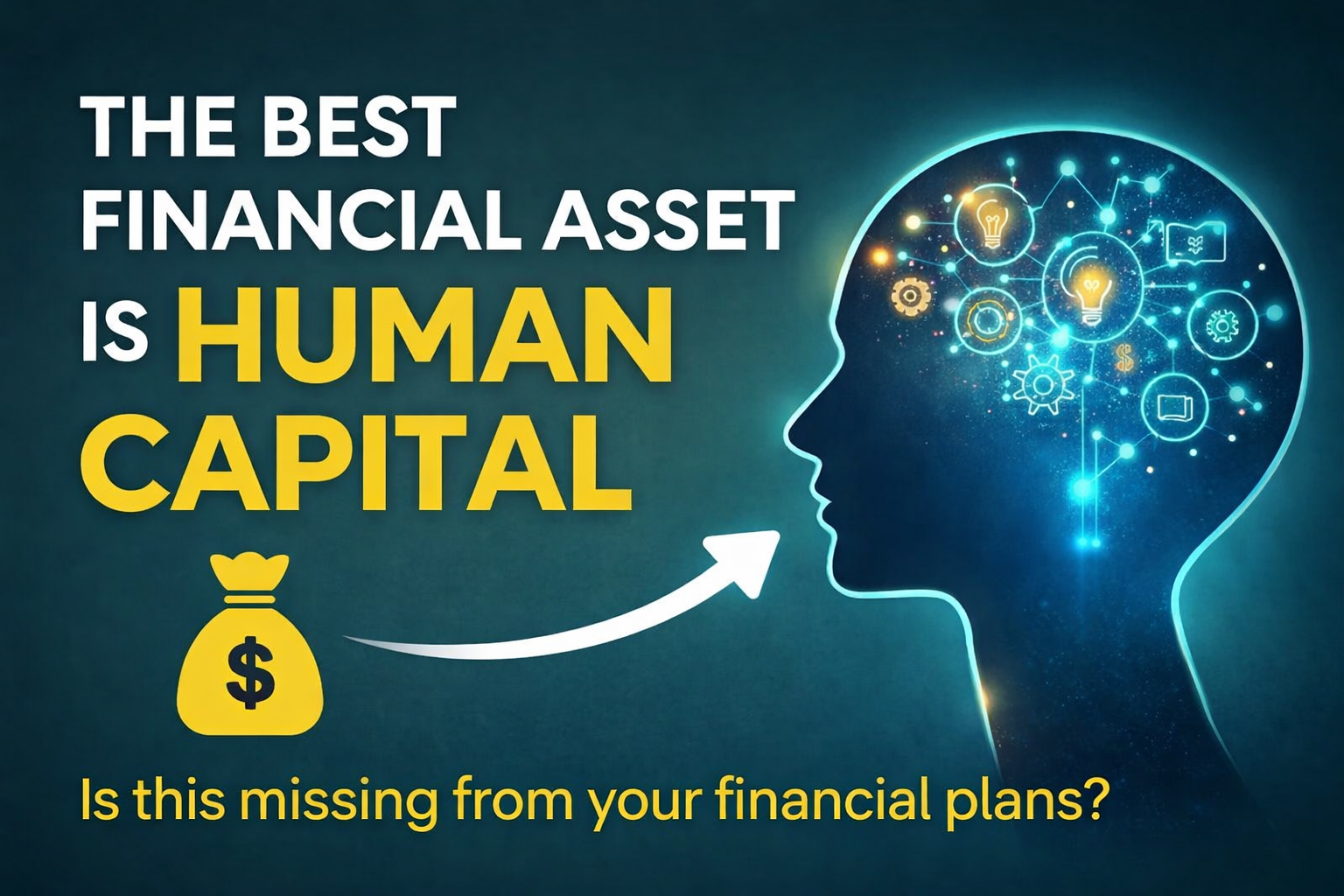
A practitioner insight for Total Wealth Planners
Traditional financial planning has taught generations of advisers to look down—at balance sheets, portfolios, wrappers, and projections.
Total Wealth Planning asks us to look up—at the living, breathing human being who generates, sustains, and renews all of that capital.
A growing body of academic research confirms what many of us already know intuitively:
Human capital—not financial capital—is the primary engine of long-term wealth.
One such study, Human Capital: The Tool for Economic Growth and Development, makes this explicit, arguing that a nation’s prosperity depends more on the skills, health, and capabilities of its people than on any physical or financial resource.
For Total Wealth Planners, this is not an abstract economic idea.
It is a call to professional recalibration.
The Core Misconception in Traditional Planning
Most conventional models still treat wealth as something that is:
- Accumulated
- Preserved
- Crystallised
- Decumulated
All within the narrow frame of financial capital.
But the study highlights a structural flaw in this thinking:
Financial and physical capital only produce results when deployed by capable, healthy, skilled people.
In other words, portfolios don’t create wealth.
People do.
When planning begins with money instead of meaning, capability, and capacity, the result is fragility—not security.
Human Capital Is the Primary Wealth Asset
The study defines human capital as the collective stock of:
- Skills
- Knowledge
- Health
- Experience
- Adaptability
These are not “soft” factors. They are productive assets that:
- Drive income
- Enable innovation
- Improve quality of life
- Extend productive longevity
For practitioners, this reframes the conversation:
- Income is not a by-product of employment
- Income is a return on human capital investment
A client’s most valuable asset is rarely their ISA or pension.
It is their ability to earn, adapt, and contribute over time.
Education, Health, and Training Are Capital Allocations
One of the most important findings in the study is that spending on education, training, and health should not be treated as consumption.
They are investments with compounding returns.
Yet many plans still treat:
- Learning as discretionary
- Health as a lifestyle issue
- Career development as “outside scope”
Total Wealth Planners know better.
Reframing these areas as capital allocation decisions does three powerful things:
- It restores agency to the client
- It strengthens long-term resilience
- It aligns money with life, not the other way around
Health Is a Financial Variable (Whether We Like It or Not)
The study is clear: health directly affects productivity, life expectancy, and economic outcomes.
Ignoring health in financial planning doesn’t make it irrelevant—it makes the plan inaccurate.
For practitioners, this means:
- Health resilience belongs inside the wealth conversation
- Burnout is a wealth risk
- Poor wellbeing undermines every projection
Total Wealth Planning integrates health not as advice, but as acknowledged reality.
Skills Obsolescence Is a Hidden Wealth Risk
Another key insight from the study is the danger of misallocated or underdeveloped skills.
When people’s capabilities fall out of alignment with the world around them, value is destroyed—not just personally, but systemically.
For planners, this elevates:
- Career transitions
- Re-skilling
- Portfolio careers
- Encore careers
from “nice to have” to core risk management strategies.
A plan that assumes static earning power is not conservative.
It is naive.
Information, Understanding, and Agency Matter
The study emphasises that people can only invest effectively in themselves if they have access to:
- Clear information
- Education
- Transparent guidance
This has profound implications for practitioners operating outside product-led models.
Education is not competition to advice.
It is the foundation of durable outcomes.
Total Wealth Planners don’t replace thinking—they restore it.
Inequality Is a Human Capital Failure
Perhaps the most important systemic insight is this:
Underinvestment in human capital leads to inequality, instability, and stagnation.
This positions Total Wealth Planning as more than a commercial model.
It is a socially constructive profession.
When planners help clients develop their human capital, they are not just improving individual outcomes—they are strengthening the fabric of the economy.
From Balance Sheets to Living Systems
The implicit lesson running through the study is that wealth is:
- Dynamic, not static
- Cyclical, not linear
- Human-led, not product-led
Human capital depreciates without renewal.
It appreciates with intention.
This is why Total Wealth Planning naturally aligns with cyclical, life-first frameworks rather than one-off “lifetime plans.”
The Practitioner Takeaway
Most of a person’s wealth does not sit in an account.
It:
- Learns
- Heals
- Adapts
- Creates
- Walks into work every day
Total Wealth Planners are not abandoning financial capital.
They are putting it back in its proper place—as a servant to human potential, not its master.
If you are a practitioner feeling the limits of traditional models, this is not a crisis.
It is an invitation.
An invitation to plan for the whole system of wealth, not just the spreadsheet.
Become a Total Wealth Planner with the Academy of Life Planning — and help people build real wealth by investing in their lives, not just their money.
 Academy of Life Planning