
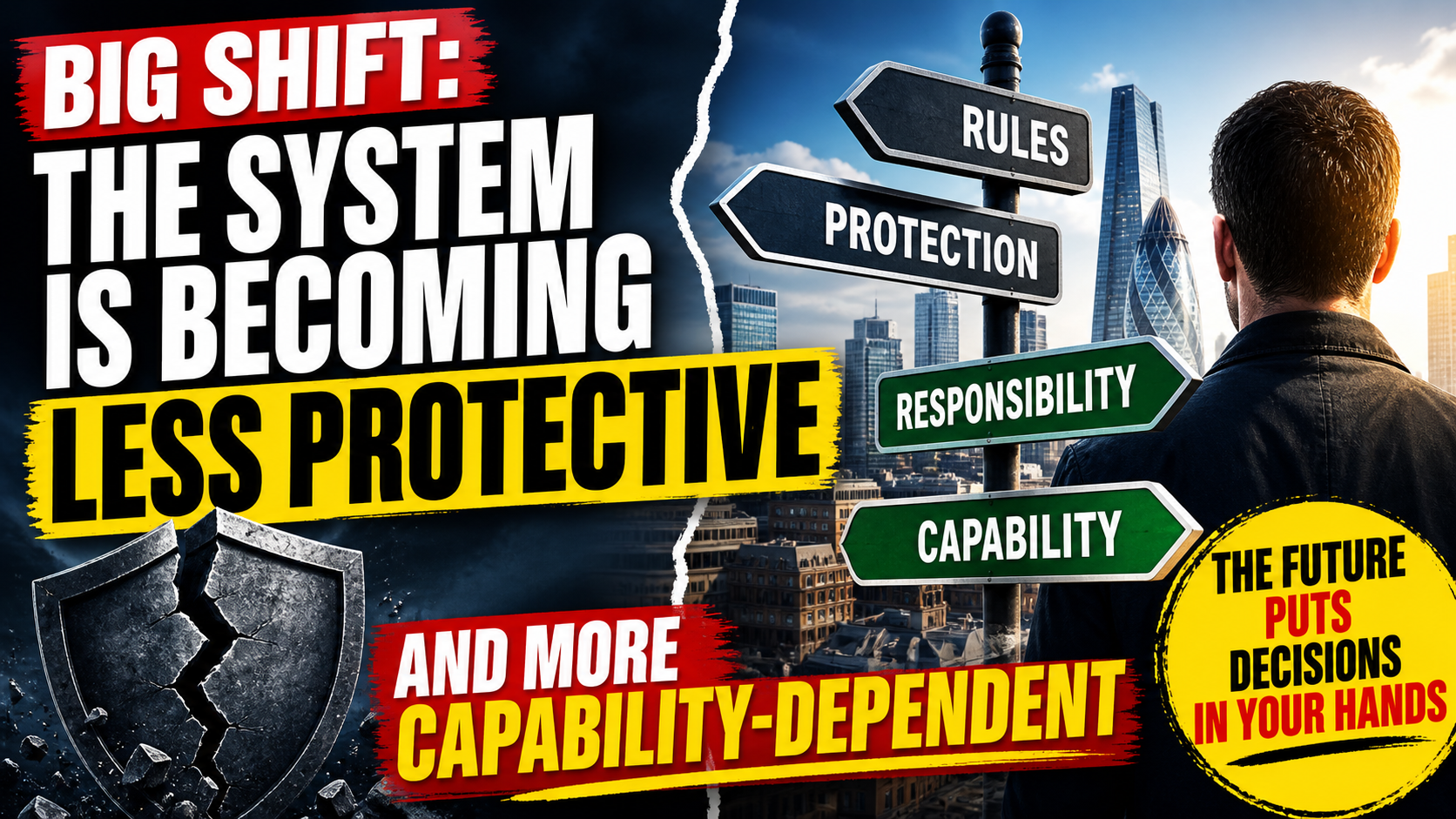
There is a quiet shift underway in UK financial services.
Not a policy announcement.
Not a headline reform.
But something far more consequential.
The Financial Conduct Authority has begun reframing its role for a new era—one shaped by artificial intelligence, faster markets, and increasingly complex consumer decisions.
The language is subtle:
“Adaptive regulation.”
“Adaptive stability.”
“Outcomes-led supervision.”
But behind those words sits a structural change that deserves far more attention than it is receiving.
Because this is not just about regulation.
It is about responsibility.
From Protection by Design… to Navigation by Capability
For decades, the implicit contract was clear.
The system would:
- set rules
- define boundaries
- reduce risk at source
Consumers, in turn, could participate with a reasonable expectation that the environment itself provided a degree of protection.
That model is now evolving.
In an adaptive regulatory framework, the emphasis shifts:
- From fixed rules → to flexible interpretation
- From upfront constraints → to retrospective judgement
- From system-led protection → to participant-led navigation
This is not a failure of regulation.
It is a response to reality.
In a world shaped by AI, real-time decision-making, and increasingly personalised financial journeys, it is no longer possible to predefine every risk, every scenario, every outcome.
So the system adapts.
And in doing so, it quietly transfers responsibility.
The Rise of the Capability Economy
What replaces structural protection is something far less visible—but far more important:
Capability.
Not knowledge in isolation.
Not access to information.
But the ability to:
- interpret complexity
- make decisions under uncertainty
- understand consequences before acting
- navigate systems that no longer guide you explicitly
This is the emerging divide.
Not between rich and poor.
Not even between advised and non-advised.
But between those who can operate within complexity…
and those who cannot.
AI Doesn’t Close the Gap—It Widens It
Artificial intelligence is often positioned as the great leveller.
In reality, it is a force multiplier.
For those with capability:
- AI accelerates thinking
- enhances clarity
- improves decision quality
For those without:
- AI amplifies confusion
- creates false confidence
- increases the risk of poor decisions at speed
The regulator understands this.
Which is why Nikhil Rathi’s remarks on “adaptive stability” matter.
The FCA is not attempting to control every outcome.
It is signalling that the system must remain flexible enough to allow innovation—while holding firms accountable for the consequences.
That is a fundamentally different posture.
Flexibility Upfront. Accountability After.
This is the new regulatory equation:
- More freedom to act
- Less prescriptive guidance
- Greater scrutiny of outcomes
In simple terms:
You will not always be told exactly what to do.
But you will be judged on what happens as a result.
For firms, this means:
- increased responsibility for design, communication, and outcomes
For individuals, it means:
- greater exposure to decision risk
And for both, it means operating in an environment where:
The rules matter less than the reasoning behind your actions.
The Illusion of Protection
There is a risk here.
Many participants will continue to behave as if the old model still exists.
Assuming:
- that products have been “approved” in a meaningful sense
- that systems will prevent poor outcomes
- that someone, somewhere, is actively steering things in their favour
But in an adaptive system, that assumption becomes fragile.
Because protection is no longer embedded in the structure.
It is increasingly dependent on:
- the quality of decisions made
- the clarity of thinking applied
- the ability to question, interpret, and act
A Different Kind of Advice Gap
For years, the industry has spoken about the “advice gap.”
Usually framed as a lack of access to regulated financial advice.
But that framing misses the deeper shift now taking place.
The real gap is not advice.
It is decision capability.
Because even with:
- more information
- more tools
- more access than ever before
…the ability to make coherent, aligned decisions is not evenly distributed.
And in an adaptive regulatory environment, that matters more than ever.
Planning Changes First. Money Follows
This is where the conversation must evolve.
If the system is becoming capability-dependent, then the solution cannot be:
- more products
- more distribution
- more layers of intermediation
It must be something more fundamental.
A shift toward:
- structured thinking
- decision architecture
- clarity of intent before action
In other words:
Planning the person first.
Then the financial architecture.
The Role of the Total Wealth Planner
This is precisely where a new professional model emerges.
Not as an intermediary.
Not as a gatekeeper.
But as a second brain.
A Total Wealth Planner operates alongside the individual, helping them:
- think clearly
- structure decisions
- understand trade-offs
- navigate complexity without surrendering control
Because in a system that is less structurally protective:
The highest value is not advice.
It is the ability to think well.
A System That Assumes Agency
The direction of travel is now clear.
The system is evolving toward one that assumes:
- participants are capable
- decisions are informed
- responsibility is shared
Whether that assumption holds true… remains to be seen.
But one thing is certain:
The future of financial planning will not be defined by access to products.
It will be defined by access to capability.
The Question That Matters
As the regulatory environment adapts, and AI accelerates change, a more fundamental question emerges:
Are we building a system that people can safely navigate…
or one that assumes they already can?
Because the answer to that question will define not just outcomes—
but trust, fairness, and the distribution of opportunity in the years ahead.
Curious how others see this shift.

