
By Steve Conley of the Academy of Life Planning
There are moments when a story returns—not because it was misunderstood, but because it was never fully told.
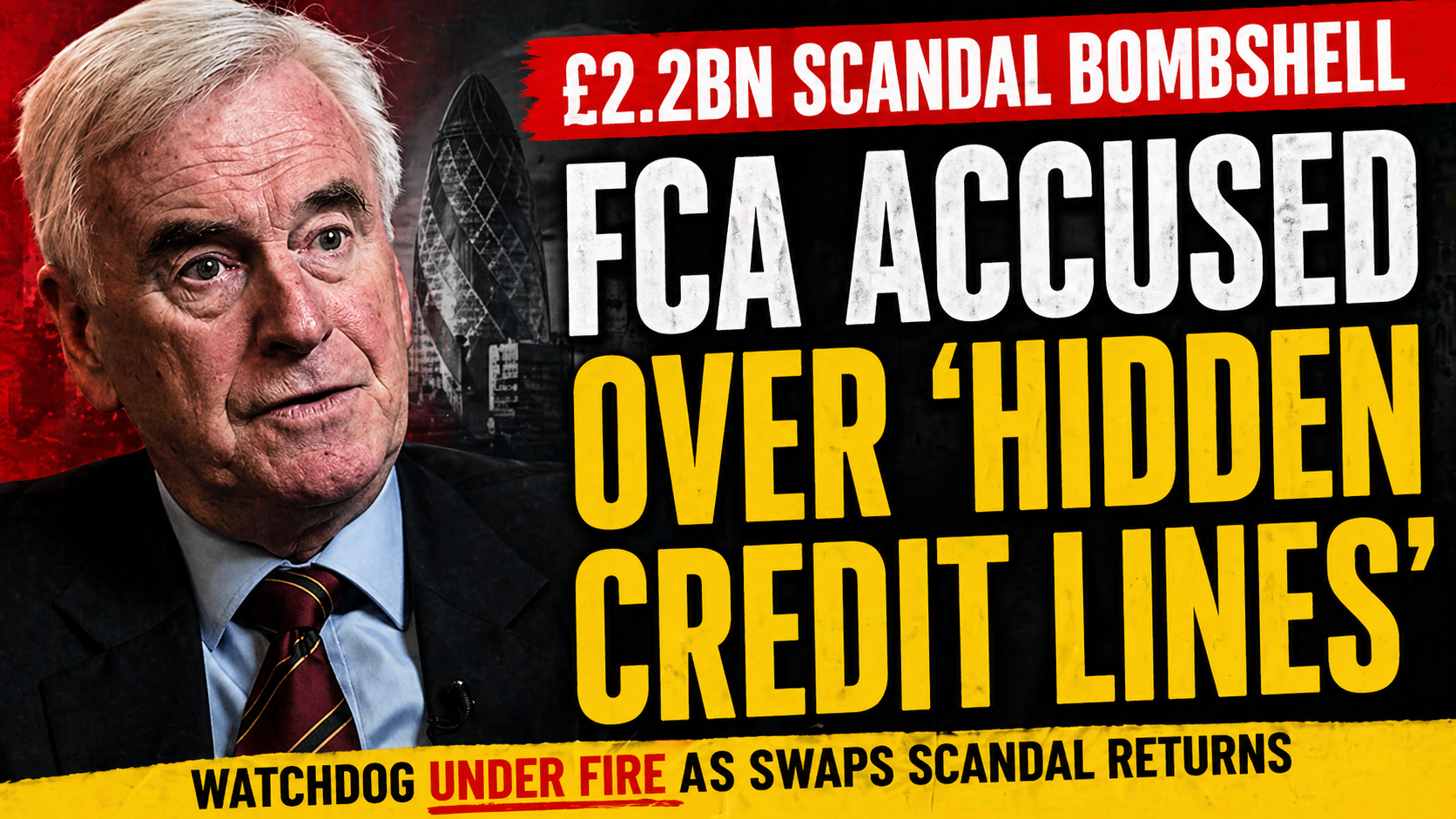
City watchdog accused over ‘hidden credit lines’ in swaps scandal:
Calls grow for judge-led inquiry into the Financial Conduct Authority’s role in mis-selling that devastated thousands of small enterprises,
1) The core allegation: “hidden credit lines”
- The article centres on claims that UK banks embedded undisclosed “credit lines” within interest rate swaps sold to SMEs before the 2008 crisis.
- These liabilities were not clearly disclosed to borrowers, yet were allegedly used by banks to:
- Trigger covenant breaches
- Justify foreclosure or restructuring
- Force asset sales or insolvency
👉 In effect, businesses may have been weakened by risks they didn’t know existed.
2) Scale of harm
- The original swaps mis-selling scandal affected tens of thousands of businesses.
- Banks paid about £2.2 billion in compensation, but campaigners argue:
- That scheme only addressed mis-selling at the point of sale
- It excluded the downstream consequences (e.g. business collapse, personal ruin)
3) The accusation against the regulator
- A senior banking figure, Ian Tyler, claims the FCA:
- Has avoided answering basic technical questions about how these swaps worked
- May have downplayed or obscured the “credit line” issue
- Critics argue this omission reduced compensation liabilities for banks.
👉 This is the crux: not just bank misconduct, but possible regulatory containment of the fallout.
4) Political escalation
- MPs and campaigners are now calling for a judge-led public inquiry.
- John McDonnell and others have linked the issue to:
- Potential institutional cover-up dynamics
- Comparisons with scandals like Horizon and contaminated blood
5) FCA’s position
- The FCA maintains:
- The redress scheme already addressed the problem
- Courts have previously considered the “credit line” issue
- However, it has not yet fully responded to the latest detailed questions.
What the Evidence Shows
The renewed scrutiny of the Financial Conduct Authority over so-called “hidden credit lines” embedded within pre-2008 interest rate swaps does exactly that. It challenges a settled narrative. It reopens a closed file. And more importantly, it exposes something far deeper than mis-selling.
It raises a question the industry has avoided for over a decade:
What if the real risk wasn’t the product—but the structure behind it?
The Original Story Was About Mis-Selling
This One Is About Power
In the aftermath of the financial crisis, banks were found to have mis-sold complex interest rate hedging products to thousands of small and medium-sized enterprises.
The response was familiar:
- A redress scheme
- Approximately £2.2 billion in compensation
- A regulatory conclusion that the issue had been “dealt with”
But that framework rested on a narrow definition of harm:
- Were the products explained properly?
- Did customers understand the risks at the point of sale?
Now, a different allegation has emerged.
That these swaps may have contained undisclosed “credit line” characteristics—internal mechanisms that could:
- Inflate perceived liabilities
- Trigger covenant breaches
- Justify enforcement action by banks
In plain terms, businesses may have been exposed to risks that were never explicitly disclosed, yet were later used against them.
This is not a question of disclosure quality.
It is a question of structural asymmetry.
The Missing Layer: Architecture Risk
If these claims are substantiated, they point to something the original redress scheme did not address:
The architecture of the financial product itself.
Most financial harm is framed as a communication failure:
- Poor advice
- Inadequate disclosure
- Misunderstood risk
But this situation suggests something more fundamental:
- The design of the instrument may have embedded leverage or contingent exposure
- That exposure may have been invisible to the client
- Yet fully visible—and actionable—by the institution
This is what we would describe at the Academy of Life Planning as architecture risk:
Risk that arises not from market movement, but from how a financial structure behaves under pressure—and who controls that behaviour.
A Regulatory Blind Spot—or Something More?
Critics now argue that the Financial Conduct Authority failed to fully investigate or disclose this dimension.
The regulator maintains that:
- The issue has been considered
- The redress scheme was appropriate
- The matter is effectively closed
Yet calls are growing for a judge-led inquiry.
Not simply into bank behaviour—but into whether key technical questions were left unresolved.
This is where the story becomes uncomfortable.
Because if a material feature of the product was:
- Known within institutional balance sheets
- Not disclosed to clients
- And not fully surfaced in remediation
Then we are no longer dealing with a mis-selling event.
We are dealing with a containment event.
The Pattern: When Systems Protect Themselves
For those observing the system over time, this will feel familiar.
Across multiple cases—from SME lending practices to more recent consumer finance issues—the same structural pattern appears:
- Complexity obscures understanding
- Power sits with the institution
- Harm is reframed as misunderstanding
- Redress addresses the surface, not the structure
The result is a system that appears to correct itself, while leaving its underlying mechanics intact.
This is what we mean by structural untrustworthiness.
Not that individuals are untrustworthy.
But that the system:
- Concentrates knowledge
- Retains control
- And distributes risk asymmetrically
Why This Matters Now
This is not just a historical issue.
It is a live signal about the future of financial planning.
Because the conditions that enabled this:
- Information asymmetry
- Product opacity
- Institutional dominance
Are now being disrupted.
Artificial intelligence, open data, and decentralised planning tools are beginning to reverse the balance.
For the first time, individuals can:
- Interrogate structures, not just outcomes
- Understand the mechanics, not just the marketing
- Challenge assumptions before harm occurs
From Advice to Agency
At the Academy of Life Planning, we have long argued that the future is not about improving advice.
It is about restoring agency.
This means:
- Planning the person before the product
- Understanding structure before committing capital
- Retaining control over decisions, rather than outsourcing them
Because the real lesson of the swaps scandal is not that advice failed.
It is that control was never truly with the client.
The Next Frontier: Pre-Decision Protection
If “hidden credit lines” represent a failure of disclosure after the fact, the solution lies before the decision is made.
We are entering an era where:
- Contracts can be analysed instantly
- Financial structures can be stress-tested in plain English
- Power imbalances can be identified in advance
This is the shift from:
- Post-harm compensation
to - Pre-harm protection
From:
- Trusting the system
to - Verifying the structure
A Story Still Being Written
The calls for inquiry may or may not result in formal proceedings.
But the deeper significance of this moment is already clear.
The narrative is shifting.
From:
- “Were customers treated fairly?”
To:
- “Was the system designed fairly in the first place?”
That is a much harder question to answer.
And a much more important one.
Final Thought
If this story confirms anything, it is this:
Financial harm rarely begins at the point of failure.
It begins at the point of design.
And until individuals are equipped to see that design clearly, the imbalance will persist.
The Academy of Life Planning exists to change that.
Not by improving the system’s messaging.
But by helping people understand—and take control of—the system itself.
Curious how others see this.

