
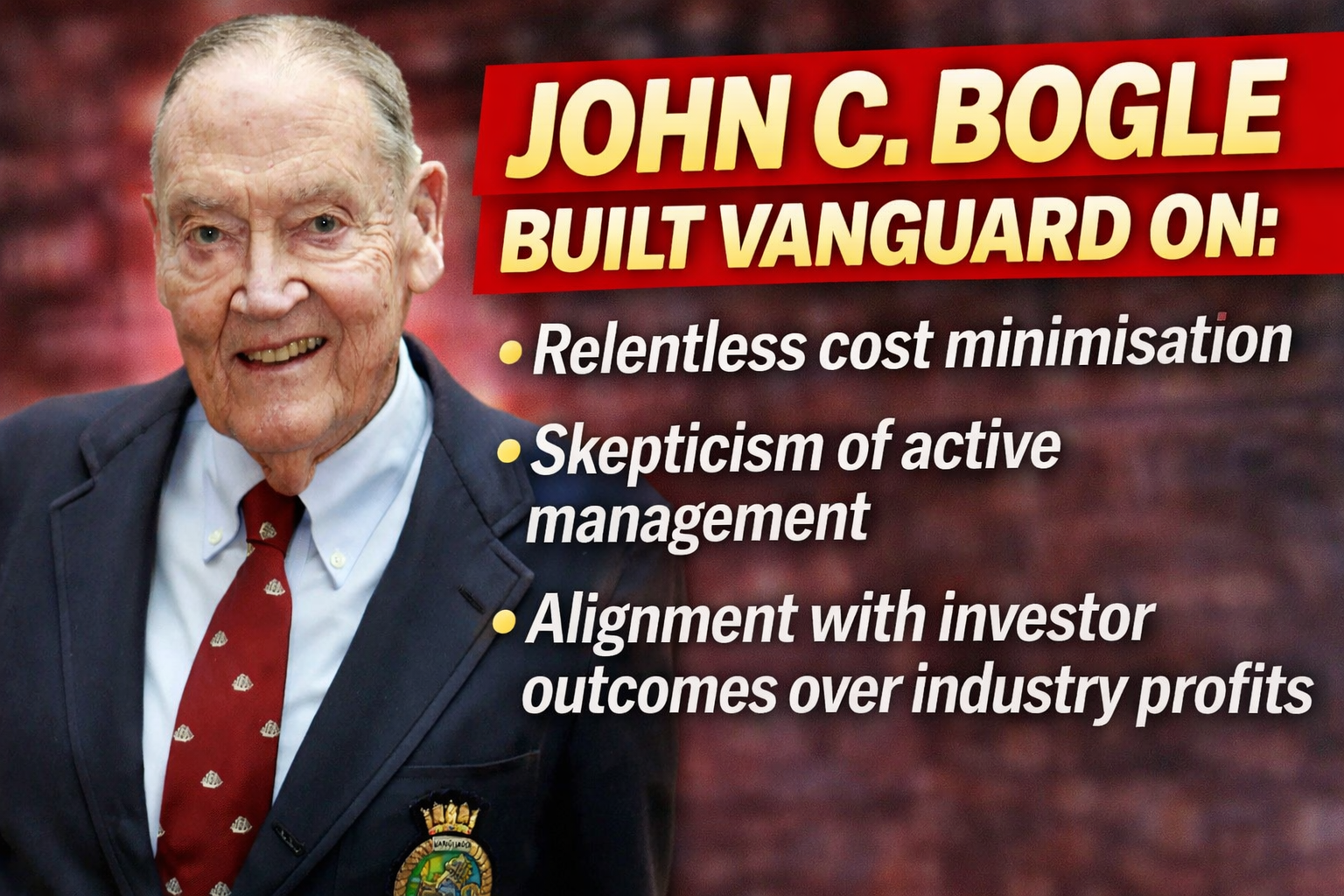
For decades, one firm stood apart.
Not because it promised more.
But because it promised less.
Less cost.
Less intervention.
Less story.
Vanguard was built on a simple, almost uncomfortable truth:
The more you do, the more you tend to take.
And the more you take, the less the investor keeps.
At the heart of that philosophy was John C. Bogle, whose position was clear:
- Markets are broadly efficient
- Costs are the most reliable predictor of outcomes
- Most active management fails to justify its fees
From that foundation came a revolution.
Not in complexity.
But in restraint.
A Quiet Shift
That is why Vanguard’s recent launch in the UK deserves attention.
On the surface, it appears modest:
- A combination of index funds and active managers
- Tactical asset allocation informed by market conditions
- A collaboration with Wellington Management Company
- Total costs of roughly 0.34%–0.45%, compared to ~0.17%–0.23% for its index-based alternatives
Framed as:
“The best of active and passive investing”
It is, in many ways, a perfectly reasonable proposition.
Which is precisely why it warrants scrutiny.
The Return of Narrative
Because this is not simply a new product.
It is the re-emergence of a familiar idea:
That markets can be improved upon through informed intervention.
The language is subtle:
- “dynamic allocation”
- “tilting toward opportunities”
- “manager selection expertise”
But the underlying premise is not new.
It is the same premise that has driven decades of active management:
That skill can outperform structure.
What the Evidence Still Says
The empirical record, however, has been remarkably consistent.
Across markets and time:
- The majority of active managers underperform after costs
- Outperformance, where it exists, is difficult to predict in advance
- Persistence of skill is weak
- Costs compound negatively and immediately
In other words:
Cost is certain.
Alpha is not.
This is not a theoretical objection.
It is a statistical one.
So Why Now?
If the evidence has not changed, why is the proposition evolving?
The answer lies not in markets.
But in distribution.
The Adviser Problem
Modern financial advice faces a structural tension.
If the optimal investment solution is:
- low-cost
- diversified
- largely self-maintaining
then a difficult question emerges:
What is the ongoing role of the adviser?
Not as a planner.
Not as a coach.
But as a portfolio intermediary.
The Role of Narrative
This is where narrative becomes essential.
Because narrative provides:
- explanation
- activity
- perceived value
It transforms:
“stay invested and keep costs low”
into:
“we are actively managing your wealth in response to changing conditions”
The difference is not just semantic.
It is commercial.
Blended Solutions: Elegant, but Problematic
The brilliance of blended propositions is that they avoid the old binary:
Active vs Passive.
Instead, they offer:
“a balance”
- Passive for efficiency
- Active for opportunity
It feels sensible.
It feels moderate.
But it quietly reintroduces a critical assumption:
That active decisions will add more value than they cost.
And here, the evidence remains unchanged.
Blending does not solve the problem.
It repackages it.
The Cost of Subtlety
The additional cost may appear marginal:
20–25 basis points.
But over time, this compounds.
More importantly, it introduces something less visible:
complexity.
And with complexity comes:
- reduced transparency
- increased reliance on explanation
- diminished client understanding
The Risk of Confusion
Perhaps the most significant issue is not performance.
It is clarity.
Within the same brand now sit:
- LifeStrategy — simple, index-based, low-cost
- BlendedLife — more complex, partially active, higher cost
To a professional, the distinction is clear.
To an investor, it may not be.
And when the difference between:
- evidence-based design
- narrative-enhanced design
is not obvious,
the decision is no longer fully informed.
A Question of Alignment
This raises a deeper question.
Who is the product designed to serve?
- The investor?
- Or the intermediary?
Because when solutions evolve to support:
- adviser scalability
- fee justification
- client retention narratives
we must be careful not to confuse:
perceived value
with
actual outcome improvement
The Broader Signal
This is not about Vanguard alone.
It is about what Vanguard represents.
If the most prominent advocate of:
- low-cost
- evidence-based
- investor-first design
begins to move toward narrative-led propositions,
then we are witnessing something significant:
The gravitational pull of intermediation.
The AoLP Perspective
At the Academy of Life Planning, the starting point is different.
Not:
“What should we invest in?”
But:
“Who is in control?”
A Total Wealth Plan does not depend on:
- tactical shifts
- manager selection
- market timing
It depends on:
- clear goals
- aligned resources
- disciplined execution
Within that framework, investing becomes:
a tool — not a theatre
The Real Risk
The danger is not that narrative investing exists.
It always has.
The danger is that it becomes:
- indistinguishable from evidence
- embedded within trusted brands
- accepted without question
When that happens:
- cost rises
- clarity falls
- dependency increases
And quietly, the investor steps further away from agency.
Closing Thought
In an age where AI is rapidly removing information asymmetry, the justification for complexity becomes weaker, not stronger.
We are entering a period where:
- knowledge is abundant
- access is universal
- tools are increasingly self-directed
The future does not belong to:
those who tell the best story.
It belongs to:
those who help others see clearly.
Evidence does not need embellishment.
Only recognition.
Curious how others see this.
 Academy of Life Planning