
Because without it, you’re not planning wealth—you’re managing decline.
For decades, financial planning has focused on one narrow question:
“How do we allocate financial capital?”
But the research is unequivocal:
The primary driver of economic growth, income, and long-term prosperity is not financial capital—it is human capital.
And yet…
Most financial plans barely acknowledge it.
The Evidence Is Overwhelming
Across the studies we’ve shared, a consistent pattern emerges:
1. Human capital is the true engine of value creation
- Investment in education, health, and skills directly increases productivity and income
- It is a factor of production, just like capital and labour—but more powerful because it drives both
As one paper outlines:
Investment in human capital → development of skills → creation of value → economic growth
[Source: The Necessity of the Development of the Human Capital Concept, By ALEXANDRU TRIFU.]
This is a causal chain.
Not a theory.
2. Higher human capital = higher earnings, employment, and opportunity
At the individual level:
- More education → higher employability
- More skills → higher income
- Better health → longer productive life
At the system level:
- Higher human capital → higher GDP
- Higher productivity → stronger economies
Research consistently shows:
Individuals with more education have better employment outcomes and higher earnings
[Source: Human Capital Development, By Hyun Son.]
This is not marginal.
This is foundational.
3. Human capital drives economic growth—directly and indirectly
The relationship is both:
- Direct → increased productivity
- Indirect → innovation, employment, and capital efficiency
One study highlights:
- Education increases GDP by up to 1.7%–12% per additional year of schooling
- Improvements in skills and knowledge lead to:
- Innovation
- Social mobility
- Reduced inequality
And critically:
Human capital doesn’t just support growth—it enables it.
[Source: What Is the Major Relationship Between Human Capital and Economic Growth? By Abdella Mohammed Ahmed. ]
4. Human capital and financial capital are interdependent—but not equal
Here’s the asymmetry most planners miss:
- Financial capital depends on human capital
- Human capital does not depend on financial capital
You can have:
- Skills without savings → still create income
- Savings without skills → eventual decline
This is why:
Economic growth requires simultaneous investment in income, education, and health—not money alone
Where Traditional Financial Planning Breaks Down
Traditional advice models:
- Focus on assets under management
- Prioritise portfolio optimisation
- Ignore income generation capacity
They assume:
Wealth = accumulated capital
But the research shows:
Wealth = productive capacity over time
And productive capacity = human capital
The Total Wealth Planning Shift
This is where Total Wealth Planning fundamentally redefines the profession.
Instead of:
- “How do we invest your money?”
We ask:
- “How do we maximise your lifetime capacity to create value?”
Human Capital in a Total Wealth Plan
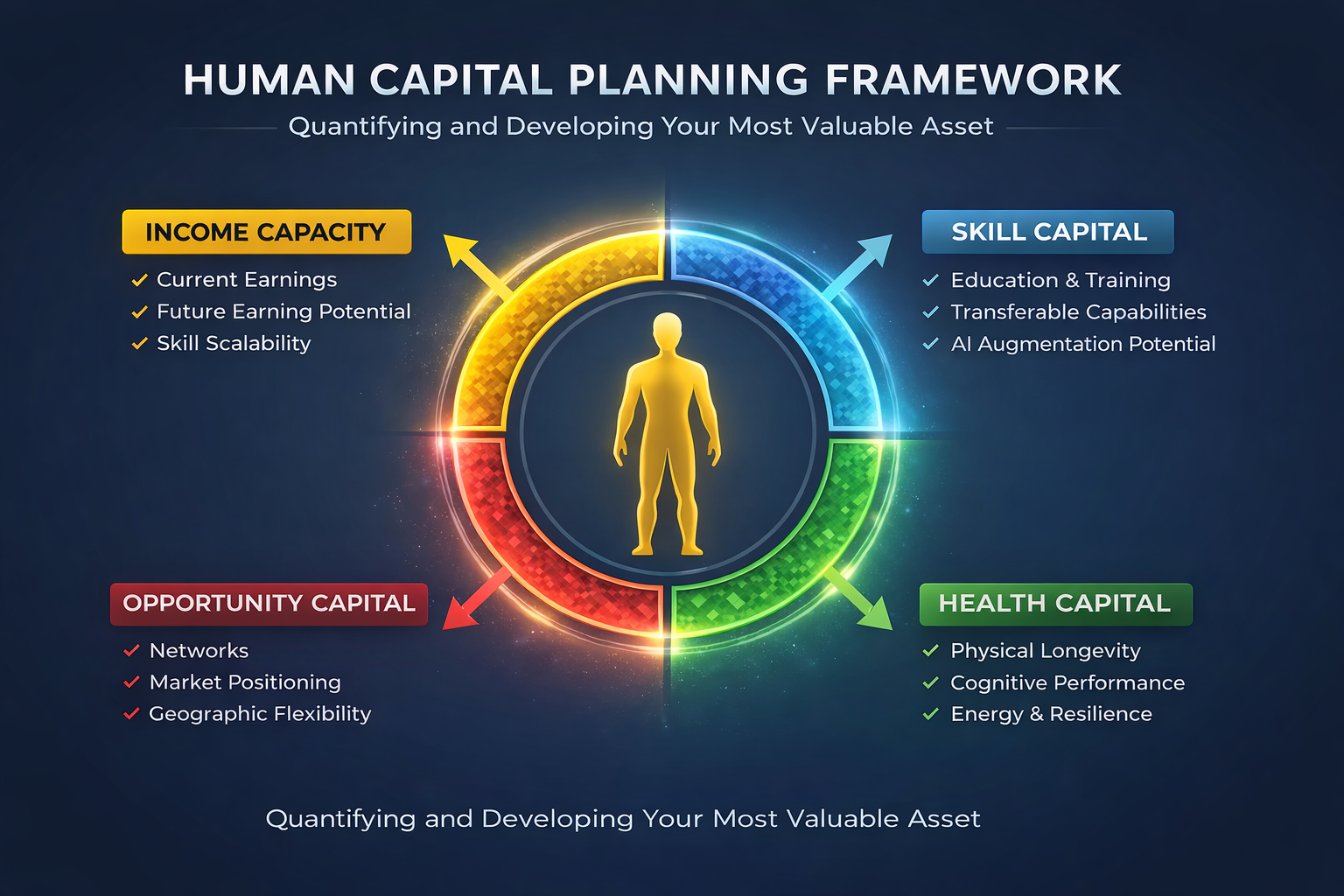
A real plan must quantify and develop:
1. Income Capacity
- Current earnings
- Future earning potential
- Skill scalability
2. Skill Capital
- Education and training
- Transferable capabilities
- AI augmentation potential
3. Health Capital
- Physical longevity
- Cognitive performance
- Energy and resilience
4. Opportunity Capital
- Networks
- Market positioning
- Geographic flexibility
Because:
Human capital is not a soft concept.
It is the largest asset most people will ever have.
The Strategic Implication (This Is the Big One)
If human capital drives:
- Income
- Productivity
- Economic growth
Then:
The primary role of a financial planner is not to manage money…
It is to develop human capital.
Everything else is downstream.
Why This Matters More in the Age of AI
The research predates AI—but the implications accelerate dramatically:
- Skills are now augmentable
- Knowledge is now accessible
- Income potential is now expandable
Which means:
Human capital is becoming more dynamic, not less
And the planner’s role shifts from:
- Gatekeeper of products
→ to - Architect of human potential
The AoLP Position
This is why the Academy exists.
To train planners who:
- Start with the person, not the portfolio
- Build human capital strategies first
- Use financial capital as a supporting tool—not the strategy itself
Closing Thought
The industry still asks:
“What return did the portfolio achieve?”
The better question is:
“What return did the person achieve?”
Because in the end:
Your portfolio is a reflection of your life.
Not the driver of it.
Invitation
If this resonates, you’re already thinking like a Total Wealth Planner.
The next step is learning how to structure this properly—
not as philosophy, but as a repeatable system.
→ Explore the Total Wealth Planning approach
→ Or join a Strategy Session to see how this applies in practice
Module: Human Capital Planning — The Foundation of Total Wealth
Module Positioning (For Accreditation Programme)
This module reframes financial planning from capital management to human potential development.
It establishes the principle that:
Human Capital is the primary driver of all financial outcomes.
Everything else—assets, investments, tax structures—is downstream.
Learning Objectives
By the end of this module, participants will be able to:
- Define Human Capital within a Total Wealth Planning framework
- Explain its relationship to income, productivity, and long-term wealth
- Quantify and map a client’s Human Capital across four dimensions
- Identify constraints and opportunities within a client’s Human Capital system
- Integrate Human Capital strategy into a structured Total Wealth Plan
Section 1: The Conceptual Shift
From Financial Capital → To Human Capital
Traditional model:
- Wealth = accumulated assets
Total Wealth Planning model:
- Wealth = lifetime productive capacity
Core Principle
Financial Capital is stored value
Human Capital is value creation
Planner Repositioning
Old role:
- Investment selector
- Product intermediary
New role:
- Human Capital strategist
- Architect of lifetime income and capability
Section 2: The Four Pillars of Human Capital
Introduce the Human Capital Planning Framework (aligned to your visual model)
1. Income Capacity
Definition:
The client’s ability to generate income over time.
Components:
- Current earnings
- Future earning potential
- Income stability
- Scalability (can income grow without time constraint?)
Planner Questions:
- What is the ceiling on current income?
- What would double income—and what’s missing?
- Is this income replaceable or defensible?
2. Skill Capital
Definition:
The client’s accumulated knowledge, capabilities, and learning potential.
Components:
- Education & training
- Transferable skills
- Market relevance
- AI augmentation potential
Planner Questions:
- Which skills are becoming obsolete?
- Which skills increase earning leverage?
- How can AI enhance output or efficiency?
3. Health Capital
Definition:
The client’s physical, mental, and emotional capacity to sustain performance.
Components:
- Physical longevity
- Cognitive performance
- Energy levels
- Stress resilience
Planner Questions:
- What risks could interrupt income capacity?
- Is the client operating sustainably?
- What would extend productive lifespan?
4. Opportunity Capital
Definition:
The external environment that enables or restricts growth.
Components:
- Networks and relationships
- Market positioning
- Geographic flexibility
- Access to opportunities
Planner Questions:
- Who knows this person—and what do they know them for?
- Are they visible in the right markets?
- What opportunities are currently inaccessible—and why?
Section 3: Quantifying Human Capital
The Human Capital Snapshot (Client Exercise)
Each dimension scored (1–10):
| Dimension | Score | Notes |
|---|---|---|
| Income Capacity | ||
| Skill Capital | ||
| Health Capital | ||
| Opportunity Capital |
Interpretation
- Imbalance = Risk
- Underdeveloped area = Constraint on wealth
- Strong area = Leverage point
Key Insight for Planners
You are not optimising a portfolio.
You are balancing a system.
Section 4: Strategy Design
From Assessment → Intervention
Each pillar must lead to actionable strategy
Examples
Income Capacity
- Career repositioning
- New income streams
- Pricing strategy
Skill Capital
- Targeted learning plan
- AI integration
- Credential development
Health Capital
- Lifestyle redesign
- Workload recalibration
- Recovery strategies
Opportunity Capital
- Network expansion
- Personal brand strategy
- Strategic relocation or repositioning
Section 5: Integration into the Total Wealth Plan
Sequence Matters
Traditional planning:
- Assets
- Investments
- Retirement
Total Wealth Planning:
- Human Capital optimisation
- Income strategy
- Financial capital deployment
Core Rule
Never optimise financial capital
at the expense of human capital
Section 6: Case Study (Applied Learning)
Scenario: Mid-career professional, £80k salary
Traditional advice:
- Increase pension contributions
- Adjust asset allocation
Total Wealth Planner approach:
- Income capacity → capped → redesign role or add income stream
- Skill capital → under-leveraged → AI + upskilling plan
- Opportunity capital → weak network → strategic visibility plan
Outcome:
- Income increases to £120k+
- Financial plan accelerates naturally
Section 7: The Ethical Layer
This is where AoLP differentiates deeply.
Planner Responsibility
You are not just improving outcomes.
You are:
- Restoring agency
- Reducing dependency
- Increasing autonomy
Final Principle
A good financial planner grows assets.
A Total Wealth Planner grows people.
Module Close
Reflection Question:
“Where in your current client work are you optimising money…
instead of developing the person generating it?”
Next Module Transition
→ From Human Capital → Income Architecture & Cashflow Design
This is where Total Wealth Planning begins.
The Human Capital Strategies module introduces the foundational shift:
From managing money → to developing people.
👉 GAME Plan Accreditation Taster
£4.99 | Immediate access
Designed for professionals who want to:
- Build structurally trustworthy planning models
- Align with the future of AI-enabled advice
- Deliver deeper, more meaningful outcomes
 Academy of Life Planning