
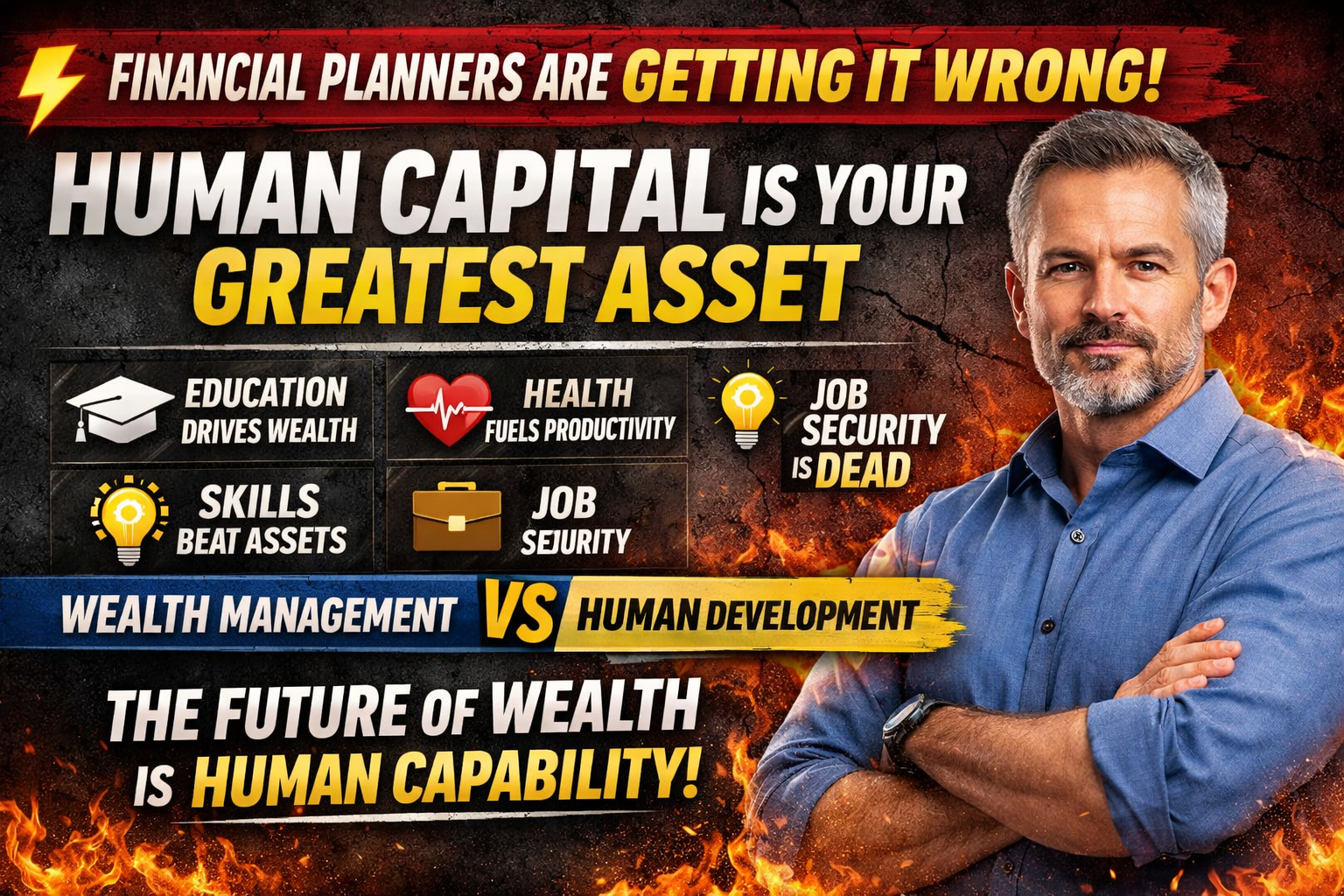
Lessons for Total Wealth Planners from Human Capital Development Theory
For decades, financial planning has been built around one dominant assumption:
Wealth is something you accumulate.
Assets.
Portfolios.
Pensions.
But the research tells a very different story.
Human capital—your ability to think, earn, adapt, and create—is not just part of wealth.
It is the foundation of it.
What the Study Actually Shows
The research defines human capital as:
- The accumulation of knowledge
- The development of skills and capabilities
- The enhancement of productivity and performance
All built through education, health, and ongoing development.
But more importantly, it makes a critical point:
Of all factors of production—land, machines, money—human beings are the most important
This is not philosophy.
This is economic theory.
Lesson 1: Human Capital Is the Primary Asset
Traditional planning treats human capital as:
- A phase (your “working years”)
- A means to an end (build financial capital)
- Something that declines over time
But the study reframes this completely:
Human capital is an investable asset that compounds over time through:
- Learning
- Skill development
- Experience
- Health maintenance
And crucially:
Increased human capital leads directly to increased productivity, income, and economic output
Total Wealth Planners must flip the model.
Financial capital is not the driver.
Human capital is.
Lesson 2: Education Is Not a Phase — It’s a Lifetime Strategy
The research is explicit:
- Education increases “cognitive stock” (your ability to think and act effectively)
- This drives productivity and long-term economic outcomes
But most planning models assume:
Education ends at 21.
Earning begins at 22.
Retirement begins at 65.
That model is broken.
In a modern economy:
- Skills expire
- Industries shift
- AI accelerates change
Human capital must be continuously reinvested.
For planners, this means:
- Planning for learning cycles, not just retirement dates
- Budgeting for capability growth, not just consumption
- Treating education as a core financial strategy
Lesson 3: Health Is Not Lifestyle — It’s Economic Infrastructure
One of the most overlooked insights in the study:
Education and health are inseparable in human capital development
You can have:
- Skills
- Knowledge
- Experience
But without health:
- You cannot deploy them effectively
Health is not a “nice to have.”
It is:
- A multiplier of productivity
- A protector of earning capacity
- A preserver of long-term wealth potential
Total Wealth Planning integrates health as a core asset class.
Lesson 4: The Market Rewards Capability, Not Loyalty
Modern human capital theory highlights a difficult truth:
- Labour markets are competitive
- Employers select the “best available capability”
- Individuals must continuously improve to remain relevant
This creates a structural shift:
Income security no longer comes from employment.
It comes from adaptability.
For planners, this means:
- Job security is not a plan
- Career resilience must be designed
- Income diversification must include human capital pathways
Lesson 5: Nations Grow the Same Way Individuals Do
The study draws a powerful parallel:
Countries become “developed” not through:
- Natural resources
- Infrastructure alone
But through:
- Education
- Health
- Investment in people
Measured through Human Development Index (HDI)
This mirrors individual planning:
| Traditional Planning | Total Wealth Planning |
|---|---|
| Grow assets | Grow capability |
| Optimise returns | Expand potential |
| Manage money | Develop the person |
Lesson 6: Technology Extends Human Capital
The research highlights a critical dynamic:
- Human capital naturally declines with age
- But technology can extend its usefulness
This is where AI changes everything.
AI allows individuals to:
- Leverage their knowledge longer
- Compensate for physical decline
- Scale decision-making ability
This is the bridge to the future of planning.
What This Means for Total Wealth Planners
This is where the Academy leads.
Because once you understand this, the implications are profound:
Planning shifts from:
- Retirement outcomes
→ to lifetime capability design
Advice shifts from:
- Product allocation
→ to human capital optimisation
Value shifts from:
- Managing money
→ to guiding decision-making
The Real Opportunity
Most of the financial services industry still operates here:
- Assets under management
- Product distribution
- Fee extraction
Meanwhile, the real economy is shifting toward:
- Knowledge
- Skills
- Adaptability
- Human agency
The gap is widening.
And that gap is where Total Wealth Planners operate.
Final Thought
The future of wealth is not something you own.
It is something you become.
Human capital is not a supporting concept.
It is the core of economic life.
And in the age of AI, it is becoming:
The most valuable asset class on the planet.
A Closing Invitation
If you’re beginning to see financial planning differently—
If you believe people should be empowered, not managed—
If you want to build a practice aligned with the future—
The Academy of Life Planning exists for that transition.
 Academy of Life Planning