
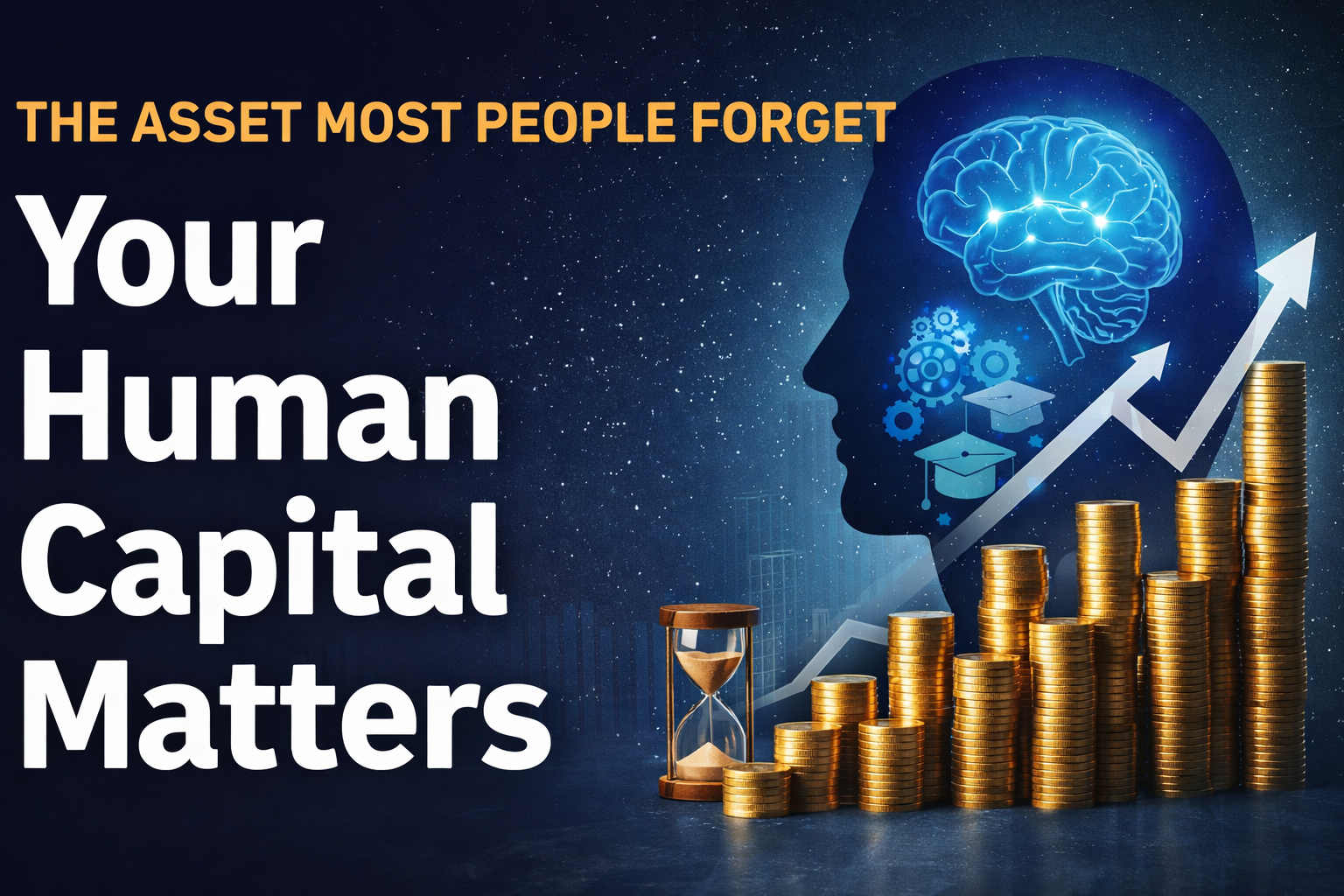
When most people think about financial planning, they think about money.
Savings.
Investments.
Pensions.
But there is a far more powerful asset sitting quietly in the background of every financial life.
You.
Your skills, your health, your experience, your relationships, your creativity, and your ability to adapt.
Economists call this human capital — and decades of research show it is one of the strongest drivers of economic prosperity for both individuals and nations.
[Source: Empirical Analysis of the effect of Human Capital generation on Economic Growth. By Rajiv Divekar.]
Yet ironically, it is the asset that traditional financial planning talks about the least.
For anyone seeking true financial agency, understanding human capital is the starting point.
What Is Human Capital?
Human capital refers to the knowledge, skills, education, experience, health, and capabilities embedded in a person.
Unlike financial assets:
- It cannot be taken away by markets
- It grows when invested in
- It produces income throughout life
Economists have recognised this for centuries.
Adam Smith compared a skilled person to a valuable machine — an asset capable of producing economic value throughout its lifetime.
Modern research reinforces the same idea.
Investment in education, training, and health improves productivity, earnings potential, and economic growth.
In other words:
Your ability to earn, learn, adapt, and contribute is the engine that powers everything else in your financial life.
Why Human Capital Matters More Than People Realise
Most people build financial plans backwards.
They start with money.
But in reality, money is usually the by-product of human capital.
Income → Savings → Investments → Wealth.
That means the quality of your human capital influences:
- Your earning power
- Your career resilience
- Your ability to recover from financial setbacks
- Your adaptability in a changing economy
- Your long-term financial security
The study shows that increases in education and skills tend to correlate with higher income levels and economic growth.
But the insight goes deeper than income.
Human capital determines freedom.
The Hidden Risk: When Human Capital Is Ignored
Traditional financial advice often focuses heavily on financial capital accumulation.
Pensions.
Investment portfolios.
Tax planning.
Those things matter.
But focusing only on financial assets can create a dangerous illusion of security.
Because financial markets are volatile.
Industries change.
Careers evolve.
The people who thrive over decades are not necessarily those with the biggest portfolios.
They are those with strong, adaptable human capital.
Skills that evolve.
Curiosity that continues.
Health that sustains productivity.
Networks that open opportunities.
In a rapidly changing economy — especially with AI and automation accelerating — human capital is becoming even more important.
The Unequal Distribution Problem
The research also highlights an important challenge.
Human capital is not evenly distributed.
Where education, skills, and opportunity concentrate, prosperity tends to follow.
Where they are lacking, inequality grows.
This is why migration often follows opportunity.
People move toward regions, industries, and communities where their skills can generate greater returns.
In economic terms this is sometimes described as brain drain or brain gain depending on the direction of movement.
But at the individual level, the lesson is simple:
Human capital follows opportunity — and opportunity follows human capital.
Financial Agency Begins With Human Capital
At Total Wealth Plans, we encourage people to start their financial thinking in a different place.
Instead of asking:
“How much money do I have?”
Ask:
“What is the value of my human capital?”
That includes:
- Skills and expertise
- Professional networks
- Education and learning capacity
- Physical and mental health
- Creativity and problem solving
- Reputation and trust
- Adaptability in a changing world
These assets produce income.
Income produces financial capital.
Financial capital then supports life choices.
The Total Wealth Perspective
Total Wealth thinking recognises that wealth is not just money.
It is the combination of:
Human Capital – your ability to create value
Financial Capital – your accumulated assets
Social Capital – your relationships and networks
Purpose Capital – meaning and direction in life
When people focus only on money, they often overlook the asset that actually drives their prosperity.
Themselves.
That is why the Total Wealth Plan always begins with life design first, financial architecture second.
The Question That Changes Everything
Before worrying about pensions or investments, ask yourself:
- What skills will remain valuable in the next 20 years?
- What new capabilities should I develop?
- How resilient is my income to change?
- How strong is my professional network?
- How am I investing in my health and energy?
- What opportunities could increase my human capital?
These questions shape financial futures far more than most portfolio decisions.
The Bottom Line
Financial security does not begin with money.
It begins with capability.
Investing in human capital — learning, skills, health, and adaptability — is often the most powerful financial decision anyone can make.
Money follows value.
Value begins with people.
And that means the most important asset in your financial life is not your pension.
It is you.
 Academy of Life Planning