
And What Total Wealth Planners Must Learn From the Pattern
Financial history has a rhythm.
Roughly every decade or so, a scandal emerges involving complex structured investment products. Markets are shocked, regulators respond, and investors ask the same question:
“How did this happen again?”
Yet the truth is uncomfortable.
These scandals are not anomalies.
They are the predictable outcome of how the financial system is structured.
For financial planners seeking to serve clients with integrity, recognising this cycle is essential.
The Recurring Pattern
Over the past thirty years, the industry has witnessed a repeating pattern of structured-product failures.
Examples include:
- The collapse of structured notes linked to Lehman Brothers during the 2008 financial crisis
- Mis-selling of structured autocall products across Europe in the 2010s
- Ongoing scrutiny surrounding structured product distributor Leonteq and failures in oversight of foreign distributors
- Regulatory enforcement actions by authorities such as FINMA and BaFin over risk management and anti-money-laundering failures
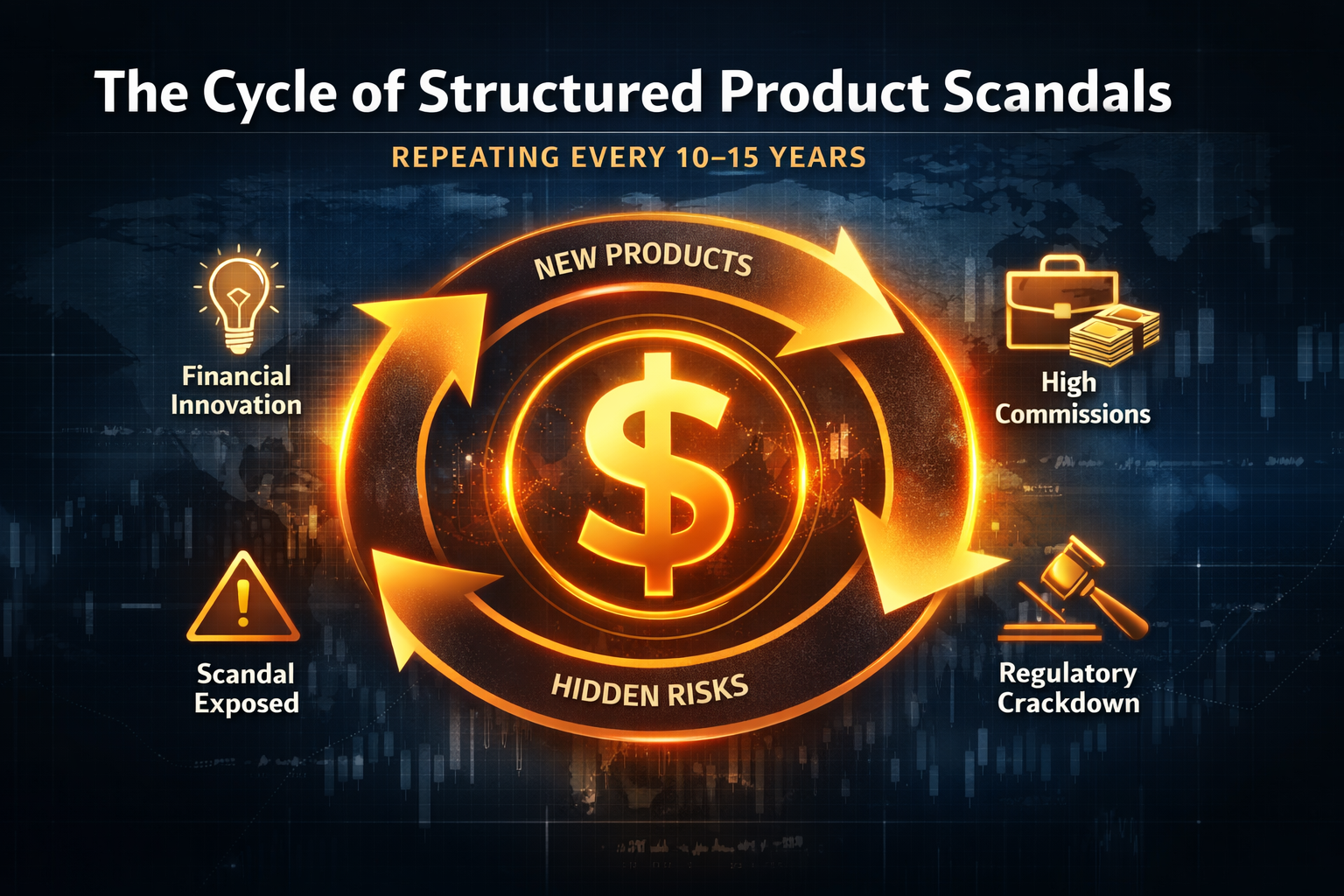
Each episode follows a familiar storyline.
- A financial innovation promises enhanced returns or protection.
- Distribution expands rapidly through advisers or intermediaries.
- The complexity hides high margins and risks.
- Regulators intervene after losses or misconduct emerge.
Then the cycle resets.
A new structure appears.
A new generation of investors encounters it for the first time.
And the pattern repeats.
Why the Cycle Exists
The repetition of these scandals is not random.
It is driven by three structural forces within the financial system.
1. Complexity Creates Economic Rent
Structured products are engineered financial instruments combining derivatives, options, and bonds.
Their complexity allows intermediaries to embed:
- large margins
- hidden fees
- asymmetric risk structures
Clients rarely have the tools to evaluate these designs independently.
As a result, the economics of structured products often favour the issuer rather than the investor.
The more complex the structure, the easier it becomes to extract value from opacity.
2. Distribution Incentives Drive Adoption
Structured products rarely spread because clients demand them.
They spread because intermediaries are incentivised to distribute them.
High margins create strong incentives for:
- product manufacturers
- distributors
- advisers operating under sales targets
Once distribution begins, marketing narratives often emphasise safety, protection, or enhanced yield.
These narratives can obscure the underlying economic reality.
3. Regulatory Intervention Happens Too Late
Regulators typically intervene after harm has occurred.
Investigations begin when:
- losses appear
- whistleblowers raise concerns
- journalists uncover irregularities
By the time enforcement actions occur, the products have often been sold widely for years.
The system therefore relies on retrospective accountability rather than preventative governance.
The Missing Layer: Client-Side Governance
This is where the profession of financial planning must evolve.
Most regulatory systems focus on supervising:
- product issuers
- financial institutions
- regulated advisers
But there is often no dedicated governance layer protecting the client’s long-term interests before a product is adopted.
This is precisely where the role of the Total Wealth Planner emerges.
The Planner as the Client’s Governance Layer
A Total Wealth Planner does not begin with the product.
Instead, planning begins with:
- life goals
- human capital
- risk resilience
- long-term financial architecture
Only after these foundations are established should investment structures be considered.
From this perspective, structured products raise important questions:
- What real problem is this product solving?
- Could a simpler strategy achieve the same objective?
- What incentives exist for those distributing the product?
- What institutional risks sit behind the structure?
These questions shift the conversation from product marketing to client protection.
Prevention Is More Powerful Than Compensation
One of the most important lessons from repeated scandals is this:
Regulation often arrives after damage is done.
Compensation schemes and enforcement actions can take years.
By contrast, effective planning prevents harm before it occurs.
This preventative mindset represents a profound shift in the role of financial planners.
Instead of acting primarily as intermediaries between product providers and clients, planners become:
- educators
- governance stewards
- architects of resilient financial lives
A New Era of Financial Planning
The financial world is changing rapidly.
Artificial intelligence is transforming information access, reducing the need for traditional intermediaries and empowering individuals to take greater control of their financial lives.
In this new environment, the planner’s role evolves.
Rather than selling financial products, planners increasingly act as trusted thinking partners, helping clients navigate complexity and avoid systemic risks embedded within financial markets.
Structured product scandals serve as a reminder that technical sophistication does not always serve the investor.
Often, the most valuable service a planner can provide is protective scepticism.
Learning the Skills of Total Wealth Planning
Delivering this level of protection requires a broader toolkit than traditional financial advice.
Total Wealth Planners must learn how to:
- analyse institutional and product risk
- understand incentive structures within financial markets
- integrate human capital planning into financial strategy
- guide clients through complex financial decisions with independence and clarity
These capabilities form the foundation of the emerging discipline of Total Wealth Planning.
The Future of the Profession
Structured product scandals will likely continue to occur.
Financial innovation will always generate new instruments, new incentives, and new risks.
But the profession of financial planning has the opportunity to evolve.
By shifting from product distribution to client governance, planners can protect individuals, families, and communities from the systemic failures that periodically emerge within financial markets.
The question facing the profession is therefore simple:
Will planners remain intermediaries within the system…
or become the independent guardians of their clients’ financial futures?
Learn More
If you are a financial professional interested in developing the skills required for Total Wealth Planning, explore the training and community offered by the Academy of Life Planning.
The future of planning is not about selling products.
It is about protecting lives.
Appendix A
Case Study: The Leonteq Structured Product Controversy
Regulators Protect the System After Harm. Total Wealth Planners Protect the Client Before Harm.
Financial scandals rarely emerge overnight. They usually unfold slowly, with warning signs visible long before regulators intervene.
The controversy surrounding Swiss structured-products firm Leonteq provides a useful illustration of how governance failures can develop within complex financial distribution systems—and why a proactive planning approach can help protect clients before harm occurs.
Background
Leonteq is a Zurich-based financial engineering firm specialising in structured investment products.
The company designs and distributes complex instruments combining derivatives, options, and debt structures, typically marketed as providing enhanced yield or capital protection.
These products are often distributed through international networks of financial intermediaries.
Concerns began to emerge in 2021–2022 when internal compliance reports and whistleblower allegations raised questions about the distribution of certain products through offshore intermediaries.
Regulatory Intervention
Multiple regulators across Europe investigated aspects of the firm’s activities.
These included:
- Financial Market Supervisory Authority (FINMA) in Switzerland
- Federal Financial Supervisory Authority (BaFin) in Germany
- Autorité des marchés financiers (AMF) in France
Investigations highlighted concerns including:
- weaknesses in risk management systems
- failures in anti-money-laundering monitoring
- inadequate oversight of foreign distributors
- deficiencies in internal compliance and record keeping
In December 2024, FINMA concluded enforcement proceedings and required Leonteq to disgorge profits linked to regulatory breaches. The regulator also imposed stricter controls on the company’s ability to work with foreign distributors.
The Whistleblower Dimension
A senior compliance officer raised concerns regarding suspicious transactions and internal oversight failures.
A Paris labour tribunal later ruled that the individual had acted in good faith when reporting concerns to regulators and granted him legal whistleblower status.
The case highlights the critical role internal compliance professionals can play in identifying emerging systemic risks.
However, it also illustrates how difficult it can be for individuals to raise concerns within large financial institutions.
Key Lessons for Financial Planners
While the Leonteq case primarily concerns regulatory oversight and institutional governance, it provides several valuable insights for planners responsible for protecting clients.
1. Product Complexity Often Masks Incentives
Structured products are engineered financial instruments.
Their complexity makes it difficult for most investors to fully understand:
- embedded costs
- payoff asymmetries
- counterparty exposure
- liquidity constraints
This complexity can enable significant margins for issuers and distributors.
Planners must therefore ask whether complexity is genuinely necessary—or whether simpler strategies could achieve the same objective.
2. Cross-Border Distribution Creates Oversight Gaps
The Leonteq controversy involved multiple jurisdictions and international distribution channels.
When financial products move across borders, regulatory responsibilities can become fragmented.
No single authority may have full visibility of the distribution chain.
For investors, this can create hidden institutional risks that are difficult to detect without independent scrutiny.
3. Regulatory Intervention Is Reactive
Financial regulators play a vital role in maintaining market integrity.
However, their interventions typically occur after potential misconduct has already occurred or been reported.
Investigations, enforcement actions, and legal proceedings can take years to complete.
For investors, this means that relying solely on regulatory oversight may not be sufficient to prevent exposure to emerging risks.
The Role of the Total Wealth Planner
The Leonteq case highlights the importance of an independent governance layer acting on behalf of the client.
A Total Wealth Planner performs this role by focusing on:
- long-term financial architecture rather than product promotion
- transparency in costs and incentives
- resilience and simplicity within portfolio structures
- alignment between financial strategies and life goals
Instead of beginning with investment products, the planner begins with the client’s life plan and risk framework.
Only after this foundation is established should specific financial instruments be considered.
Prevention vs. Compensation
The financial system typically responds to failures through enforcement and compensation mechanisms.
These mechanisms are important but often slow.
Total Wealth Planning emphasises prevention.
By questioning product structures, distribution incentives, and institutional risks before investments are made, planners can help clients avoid exposure to problematic structures altogether.
A Broader Lesson
The Leonteq controversy illustrates a wider truth within financial markets:
Complex financial products can sometimes prioritise institutional incentives over client outcomes.
For planners committed to acting in their clients’ best interests, this reality reinforces the importance of independent thinking and careful scrutiny.
Conclusion
Financial regulation remains essential for maintaining trust in markets.
But regulation alone cannot protect every investor from emerging risks.
That responsibility increasingly falls to professionals who place the client’s interests at the centre of the planning process.
Regulators protect the system after harm.
Total Wealth Planners protect the client before harm.
 Academy of Life Planning