
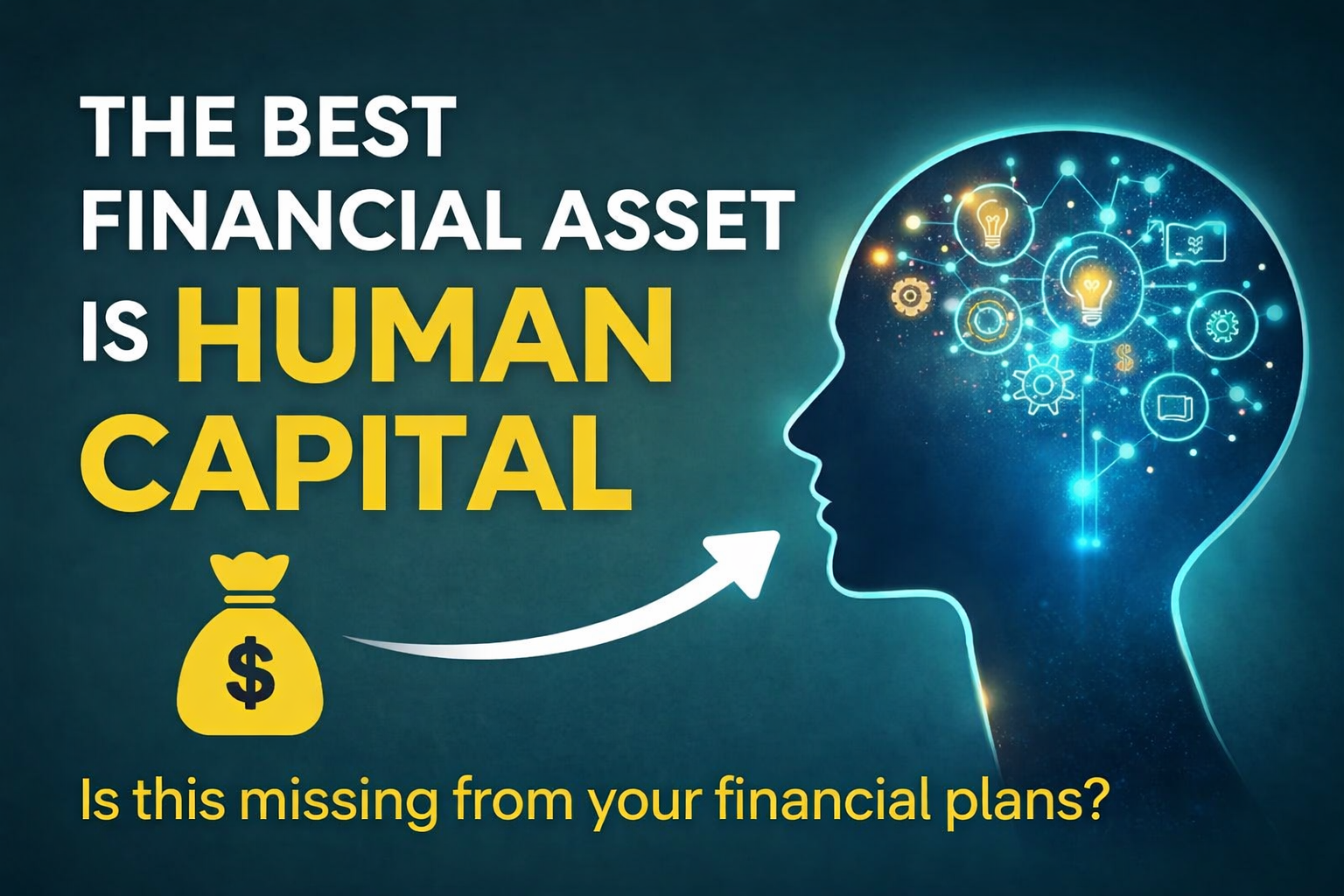
Why Human Capital Belongs at the Heart of Financial Planning
Most lifetime cashflow forecasts begin with:
- Current assets
- Investment returns
- Pension projections
- Inflation assumptions
But they often overlook the largest asset on the client’s balance sheet.
Human capital.
A recent academic review on human capital development reinforces what leading economic theory has argued for decades: investment in education, skills, health, and productive capacity is a primary driver of long-term wealth creation and inclusive growth.
[Ref: Further Theoretical Discourse on Human Capital Development, By Gabriel Omowaye.]
For financial planners, this has direct implications.
What the Research Confirms
The study highlights several critical findings:
1. Human capital drives productivity and income growth
Education, training, and health increase lifetime earning capacity and economic resilience.
2. Investment in human capital produces strong private and social returns
Returns to education in developing economies are often higher than returns to physical capital.
3. Health and longevity compound financial outcomes
Better education improves planning ability and long-term decision-making, which in turn supports higher lifetime income and longer productive lives.
4. “Waste Power” is real
Untapped capacity — whether in older workers, those retraining, or individuals overcoming adversity — represents unrealised economic value.
This isn’t just macroeconomics.
It’s client planning.
Why This Matters for Lifetime Cashflow Forecasting
Traditional cashflow software typically:
- Assumes earnings as fixed inputs
- Projects passive retirement
- Focuses heavily on portfolio sustainability
But earnings capacity is not static.
Human capital:
- Can be developed
- Can be redeployed
- Can be extended
- Can be protected
For working-age clients, lifetime earnings are often 5–15x larger than accumulated financial capital.
If we ignore the largest asset, the plan is incomplete.
The Strategic Shift: From Wealth Modelling to Wealth Architecture
Including human capital in forecasting means:
✔ Modelling income growth scenarios
Career development, retraining, entrepreneurship, part-time reinvention.
✔ Stress-testing health and longevity impacts
Not just mortality — but productive years and earning extension.
✔ Factoring skill resilience
Is the client’s income at risk from automation or industry disruption?
✔ Integrating human and financial capital
Investment strategy should complement career stage and income volatility.
This moves the conversation from:
“How long will your money last?”
To:
“How will your capabilities shape your lifetime wealth?”
That is a fundamentally different advisory posture.
Future-Proofing Your Firm
The study also makes a wider point: economies that prioritise infrastructure over human capital struggle to achieve sustainable growth Further_Theoretical_Discourse_o….
The same may be true for advice firms.
If your value proposition is primarily portfolio management:
- AI will compress margins
- Passive investing will commoditise allocation
- Scale players will dominate
But human capital planning is relational, strategic, and behavioural.
It cannot be automated away.
Firms that integrate:
- Career planning
- Life design
- Skill monetisation
- Longevity strategy
- Human capital risk management
… position themselves as architects of lifetime prosperity — not product distributors.
The Competitive Advantage
Research cited in the study suggests that even a 1% increase in human capital growth can have significant GDP impact.
Translate that to a client level:
- Small improvements in income trajectory
- Delayed retirement by 2–3 years
- Strategic retraining
- Better health maintenance
… can transform financial outcomes more than marginal portfolio optimisation.
That is where advisory alpha increasingly lives.
From Financial Adviser to Total Wealth Planner
At the Academy of Life Planning, we help advisers make this transition deliberately.
Our 12-Week Transition Bridge equips you to:
- Integrate human capital into lifetime modelling
- Reframe client discovery around purpose and productive capacity
- Build planning structures beyond product intermediation
- Combine AI-supported self-direction with human expertise
- Future-proof your practice in the advice evolution era
Human capital is not a theoretical concept.
It is the dominant asset class of the 21st century.
If your forecasting tools ignore it, your advice proposition is underpowered.
The Invitation
If you’re a forward-thinking planner who recognises that the future of advice lies in integrating human and financial capital:
Explore the Academy’s 12-Week Transition Bridge to becoming a Total Wealth Planner.
The profession is evolving.
The question is whether your model evolves with it.
 Academy of Life Planning