
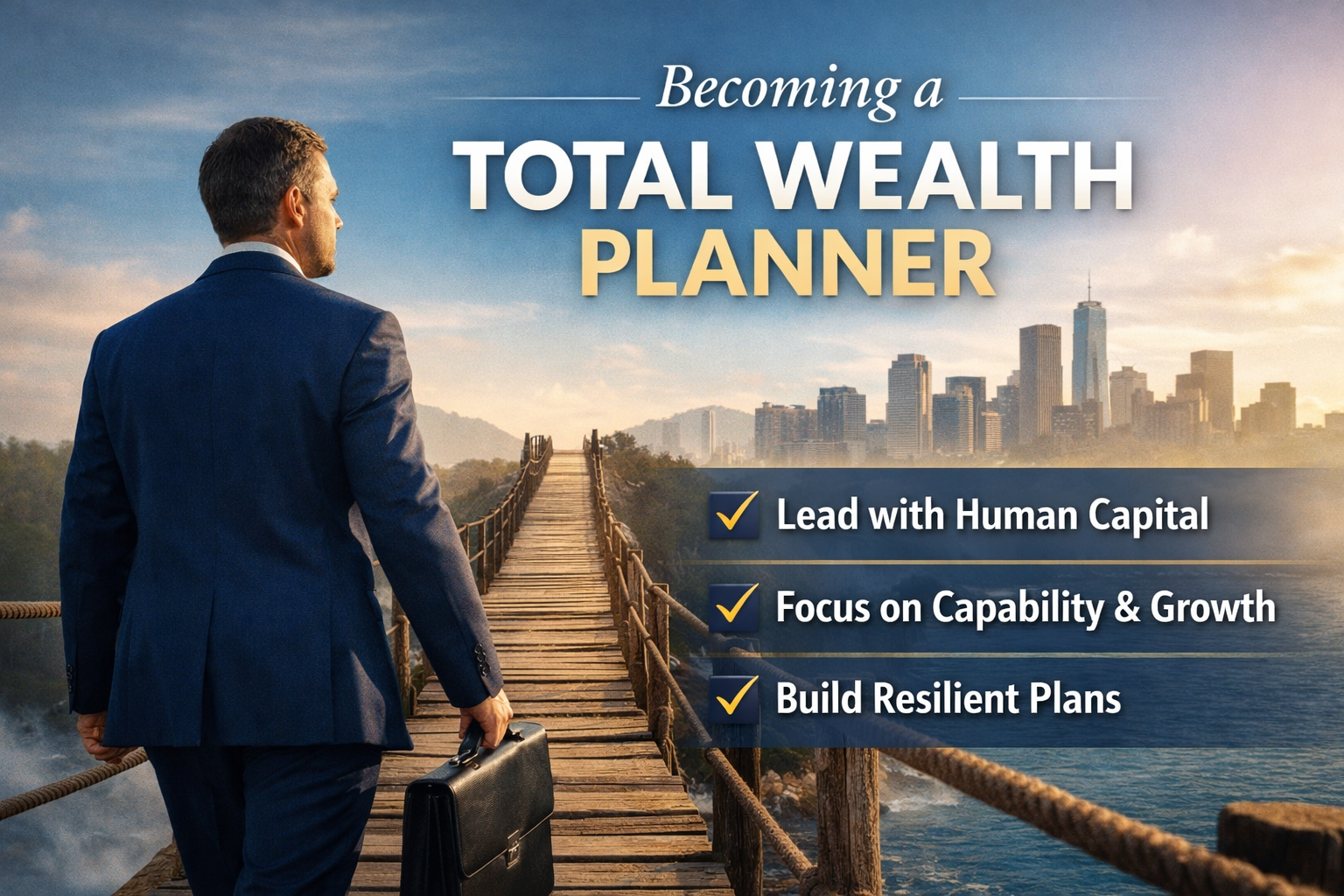
What’s Missing from Financial Planning — and Why Total Wealth Planning Matters Now
Most financial planners don’t wake up one morning and decide that financial planning is broken.
They arrive at a quieter realisation.
The plans are technically correct.
The assumptions are defensible.
The portfolios are optimised.
And yet clients feel more anxious, more fragile, and more uncertain than ever.
If you’re approaching what we call the bridge — the point where you sense that financial planning alone no longer explains real life outcomes — you’re not imagining it.
The data backs you up.
The Structural Blind Spot in Financial Planning
Conventional financial planning is almost entirely oriented around financial capital:
- assets,
- accumulation,
- drawdown,
- risk efficiency.
That answers an important question:
“How should the money behave?”
But it consistently avoids a more fundamental one:
“What produces, sustains, and regenerates the money across a lifetime?”
The academic literature is clear: that engine is human capital.
The report defines human capital as the combined value of an individual’s knowledge, skills, health, creativity, adaptability, and productive capacity — not merely education or income.
[See, European Journal of Social Impact and Circular Economy – ISSN: 2704-9906 DOI: 10.13135/2704-9906/4562 Published by University of Turin http://www.ojs.unito.it/index.php/ejsice/index EJSICE content is licensed under a Creative Commons Attribution 4.0 International License 38 The impact of stimulating the development of Human Capital on Economic Development.]
In other words, the person is the asset.
Yet in most financial plans, that asset is assumed, not analysed.
What the Evidence Actually Shows
The report’s findings are unambiguous:
- Human capital is the dominant driver of long-term economic outcomes, accounting for roughly 64% of growth, compared to far smaller contributions from financial or physical capital.
- Countries — and individuals — with stronger human capital show greater resilience, adaptability, and sustained prosperity, even when financial capital is disrupted.
- The largest obstacles to long-term development are not market volatility, but declining health, skills mismatch, burnout, and loss of productive capacity.
Translated into client reality:
Financial plans fail not because markets move —
but because lives do.
Career disruption.
Health events.
Caring responsibilities.
Mid-life reinvention.
Extended working lives.
These are human capital events, not financial ones.
Why This Gap Matters Now
Financial planning was designed for a world of:
- stable careers,
- predictable retirement ages,
- institutional guarantees,
- linear accumulation.
The report makes clear that this world no longer exists.
Modern economies — and modern lives — are knowledge-driven, volatile, and adaptive. Value is created less by ownership of capital and more by the ongoing capacity of people to create value.
Yet most plans still:
- extrapolate income without testing resilience,
- model retirement without addressing employability,
- price risk without examining human fragility.
This creates a dangerous illusion of certainty.
From Financial Planning to Total Wealth Planning
Total Wealth Planning doesn’t reject financial planning.
It completes it.
It responds directly to what the evidence demands: planning that integrates human capital and financial capital as one system.
In Total Wealth Planning, we explicitly examine:
- the durability of a client’s earning engine,
- exposure to health and capability risks,
- opportunities for skill renewal and reinvention,
- the alignment between life, work, and financial structure.
This mirrors exactly what the research shows drives sustainable outcomes: investment in people first, money second.
Financial capital becomes a tool — not the strategy.
Why Planners Are Crossing the Bridge
Planners who move toward Total Wealth Planning often say the same thing:
“This explains why my ‘best’ plans sometimes still fail.”
They recognise that:
- clients don’t need more optimisation,
- they need more agency, adaptability, and confidence,
- and that these are human capital outcomes, not portfolio ones.
Crucially, planners also experience relief.
Responsibility shifts from predicting outcomes to building capacity — which the evidence shows is where real resilience lives.
Experience It Before You Decide
You don’t cross this bridge by adopting new language.
You cross it by experiencing the Total Wealth Plan yourself.
That’s why the Academy of Life Planning invites financial planners to start with a free Total Wealth Plan experience — not as training, but as evidence in practice.
No selling.
No commitment.
Just clarity.
👉 Experience the free Total Wealth Plan
And decide, with confidence and evidence, whether this is the future of planning.
 Academy of Life Planning