
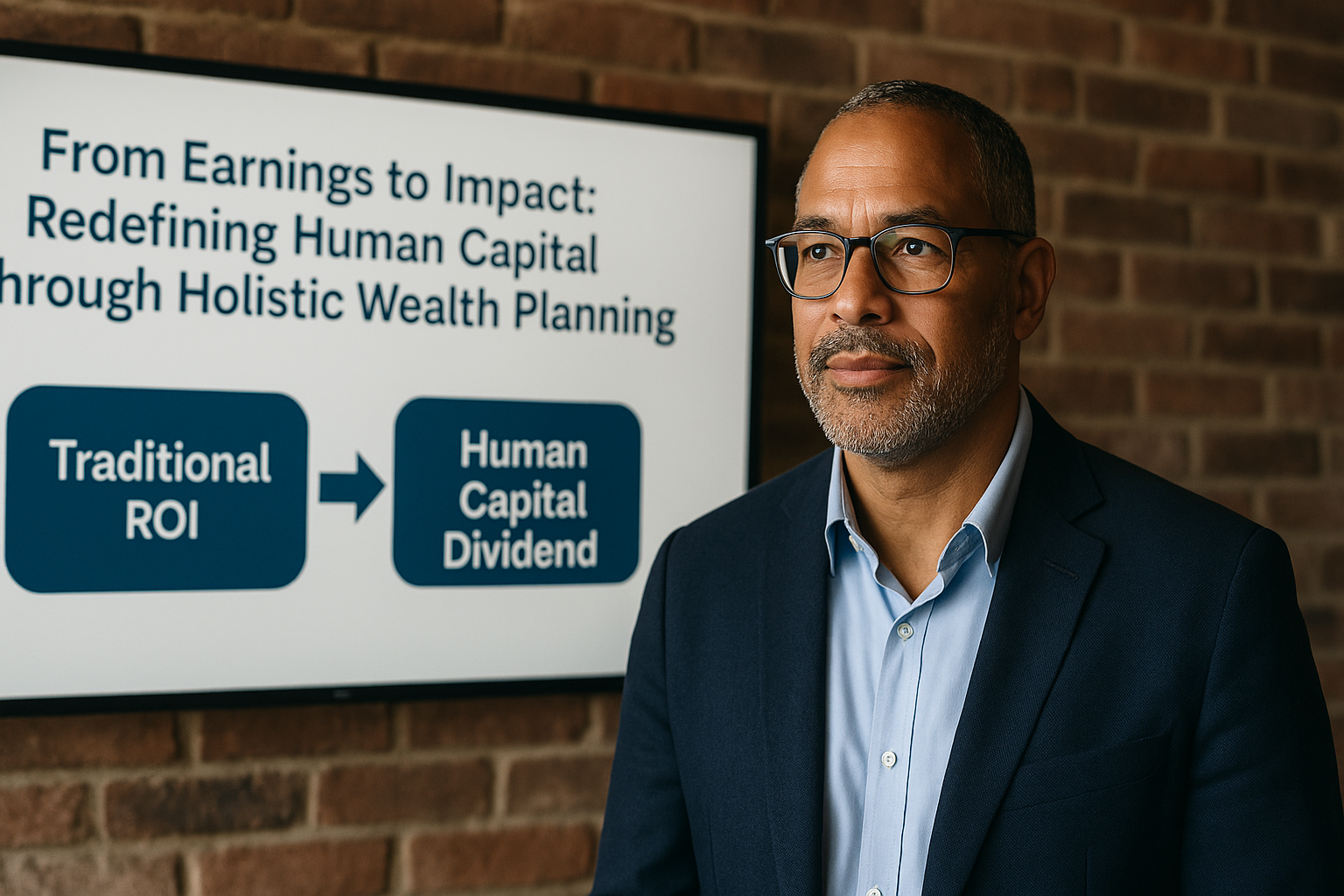
From Earnings to Impact: Redefining Human Capital through Holistic Wealth Planning
By Steve Conley
In the conventional world of financial planning, human capital is often reduced to a mathematical abstraction—the present value of future earnings. This narrow view, rooted in neoclassical economic thought, fails to capture the full spectrum of human potential and the expansive social impact individuals can create over a lifetime. At the Academy of Life Planning, we propose a richer, more human-centred framework—one that reimagines human capital not only as an economic asset, but also as a source of social value, meaning, and care.
Beyond Earnings: The Case for Capabilities
Paula England and Nancy Folbre’s reconceptualisation of human capital offers a powerful theoretical foundation. They introduce the concept of capabilities—a term borrowed from Amartya Sen—to describe the integrated skills, motivation, and health that enable individuals to contribute to the well-being of themselves and others. Capabilities go beyond employability. They encompass cognitive function, emotional intelligence, physical health, self-regulation, and, crucially, the capacity to care.
In this broader framing, human capital is no longer merely instrumental. It is relational, ethical, and socially embedded. The ability to nurture, empathise, educate, or support others—whether through paid or unpaid work—is as vital to societal well-being as technical or financial prowess. Yet traditional economic models often undervalue or entirely overlook these forms of contribution because they occur outside of markets or do not yield immediate pecuniary return.
The Role of the Holistic Wealth Planner
Holistic wealth planners—particularly GAME Plan practitioners at the Academy—are uniquely positioned to integrate this expanded notion of human capital into their practice. Our role is not merely to help clients manage money, but to awaken their potential to contribute meaningfully to others through the wise use of their time, talents, and treasure.
This is where Social Return on Investment (SROI) enters as a vital tool. When used alongside Effective Altruism (EA), SROI enables planners to guide clients in allocating capital—not just for profit, but for maximum positive impact. Whether through philanthropy, volunteerism, or purposeful enterprise, the focus shifts from income maximisation to value creation for humanity.
Capabilities as Social Assets
England and Folbre point out that many of the most important human capabilities—such as caring—generate significant positive externalities. These are public goods whose benefits are diffuse and long-term. Yet, because they are not captured by the market, they are systematically undervalued. As a result, investments in such capabilities—both in ourselves and in others—are often neglected.
Effective altruism provides a bridge here, quantifying the long-term impact of investing in health, education, and well-being. For instance, helping a young person develop cognitive and emotional capabilities creates not just a higher-earning individual, but a future mentor, citizen, caregiver, and innovator. These outcomes are harder to measure but no less real.
As holistic wealth planners, we can help clients see these investments not as charitable acts detached from financial strategy, but as part of a broader portfolio of social impact—one that aligns purpose with capital and integrates self-actualisation with self-transcendence.
Redefining Return: Introducing the Human Capital Dividend
To move forward, we must redefine what we mean by “return.” In the expanded framework, return is not merely financial—it is personal, social, and environmental. We might call this the Human Capital Dividend: the cumulative benefit to society that arises when individuals are empowered to contribute their full selves—not just as workers or consumers, but as carers, mentors, and changemakers.
This approach requires planners to ask different questions:
- What capabilities does the client wish to develop or amplify?
- How can their resources be aligned to support the development of others’ capabilities?
- What impact, beyond financial, do they wish to leave in the world?
From Self-Investment to Collective Empowerment
The traditional language of self-investment—so dominant in financial circles—falls short in the face of these questions. Instead, we must embrace the logic of interdependence: that our human capital is shaped not just by our own choices, but by families, communities, and systems. This insight is foundational for addressing inequality, unlocking potential, and fostering inclusive prosperity.
The GAME Plan supports this evolution by rooting financial planning in a cyclical model of personal development: Goals, Actions, Means, Execution—all oriented toward creating ‘enough’ for the self and surplus for others. By aligning with longtermist thinking and the principles of SROI, we transform financial planning into a catalyst for systemic change.
Conclusion: Wealth That Cares
At the Academy of Life Planning, we believe the future of financial planning lies in recognising human beings not just as earners or investors, but as capability-builders and stewards of social value. By expanding the concept of human capital to include emotional, cognitive, and caring capacities—and by embracing frameworks like SROI and Effective Altruism—we elevate planning from a technical profession to a transformative practice.
In a world hungry for connection, justice, and care, this redefinition is not just necessary—it is revolutionary. Through it, we can help clients not only live well, but leave a legacy of impact that transcends wealth.
💬 Q&A Companion: Redefining Human Capital in Wealth Planning
Q1: What’s the traditional definition of human capital, and why is it limited?
A: Traditionally, human capital is defined as the present value of future earnings. This narrow economic lens overlooks the broader capabilities people possess—such as empathy, care, emotional intelligence, and social contribution—which may not generate direct income but are vital for individual and societal well-being.
Q2: How does the Academy of Life Planning redefine human capital?
A: At AoLP, we expand human capital to include capabilities—skills, health, motivation, self-regulation, and caring. These are not only valuable in the marketplace but also generate positive social impact. Our model emphasises the Human Capital Dividend, where individuals use their resources to uplift others, not just themselves.
Q3: What are capabilities, and how are they different from skills?
A: Capabilities go beyond raw skills—they are the power to act in ways that improve one’s own and others’ well-being. They encompass physical health, cognitive ability, emotional resilience, and the capacity to care. Crucially, they integrate both skill and preference, meaning people tend to enjoy what they’re good at, and vice versa.
Q4: What is the Human Capital Dividend?
A: The Human Capital Dividend refers to the social return created when an individual’s capabilities are used not just for personal gain but to benefit others. This could mean mentoring, caregiving, educating, or leading with empathy. Unlike traditional ROI, which focuses on monetary return, the Human Capital Dividend recognises relational and communal impact.
Q5: How do Social Return on Investment (SROI) and Effective Altruism (EA) fit in?
A: SROI measures the broader value of investments—economic, social, and environmental. Effective Altruism guides decision-making to ensure resources are used where they have the most impact. Together, they empower holistic wealth planners to help clients align financial strategies with altruistic goals, creating not just profit, but purpose.
Q6: Why is caring considered a capability?
A: Caring involves physical, cognitive, and emotional dimensions. It’s a skill, a disposition, and a vital contribution to social life. Yet it’s often unpaid or underpaid, undervalued in traditional economics. Recognising it as a core capability challenges the status quo and underscores its essential role in societal well-being.
Q7: How should holistic wealth planners guide clients under this model?
A: Practitioners should:
- Identify clients’ non-monetary capabilities.
- Align financial assets with life goals and social impact.
- Support clients in developing or funding the development of others’ capabilities.
- Use SROI metrics to help clients evaluate philanthropic and investment decisions.
Q8: What are the practical implications for planning?
A: This model shifts focus:
- From maximising wealth to optimising impact.
- From individual success to shared prosperity.
- From short-term income to long-term legacy.
Clients don’t just plan for retirement—they plan to regenerate, mentor, contribute, and transcend.
Your Money or Your Life
Unmask the highway robbers – Enjoy wealth in every area of your life!

By Steve Conley. Available on Amazon. Visit www.steve.conley.co.uk to find out more.
 Academy of Life Planning