
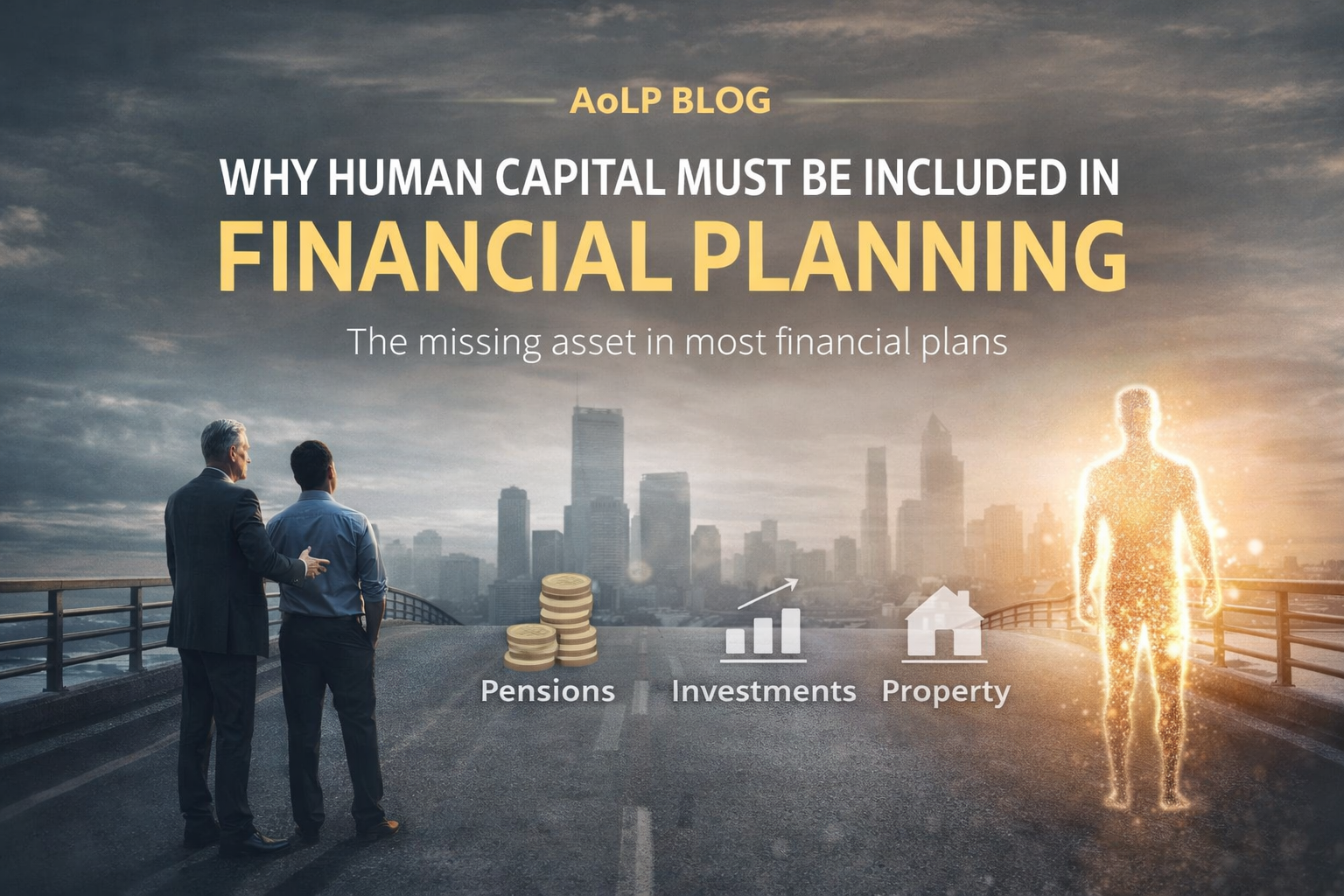
The missing asset in most financial plans
For decades, financial planning has revolved around a familiar set of assets:
- pensions
- investment portfolios
- property
- insurance products
Yet there is one asset that is almost always absent from financial plans.
And ironically, it is usually the largest asset a client possesses.
Human capital.
As artificial intelligence begins restoring agency to individuals and challenging traditional advice models, the profession is being forced to reconsider a fundamental question:
What exactly are we planning?
Money — or life?
The Economic Foundation: Human Capital
The concept of human capital emerged from economic research examining why economic growth could not be explained by physical capital alone.
Economists found that increases in machinery, factories, and infrastructure explained only a portion of economic growth. A large residual remained unexplained.
[Source: The Theory of Human Capital Formation: Implications for Developing Countries, By Joseph Ngu.]
That unexplained growth was eventually attributed to something else:
- improved skills
- education
- knowledge
- training
- mobility of workers
- health and productivity
In other words:
the quality of people themselves.
Economists such as Theodore Schultz argued that these factors should be treated as capital investments, because they require present sacrifices but generate future returns.
Human capital therefore includes investments such as:
- education
- skills development
- health
- experience
- training
- migration for opportunity
- knowledge acquisition
These investments improve productivity and generate future income streams, just like financial capital.
Yet most financial plans ignore them completely.
The Invisible Asset in Financial Planning
Consider a typical client in their 30s or 40s.
Their balance sheet might look something like this:
| Asset | Value |
|---|---|
| Pension | £120,000 |
| ISA | £35,000 |
| Property equity | £90,000 |
Total financial assets: £245,000
But if that same person earns £80,000 per year and has 25 years of productive work ahead of them, their human capital value may exceed £2 million.
And yet:
- it rarely appears in planning software
- it rarely appears in advice reports
- it rarely shapes investment strategy
The profession focuses on the smallest asset first.
The Core Insight of Human Capital Theory
Human capital theory reframed education, skills, and training as economic investments that produce returns over time.
These returns can appear as:
- higher earnings
- career mobility
- productivity gains
- innovation
- entrepreneurial opportunity
In economic terms:
Human capital is embodied in the individual and generates future services and income.
This perspective fundamentally changes how planning should work.
Instead of starting with:
“How should we invest your money?”
The better question becomes:
“How should we invest in you?”
The Bridge Financial Planners Must Cross
The traditional advice model evolved in an era where planners primarily managed financial capital accumulation.
The structure looked like this:
Product Provider → Adviser → Client
But the Age of AI is changing the balance of capability.
Clients now have tools that allow them to:
- model financial scenarios
- analyse tax strategies
- simulate retirement outcomes
- evaluate investment options
This means the planner’s value cannot remain centred on product selection or portfolio mechanics.
Instead, planners must move upstream into something far more valuable:
human capital architecture.
What Human Capital Planning Actually Looks Like
Including human capital in planning means addressing questions such as:
Career strategy
- Is the client in the right industry for the next 20 years?
- What income growth trajectory is realistic?
Skills investment
- Which capabilities increase lifetime earnings?
- Should the client invest in education or retraining?
Entrepreneurial potential
- Could a business generate greater returns than portfolio growth?
Health and longevity
- What investments preserve productivity and well-being?
Life direction
- What kind of work actually aligns with the client’s values and goals?
These questions determine the trajectory of lifetime wealth far more than portfolio optimisation.
Why Traditional Planning Missed This
The financial advice profession emerged largely within an intermediation model.
Revenue depended on:
- product distribution
- assets under management
- portfolio implementation
So the system naturally focused on financial capital flows rather than human capability.
But if the objective of planning is genuinely to help clients build meaningful wealth, then ignoring human capital is a serious omission.
The Future: Total Wealth Planning
At the Academy of Life Planning, we teach planners to treat human capital as the starting point of planning.
Our framework is simple:
Life first.
Money second.
The process begins with four stages:
- Goals – What life is the client trying to create?
- Actions – What choices move them toward it?
- Means – What resources support those choices?
- Execution – How is the plan implemented?
Only in the third stage do financial assets enter the picture.
Because money is not the engine of wealth.
People are.
The Opportunity for Financial Planners
The profession now stands at a bridge.
On one side lies the traditional model:
- portfolio management
- product distribution
- financial capital optimisation
On the other side lies the future profession:
- human capital strategy
- life architecture
- decision coaching
- AI-enabled planning
The planners who cross that bridge will not be replaced by technology.
They will become more valuable than ever.
A New Role for the Planner
The planner of the future is not primarily a product expert.
They are something more powerful:
a life architect.
Someone who helps clients design:
- meaningful work
- sustainable income
- purposeful living
- financial resilience
Human capital is not a soft concept.
It is the largest asset most clients will ever possess.
And it is time the profession started planning for it.
For further details, visit the Academy of Life Planning.
 Academy of Life Planning