
Most planning frameworks attempt to organise life.
The GAME Plan is designed to ground it.
There is a difference.
Traditional planning asks:
- What do you want?
- How much do you need?
- When do you want to retire?
The GAME Plan asks something far more fundamental:
- From what centre do you act?
- Who are you beneath your circumstances?
- On what foundation does your life stand?
To understand why this matters, we need to revisit an ancient philosophical idea: causa sui.
Causa Sui: The Self-Grounding Principle
In classical philosophy, causa sui means “that which is the cause of itself.”
In Baruch Spinoza, it referred to ultimate substance — self-grounding reality. Something that exists not because something else made it exist, but because its very essence involves existence.
Spinoza applied this to God or Nature — the foundational reality that depends on nothing outside itself.
It is an idea of metaphysical sovereignty.
Nothing external explains it.
Nothing external sustains it.
Nothing external validates it.
It simply is.
Humans are not metaphysically causa sui in that strict sense. We are born into conditions. We are shaped by culture, family, history, trauma, opportunity.
But psychologically, something extraordinary can happen.
We can become self-authored.
From Metaphysics to Psychology: The Self-Creating Project
In the twentieth century, thinkers such as Ernest Becker reframed causa sui in existential terms.
For Becker, human beings construct what he called a “causa-sui project” — a self-creating project that gives meaning, coherence, and justification to their existence.
It is the internal meaning structure through which a person answers:
- Why do I matter?
- What is my life for?
- What continues after I am gone?
This is not abstract philosophy. It is psychological survival.
Without a coherent self-creating project, individuals drift. They become reactive. They seek validation from external systems — institutions, employers, markets, political tribes, or financial status.
They become authored by circumstances rather than authors of their own lives.
This is the silent crisis of modern society.
And it is precisely the problem the GAME Plan addresses.
The GAME Plan Is Not Goal-Setting
Let us be clear.
The GAME Plan is not:
- A productivity system
- A financial forecasting tool
- A retirement planning process
- A motivational worksheet
It begins at a far deeper level.
It begins with identity.
Step One: Who Am I?
The personal values assessment is not a soft exercise.
It is ontological grounding.
Values define the axis around which your decisions rotate. Without clarified values, goals become arbitrary and money becomes the default compass.
This stage stabilises the centre.
It answers: From what moral and existential foundation do I stand?
Step Two: What Are My Talents?
Talents are not hobbies.
They are latent capacities for contribution.
When examined properly, they reveal a person’s natural architecture — the ways in which they generate energy rather than drain it.
This is not ego-building.
It is structural alignment.
When you understand your talents, you stop imitating other people’s trajectories. You begin designing life in accordance with your internal wiring.
Step Three: Why Am I Here?
Here the GAME Plan becomes radical.
On the premise that our purpose is to use our talents to help others — in alignment with what many would call divine will — we articulate life direction.
Not ambition.
Not status.
Not comparison.
But service-based expression of capability.
This integrates:
- Divine wisdom — know thyself
- Divine will — use your gifts in service
- Divine inspiration — set goals aligned with spirit
At this stage, the individual moves from survival to vocation.
From reaction to direction.
From drift to design.
Operationalising Causa Sui
The GAME Plan is neither purely theological nor purely existential.
It does something more practical.
It operationalises causa sui.
It does not claim humans are metaphysically self-caused.
It provides a structure through which humans become psychologically self-authored.
That is a profound distinction.
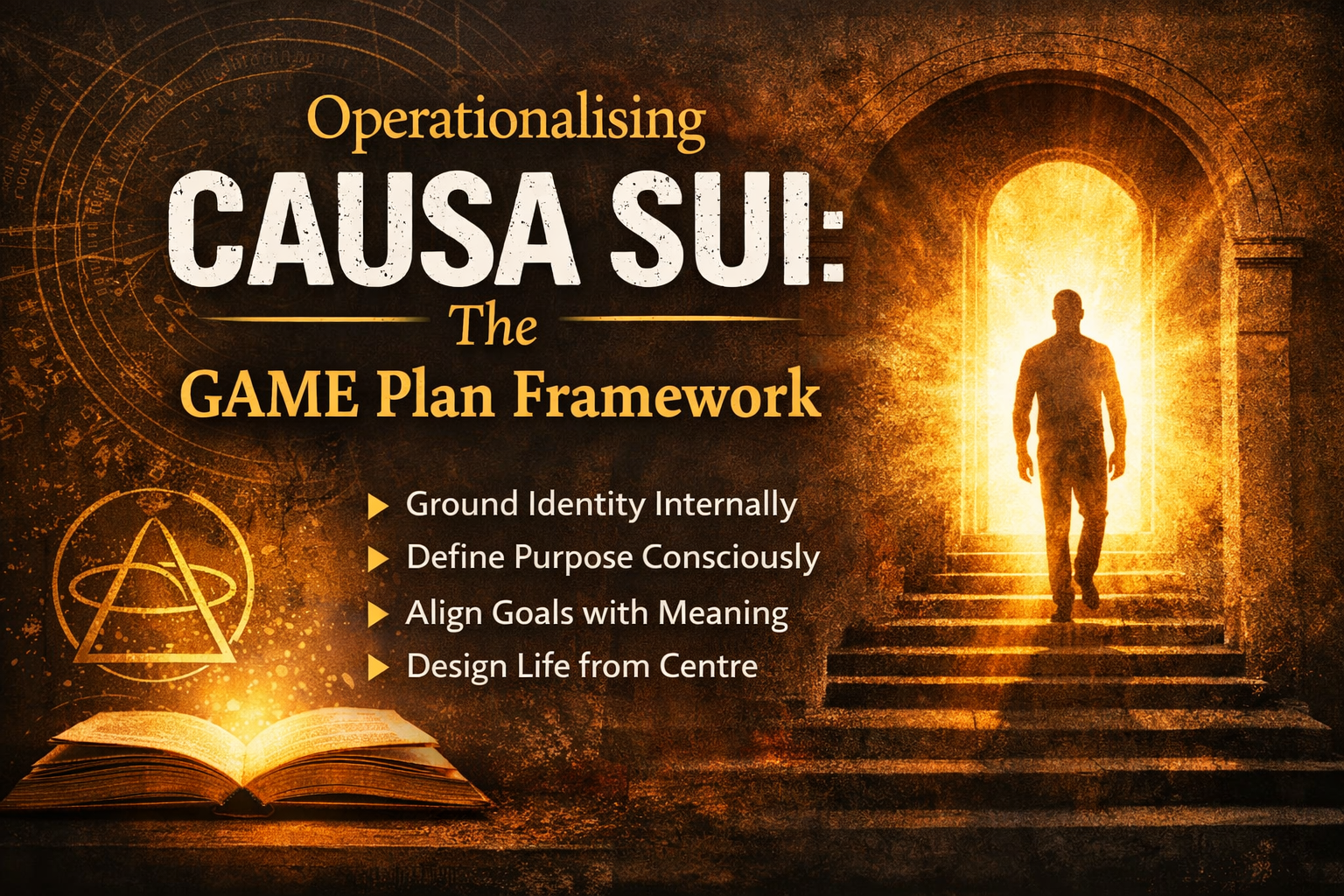
The framework enables individuals to:
- Ground identity internally rather than socially
- Define purpose consciously rather than absorb it passively
- Set goals aligned with meaning rather than impulse
- Design financial architecture in service of life, not the other way round
This is self-grounding reality in action.
Why This Matters More Than Ever
Most financial planning systems begin with money.
But money is not foundational.
Money is a tool.
When planning begins with financial capital and ignores human capital, identity, and purpose, it builds structure without grounding.
The result is:
- High earners without meaning
- Retirees without direction
- Entrepreneurs without alignment
- Professionals with burnout
- Individuals defined by external metrics
The GAME Plan reverses the order.
It begins with grounding.
It builds purpose.
It channels talent.
It then structures means.
It finally executes.
Goals → Actions → Means → Execution.
Identity precedes strategy.
Being precedes doing.
Purpose precedes profit.
The Sovereignty Framework
When properly understood, the GAME Plan is a sovereignty framework.
It protects against:
- Institutional overreach
- Market-driven identity
- Status-based self-worth
- Trauma-reactive life choices
- Financial dependency on opaque systems
Because when identity is grounded internally, systems cannot define you.
When purpose is clarified, distraction loses power.
When goals are spirit-aligned, discipline becomes natural.
This is not self-help.
It is structural coherence.
Living in Self-Grounding Reality
Self-grounding reality does not mean isolation.
It means acting from centre.
It means your decisions are anchored in values, talents, and service rather than fear, comparison, or extraction.
It means financial planning becomes an expression of vocation, not an escape from work.
It means retirement is not withdrawal, but transition.
It means wealth is defined across:
- Financial capital
- Human capital
- Relational capital
- Intellectual capital
- Spiritual capital
This is living life itself, not merely organising it.
The Deeper Implication
The GAME Plan is not just a life planning framework.
It is a disciplined path to self-authorship.
It is a structured method for constructing a coherent causa-sui project — a life that justifies itself through alignment of identity, contribution, and execution.
In a world that fragments attention and outsources meaning, that is revolutionary.
Because a self-authored individual cannot be easily manipulated.
A grounded individual cannot be easily destabilised.
A purpose-aligned individual cannot be easily bought.
And a life built from centre does not collapse when external conditions shift.
The GAME Plan is not about planning money.
It is about planning from essence.
It is not about forecasting retirement.
It is about constructing a life that is internally coherent, externally contributive, and spiritually aligned.
It is not about optimisation.
It is about grounding.
That is why it endures.
And that is why it matters.
About the Author
Steve Conley is the author of Your Money or Your Life: Unmask the Highway Robbers – Enjoy wealth in every area of your life.
The book challenges extractive financial systems and exposes how individuals are often separated from their own agency through opaque structures, conflicted incentives, and institutionalised dependency.
Its central thesis is simple but disruptive:
Wealth is not merely financial accumulation.
It is sovereignty across every domain of life.
That idea did not end with the book.
It evolved.
The GAME Plan builds on that foundation by providing a structured pathway to reclaim authorship — not only over money, but over meaning, contribution, and direction.
Where Your Money or Your Life exposed the highway robbers,
the GAME Plan equips individuals to build roads of their own.
 Academy of Life Planning