
A survival guide for citizen advocates who can’t switch their minds off
If you’re reading this at night, wide awake, replaying exchanges with regulators, professionals, or officials who seem calm while people are being harmed — you’re not alone.
Many citizen advocates, Transparency Task Force members, and victim supporters describe the same experience:
“I can’t understand how they can say that.”
“Why doesn’t this land?”
“How can they be so detached?”
This article is for you.
Not to harden you.
But to help you understand what’s happening — and how to cope without burning out.
The pattern you’re seeing is real
Across institutions like the Financial Conduct Authority, Financial Ombudsman Service, HM Treasury, HMRC, Parliament, the Serious Fraud Office, the Courts, Judiciary, Information Commissioner’s Office, Solicitors Regulation Authority, Prudential Regulation Authority, and even the Police — many advocates encounter the same response style:
- calm
- procedural
- technically correct
- emotionally detached
- dismissive of lived consequence
This is not coincidence.
It is systemic self-protection.
The hardest truth to accept (but the most freeing)
Most “system defenders” are not consciously cruel.
They are not waking up thinking:
“How can I harm people today?”
What they are doing — often unconsciously — is protecting identity, coherence, and legitimacy.
When you raise lived harm, the system hears:
- “This framework failed.”
- “This harm was preventable.”
- “Your rules are not enough.”
For people whose identity, career, or moral self-image is tied to the system, that feels existential.
So the response is not empathy.
It is defence.
Why it feels like “rational debate” — but isn’t
System defenders retreat to:
- formal boundaries (“out of scope”)
- procedural availability (“you can still go to court”)
- abstract responsibility (“personal accountability”)
- inevitability (“there will always be limits”)
This feels rational to them.
But notice what disappears:
- power asymmetry
- access to justice
- health impact
- time, money, stamina
- human survivability
This is not a debate about facts.
It is a conflict between two ethical lenses:
- Structure-first ethics: protect the system, accept casualties
- Consequence-first ethics: protect people, fix the structure
These lenses do not reconcile in comment threads.
The archetypes you’re encountering (name them, don’t fight them)
Recognising these patterns helps your nervous system stand down.
1. The Proceduralist
“If the process exists, the problem is solved.”
Blind spot: access ≠ availability.
2. The Responsibility Shifter
“People must take personal accountability.”
Blind spot: accountability without power is moralising.
3. The Scarcity Normaliser
“There will always be limits.”
Blind spot: limits are not neutral when harm is predictable.
4. The Status Signaller
“This is how grown-ups understand the system.”
Blind spot: legitimacy ≠ justice.
Once you see the archetype, stop trying to educate it.
Why this keeps you awake at night
You are not “too sensitive”.
You are experiencing moral injury.
You carry:
- names, not numbers
- stories, not statistics
- outcomes, not hypotheticals
When harm is minimised, your body reacts as if people are being erased — again.
That vigilance once kept others safe.
But it does not need to run all night.
Get SAFE guidance: how helpers protect themselves
This is the part no institution teaches you.
1. Stop debating inside your head
Re-arguing at night does not help victims.
It exhausts advocates.
Replace the loop with one sentence:
“I’ve already named the truth.”
2. Externalise before sleep
Write, by hand:
- what triggered you
- what value was threatened
- what you already did to help
Then close the book.
Your nervous system needs completion, not perfection.
3. Contain exposure
You do not owe your attention to every defence of a broken structure.
Muting, ignoring, or disengaging is not cowardice.
It is ethical energy management.
4. Remember your real audience
You are not speaking to system defenders.
You are speaking to:
- silent readers
- future complainants
- frightened victims
- other exhausted advocates
They are listening — even when the system isn’t.
5. Rest is not retreat
Staying awake does not protect people.
Burnout helps no one.
The most radical act for a helper is sometimes to sleep.
A message from Get SAFE to helpers
If you are struggling to understand how others can be so detached — it’s because you are still connected to consequence.
That is not naïveté.
That is humanity.
You are not here to make the system comfortable.
You are here to make harm visible.
And you are allowed to protect yourself while doing it.
Final words (read slowly)
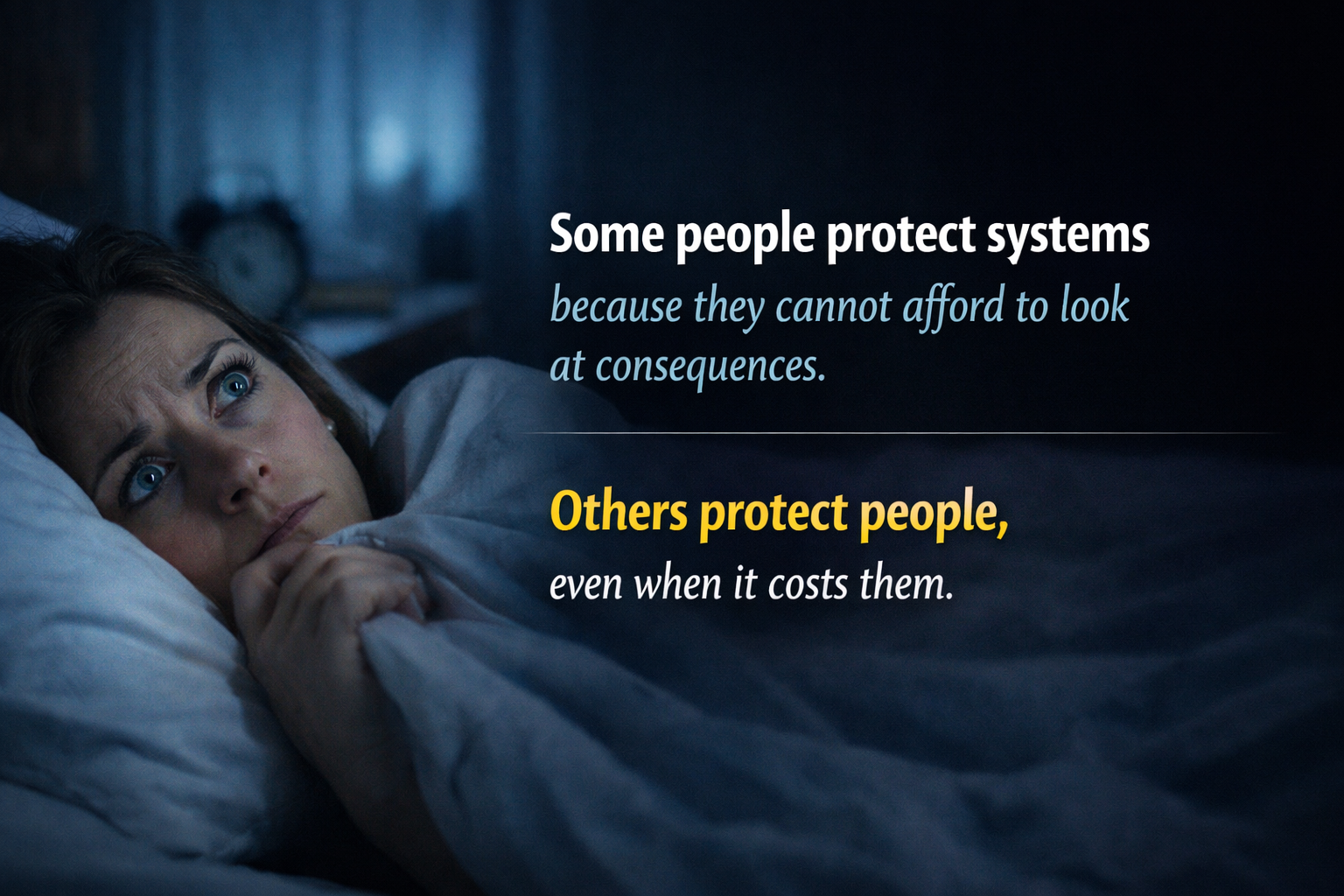
Some people protect systems because they cannot afford to look at consequences.
Others protect people, even when it costs them.
If this article helped you feel less alone, it has done its job.
Get SAFE — Support After Financial Exploitation
Helping helpers stay safe, steady, and human.
We’re creating a national lifeline for victims — offering free emotional recovery, life-planning, and justice support through our Fellowship, Witnessing Service, and Citizen Investigator training.
We’re now raising £20,000 to:
Register Get SAFE as a Charity (CIO)
Build our website, CRM, and outreach platform
Fund our first year of free support and recovery programmes
Every £50 donation provides a bursary for one survivor — giving access to the tools, training, and community needed to rebuild life and pursue justice with confidence.
Your contribution doesn’t just fund a project — it fuels a movement.
Support the Crowdfunder today and help us rebuild lives and restore justice.
Join us at: https://www.get-safe.org.uk/

 Academy of Life Planning