
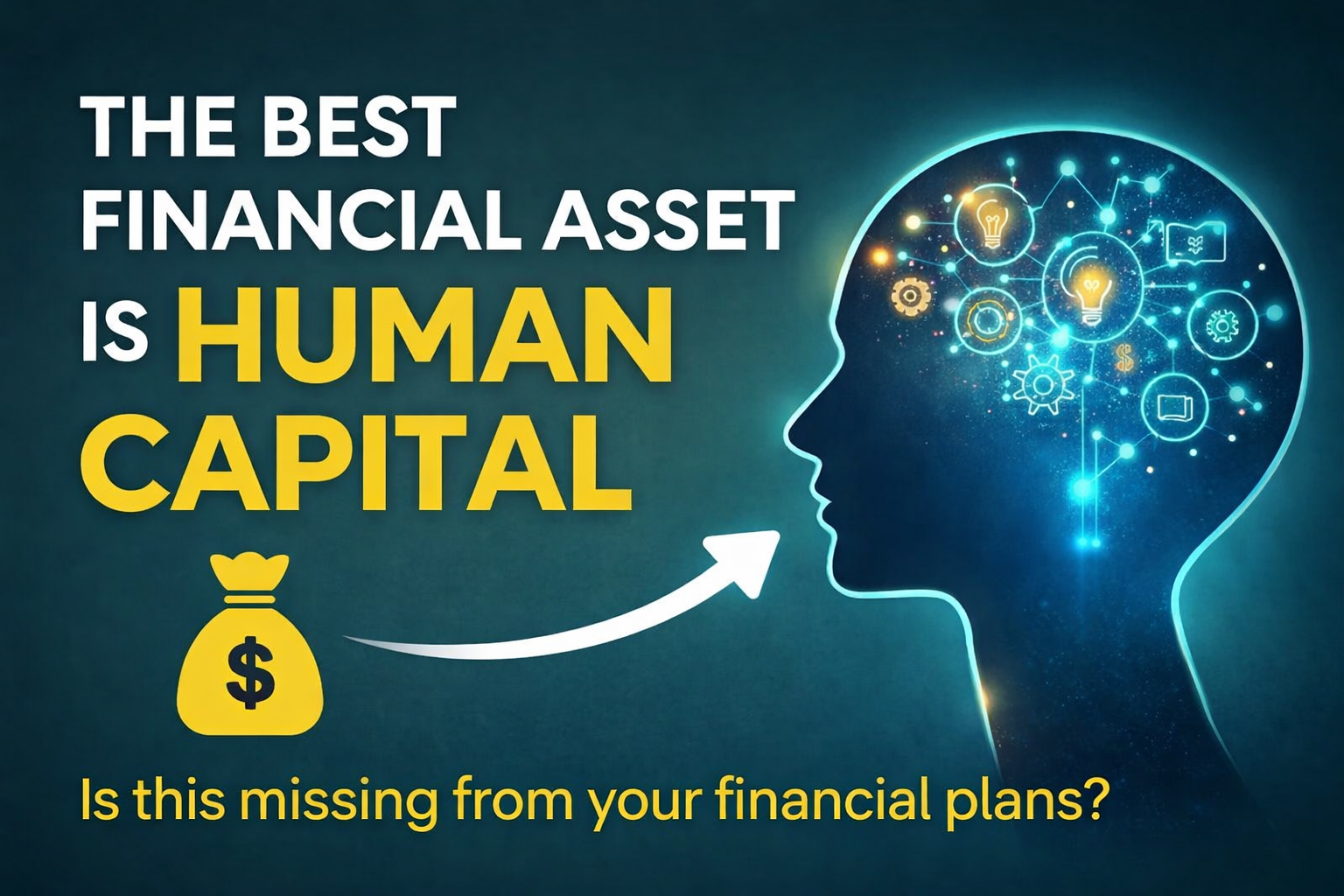
Most financial planners are trained to think in terms of financial capital:
- portfolios
- contribution rates
- withdrawal sustainability
- asset allocation
But as many planners approach the bridge—that moment where traditional advice starts to feel incomplete—one question keeps resurfacing:
Why do our models ignore the single biggest driver of long-term financial outcomes?
Human capital.
A major cross-country study analysing data from 89 countries provides strong empirical evidence that human capital is not just morally important or philosophically appealing—it is statistically decisive in shaping real-world financial outcomes.
[See: THE EFFECT OF HUMAN CAPITAL ON INCOME EQUALITY: CROSS-SECTIONAL ANALYSIS]
And the implications for financial planning are profound.
What the Study Actually Shows (In Plain English)
The study examined the relationship between:
- Human capital (measured by tertiary education participation)
- Income equality (measured as the income share of the lowest 10% relative to the highest 10%)
After controlling for GDP, trade openness, technology investment, and unemployment, the results were unambiguous:
Higher human capital leads to higher income equality.
Quantitatively:
- A 1% increase in higher education participation was associated with a 0.027% increase in income equality
- This effect remained statistically significant across all models
This isn’t correlation dressed up as causation. It’s robust, controlled, and consistent across economies at different stages of development.
Why This Matters to Financial Planners (Not Economists)
Most planners don’t advise countries.
They advise people.
And the same mechanism applies.
When we fail to model:
- skills
- adaptability
- health
- learning capacity
- career optionality
we systematically underestimate resilience and overestimate financial fragility.
Traditional cashflow tools implicitly assume:
- income is static
- careers are linear
- adaptability is irrelevant
- human agency stops at retirement
The study demonstrates that these assumptions are not just incomplete — they are wrong at scale.
The Bridge Moment: From Portfolio Manager to Capability Architect
Planners approaching Total Wealth Planning often describe a moment of discomfort:
“I’m modelling money flows, but I’m ignoring the person.”
This study validates that instinct.
It shows that:
- Human capital accumulation reduces inequality
- Reduced inequality improves long-term stability
- Stability improves financial outcomes even before capital markets are considered
In other words:
Human capital is not an input to be “assumed away”.
It is the engine that makes financial capital behave.
Why AI Has Made This Impossible to Ignore
Until recently, human capital was hard to model.
Now it isn’t.
AI-enabled planning frameworks, such as the Academy’s Total Wealth Plan, can:
- map skills and income pathways
- model learning return on investment
- simulate career transitions
- integrate health, energy, and time into forecasts
- stress-test plans against adaptability, not just volatility
This is why Total Wealth Planning isn’t a philosophical upgrade.
It’s a technological inevitability.
The study gives you the evidence.
AI gives you the tools.
The bridge gives you the choice.
A Quiet Warning for the Traditional Advice Model
There’s a subtle but important implication in the data.
The study shows that:
- income equality initially falls as economies grow
- then rises again once human capital deepens
Translated into planning terms:
Money-first planning amplifies inequality.
Capability-first planning reverses it.
This explains why:
- threshold creep excludes more clients
- suitability rules become more brittle
- advice feels less human, not more precise
Human capital isn’t a “nice to have”.
It’s the stabiliser that the advice system quietly removed.
The Invitation: Experience This for Yourself
If you’re approaching the bridge and asking:
- What’s missing from my planning?
- Why does this feel incomplete?
- What comes after product-led advice?
Don’t take this on faith.
Experience it directly.
👉 Try the Total Wealth Plan for free
See how human capital changes:
- forecasts
- conversations
- confidence
- client outcomes
No commitment. No sales pressure. Just clarity.
Final Thought
The study concludes with a simple policy recommendation:
Invest in human capital.
For financial planners, the translation is equally simple:
If you don’t model human capital, you are planning with one eye closed.
The bridge isn’t about leaving financial planning behind.
It’s about finishing it.
 Academy of Life Planning