
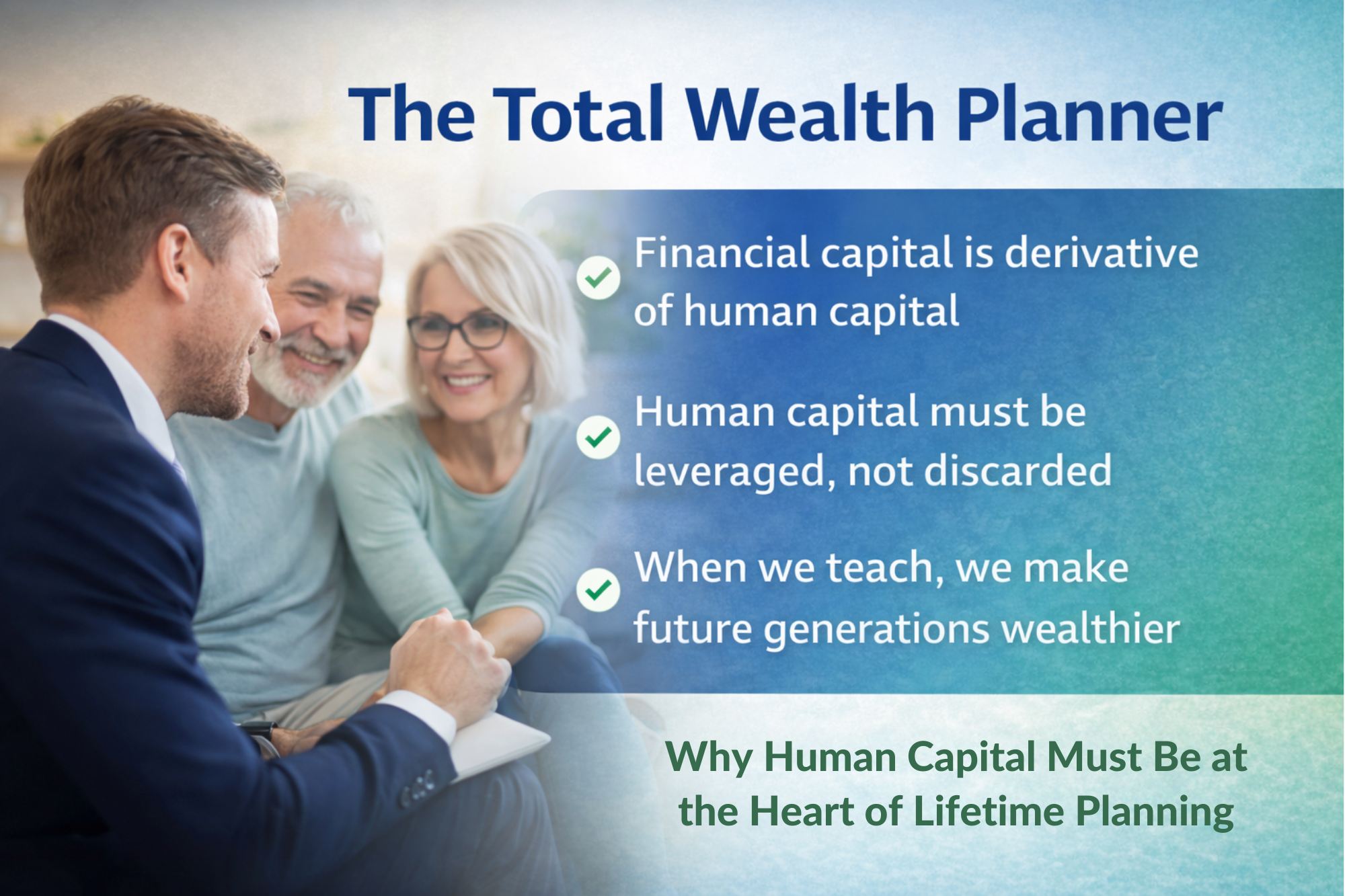
Why the future of financial planning is not about better portfolios — but better humans.
For decades, financial advice has been built on a narrow idea of “wealth”:
money first, life second, people last.
But a growing body of serious economic research is now saying what many progressive advisers already feel in practice:
Money doesn’t create life outcomes.
Life capabilities create money outcomes.
One of the clearest academic expressions of this shift comes from Lucia Rizzica’s doctoral research at UCL on human capital accumulation — how skills, motivation, aspirations, family context, and access to opportunity interact to shape long-term prosperity.
While her work focuses on education policy, the implications for financial advisers are profound — especially those standing at the bridge between traditional product-led advice and the emerging Total Wealth Planner model.
“The evidence shows that motivation and aspirations materially change life outcomes — even when financial resources stay the same. That makes them economic assets, not soft extras.”
Here are the key lessons.
Lesson 1: Aspirations Are a Real Economic Asset (Not a Soft Add-On)
Rizzica’s research shows that non-cognitive traits — especially aspirations, motivation, and self-belief — materially affect life outcomes.
Raising aspirations:
- Increased how long young people stayed in education
- Increased skill accumulation
- Changed life trajectories
Even without changing their financial resources. Essays_on_the_economics_of_huma…
Translation for advisers
If your financial planning process:
- Ignores motivation
- Ignores purpose
- Ignores confidence
- Ignores self-belief
…then it is structurally incomplete.
A cashflow model that doesn’t include human drive is not conservative.
It’s blind.
“A cashflow model that ignores human drive isn’t conservative. It’s incomplete.”
Lesson 2: Technical Accuracy Alone Doesn’t Change Outcomes
The study found something uncomfortable for technocrats:
Even when aspirations were successfully raised, outcomes still failed to improve for people who lacked structural support (access, resources, guidance, belief reinforcement). Essays_on_the_economics_of_huma…
In other words:
Information alone does not equal transformation.
Translation for advisers
This maps directly onto what many advisers see in real life:
- Clients who know what to do
- Clients who understand the maths
- Clients who agree with the plan
…yet still fail to follow through.
Why?
Because:
- Self-control is a trainable wealth asset
- Confidence is an economic variable
- Meaning is a behavioural driver
- Agency is a financial multiplier
A Total Wealth Planner doesn’t just model money.
They build the human muscle required to carry the plan.
“Information alone doesn’t change behaviour. Human capability does. That’s why technically perfect plans still fail in real life.”
Lesson 3: Poverty Is Often a Capability Trap, Not Just a Cash Trap
One of the study’s most important findings:
Raising aspirations worked only for people who weren’t constrained by deeper structural limits (credit access, family background, social friction). Essays_on_the_economics_of_huma…
This means:
- You can’t motivational-quote your way out of inequality
- You can’t spreadsheet your way out of life constraints
- You can’t invest your way out of a broken capability system
Translation for advisers
This is where traditional advice quietly fails people.
It assumes:
- Rational behaviour
- Stable psychology
- Frictionless environments
- Linear execution
Real life doesn’t work like that.
Total Wealth Planning treats:
- Human capital
- Social capital
- Psychological capital
- Environmental capital
…as first-class assets, not lifestyle extras.
“Self-control isn’t a personality trait. It’s a trainable wealth asset — and every financial plan silently depends on it.”
Lesson 4: Ability Is a Composite System, Not a Talent Score
Rizzica models “ability” as a blend of:
- Cognitive skills
- Non-cognitive skills (motivation, resilience, aspirations)
- Family and social environment
These factors interact.
They compound.
They amplify each other. Essays_on_the_economics_of_huma…
Translation for advisers
This is a direct rebuttal of the “rational client” myth.
It tells us:
- You can’t separate money from identity
- You can’t separate goals from psychology
- You can’t separate discipline from context
- You can’t separate skills from meaning
A Total Wealth Planner doesn’t ask:
“What product fits this client?”
They ask:
“What human system needs strengthening here?”
Lesson 5: The Adviser’s Future Role Is Capability Architect, Not Product Intermediary
The study’s biggest meta-lesson is this:
Sustainable wealth is generated by life capabilities, not financial instruments.
Financial capital is downstream of:
- Skills
- Health
- Confidence
- Purpose
- Opportunity access
- Behavioural stability
- Strategic agency
Translation for advisers
This reframes your professional identity:
Old model
→ Product selector
→ Risk allocator
→ Compliance intermediary
New model
→ Human capital developer
→ Life strategy architect
→ Agency amplifier
→ Financial sovereignty guide
That’s not “soft”.
That’s structural.
“Ability isn’t a talent score. It’s a composite system of skills, motivation, environment, and belief — and those inputs compound each other over time.”
What This Means for Advisers Standing at the Bridge
If you feel:
- Technically strong
- Ethically uneasy
- Increasingly disillusioned with AUM pressure
- Drawn toward deeper, more meaningful client work
- Curious about AI-enabled, human-centred planning
…you’re not leaving the profession.
You’re evolving it.
The research is catching up to what progressive advisers already sense:
Total Wealth Planning isn’t a lifestyle add-on.
It’s a correction of a 50-year category error in financial theory.
The Invitation
The Academy of Life Planning exists to support advisers who want to cross this bridge consciously — without burning their past, abandoning their professionalism, or walking away from income.
We train planners to:
- Integrate human capital into financial planning
- Shift from product-led to purpose-led models
- Use AI to democratise planning power
- Build ethical, scalable, client-centred practices
- Become Total Wealth Planners in a structurally untrustworthy world
This isn’t about rejecting technical excellence.
It’s about completing it.
“You can’t spreadsheet your way out of structural life constraints. That’s why product-led advice keeps failing the same people.”
Source:
Rizzica, L. (2013). Essays on the Economics of Human Capital Accumulation, University College London.
 Academy of Life Planning