
Why Millions May Be Exposed to Unchecked Financial Enforcement — and How Citizens Can Test Whether Justice Was Done
When people think about injustice in the courts, they usually imagine dramatic errors: the wrong person convicted, a forged document, a corrupt official.
What rarely gets attention is something quieter — and potentially far larger in impact:
What happens when procedures that are meant to protect citizens are simply… not applied?
Not ignored out of malice.
Not subverted by conspiracy.
But missed, weakened, or treated as optional — thousands of times a year.
From the cases analysed through Get SAFE and the Academy of Life Planning, a troubling pattern is emerging:
In a significant number of financial enforcement and repossession cases, outcomes appear to have been reached without all the required procedural safeguards being tested.
If that pattern holds beyond individual cases, the implications are profound.
Why This Is Potentially a Mass-Scale Problem
Let’s start with numbers — not accusations.
Each year in the UK there are:
- Tens of thousands of mortgage possession claims
- Large volumes of enforcement actions on loans, guarantees, and secured debts
- A growing population of Litigants in Person (LIPs), often facing banks and servicers represented by specialist firms
Now combine that with three observable realities from our case analysis:
- Most defendants do not know what procedure should look like
- Courts are under extreme time and volume pressure
- Judges rely heavily on the evidence and framing put before them
This creates a structural risk:
If claimants present incomplete or weakly evidenced cases — and no one challenges that — outcomes may be legally tidy but procedurally unsafe.
When that happens occasionally, it is an error.
When it happens repeatedly, it becomes a systemic exposure.
What “Proper Judicial Process” Is Actually Meant to Do
Judicial process is not just about whether a contract exists or arrears are shown.
In financial enforcement cases, proper process is meant to ensure that:
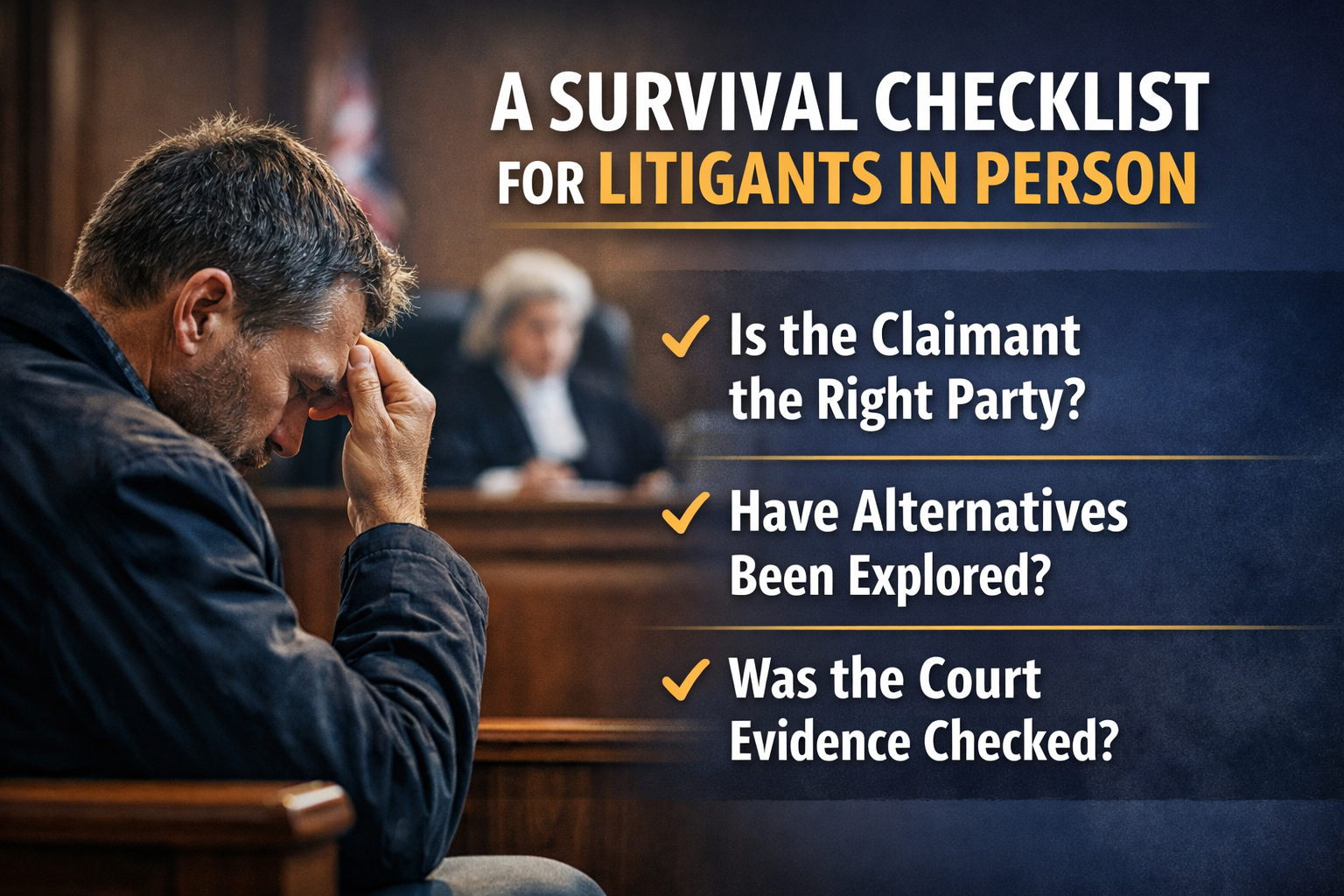
- The right party is bringing the claim
- The claimant can prove their right to enforce, not just assert it
- The correct paperwork exists and is reliable
- Enforcement is proportionate to the breach
- Alternatives have been properly explored where required
- The court acts as a checkpoint, not a rubber stamp
This is especially important in areas regulated by the Financial Conduct Authority, where repossession and enforcement are expected to be last-resort remedies, not default responses.
What We Are Seeing Instead (From Citizen-Led Case Analysis)
Across multiple Get SAFE cases — mortgages, SME loans, personal guarantees, and related enforcement — several recurring issues appear:
1. Enforcement Issued Early and Automatically
Proceedings are often triggered:
- At relatively low arrears levels
- By internal systems rather than human review
- Without clear evidence of meaningful alternatives being explored
This matters because timing is part of proportionality.
2. Weak Scrutiny of “Right to Enforce”
In some cases:
- The claimant’s identity changes over time
- Servicers act “on behalf of” unnamed entities
- Authority to enforce is asserted, not evidenced
Courts can only test what is put before them — and LIPs are rarely told this is something they can challenge.
3. Missing or Reconstructed Paperwork
We repeatedly see situations where:
- Full statements only appear after DSARs
- Key documents are missing, inconsistent, or reconstructed
- The pleaded balance is not transparently derived
Yet enforcement proceeds regardless.
4. Venue Choice That Disadvantages Defendants
Some cases raise legitimate questions about:
- Why a particular court was chosen
- Whether there is a strong geographic connection
- Whether transfer was resisted despite inconvenience to the defendant
This is not about alleging bias.
It is about procedural fairness and equality of arms.
Why This Matters for Citizen Investigators and LIPs
If procedures are not followed, justice can fail silently.
Not because judges are acting improperly — but because:
- They are not given the full picture
- They are under pressure to manage volume
- They assume procedural steps have already been met
That is why citizen-level procedural literacy matters.
Not to attack the courts —
but to help them do their job properly.
What Should Be Happening in a Properly Run Case
At a minimum, a court should be satisfied that:
- The claimant is the correct legal entity
- The claimant can prove entitlement to enforce
- The debt and balance are accurately evidenced
- Any required pre-action steps were genuinely taken
- Enforcement is proportionate and necessary
- The defendant had a fair opportunity to engage and respond
If any of these steps are missing, the process may be incomplete — even if the outcome looks “lawful” on the surface.
The Citizen Investigator & LIP Checklist
(Compare This Against Your Own Experience)
You do not need legal training to use this.
You are simply checking whether the process was complete.
A. Claimant Identity & Standing
- ☐ Do you know exactly who is bringing the claim?
- ☐ Have they proven their right to enforce, not just stated it?
- ☐ Is their role consistent throughout the case?
B. Paperwork & Evidence
- ☐ Were the original contract and security produced?
- ☐ Is the balance clearly explained and traceable?
- ☐ Are there unexplained gaps or inconsistencies?
C. Pre-Action Conduct / Last Resort
- ☐ Were alternatives genuinely explored?
- ☐ Is there written evidence of those discussions?
- ☐ Was vulnerability or hardship considered?
D. Venue & Fairness
- ☐ Is the court location logically connected to you or the property?
- ☐ Were transfer requests considered fairly?
- ☐ Were you given adequate time and explanation?
E. The Hearing Itself
- ☐ Did the judge ask about evidence and alternatives?
- ☐ Were your points acknowledged?
- ☐ Were reasons for the decision clearly explained?
If you answered “no” or “not sure” to several of these, it does not mean you were wrong.
It may mean the process was incomplete.
How to Use This Checklist
A simple guide for Litigants in Person
First, a reassurance:
You are not expected to know the law.
You are not expected to argue like a lawyer.
This checklist is not a test — it is a mirror.
It helps you compare what should happen in a fair court process with what actually happened in your case.
What This Checklist Is — and Is Not
This checklist IS:
- A way to check whether proper procedure was followed
- A tool to help you organise your thoughts
- A prompt to help courts focus on missing steps
- Something you can use at your own pace
This checklist is NOT:
- Legal advice
- A criticism of judges
- Proof that you were “wrong” or “at fault”
- A requirement to challenge everything at once
How to Use It Safely and Calmly
1. Do not rush
You do not need to complete this in one sitting.
If you feel overwhelmed:
- Take one section at a time
- Stop when your body tells you to stop
- Come back later
Slow is safe.
2. Answer honestly — “Not sure” is a valid answer
For each question, simply ask yourself:
- Yes — I clearly remember this happening
- No — this did not happen
- Not sure — I don’t remember, or it wasn’t explained
“Not sure” often matters just as much as “No”.
3. You are checking the process — not judging yourself
If several answers are “No” or “Not sure”, that does not mean:
- you failed
- you missed something obvious
- the outcome was inevitable
It may mean the process was incomplete.
That is not your fault.
4. Use the checklist as a reference, not a weapon
You do not need to read this checklist out loud in court.
You can use it to:
- make notes before a hearing
- prepare questions
- understand what documents are missing
- explain your concerns calmly to the court or a supporter
One simple sentence is often enough, for example:
“I’m not sure the court has seen evidence that alternatives were properly explored.”
5. If you feel distressed during a hearing
You are allowed to:
- ask for a short pause
- say you are struggling to follow
- ask for something to be explained again
Courts deal with unrepresented people every day.
You are not a burden.
What to Do If the Checklist Raises Concerns
If you notice gaps in procedure, you can:
- write them down for your own record
- raise one or two key points, not everything
- ask for clarification or more time
- seek support from a Citizen Investigator, advocate, or support organisation
You do not need to confront anyone.
Process can be corrected calmly.
Most Important Thing to Remember
Courts exist to do justice — not to catch you out.
This checklist exists to help:
- you be heard
- the court see the full picture
- decisions rest on proper foundations
Even asking the right question can change the course of a case.
You are not alone in this.
Why This Checklist Exists
This checklist is not about blame.
It is about restoring balance.
When citizens understand procedure:
- Courts get better information
- Weak cases are properly tested
- Strong cases proceed on solid ground
- Trust in justice improves
That is how systems heal.
Next Step: Downloadable Checklist for Citizen Investigators & LIPs
The checklist above will be made available as a downloadable, plain-English PDF through Get SAFE, so that:
- Citizens can compare their own experience step-by-step
- Advocates can spot procedural gaps early
- Patterns can be documented across cases
When millions of cases depend on procedure,
procedure itself becomes a matter of public interest.
This is not about fighting the system.
It is about helping it work as intended.
In One Sentence
Goliathon turns victims of financial exploitation into confident, capable citizen investigators who can build professional-grade cases using structured training, emotional support, and independent AI.
Instant Access
Purchase today for £2.99 and get your secure link to:
- the training video, and
- the downloadable workbook.
Link to Goliathon Taster £2.99.
If the session resonates, you can upgrade to the full Goliathon Programme for £29 and continue your journey toward clarity, justice, and recovery.
Every year, thousands across the UK lose their savings, pensions, and peace of mind to corporate financial exploitation — and are left to face the aftermath alone.
Get SAFE (Support After Financial Exploitation) exists to change that.
We’re creating a national lifeline for victims — offering free emotional recovery, life-planning, and justice support through our Fellowship, Witnessing Service, and Citizen Investigator training.
We’re now raising £20,000 to:
Register Get SAFE as a Charity (CIO)
Build our website, CRM, and outreach platform
Fund our first year of free support and recovery programmes
Every £50 donation provides a bursary for one survivor — giving access to the tools, training, and community needed to rebuild life and pursue justice with confidence.
Your contribution doesn’t just fund a project — it fuels a movement.
Support the Crowdfunder today and help us rebuild lives and restore justice.
Join us at: https://www.get-safe.org.uk/

 Academy of Life Planning