
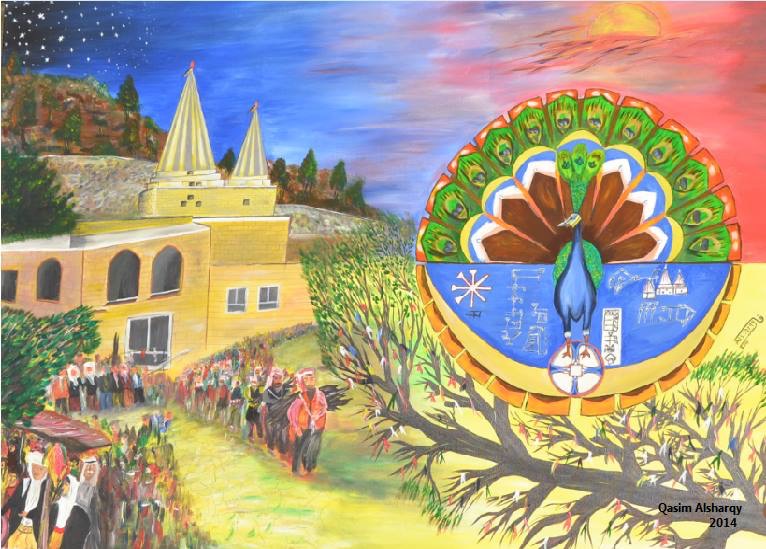
The Yazidi (also spelled Yezidi or Êzidî) are an ancient, deeply spiritual people whose faith and culture reach back thousands of years — long before the Abrahamic religions took form.
They are indigenous to northern Mesopotamia — mainly northern Iraq (Sinjar region), with communities in Syria, Turkey, and the Caucasus — and today number around 1–1.5 million worldwide.
Despite centuries of persecution, their faith remains one of the most remarkable survivals of pre-Abrahamic spirituality — a living thread connecting the earliest human reverence for nature, light, and divine unity.
🌞 Core Beliefs
Yazidism is monotheistic but non-dualistic. They believe in one transcendent God, Xwedê, who emanates creation through seven holy beings or angels. Chief among them is Tawûsê Melek — the Peacock Angel — a radiant, complex figure representing divine light, pride, and reconciliation.
Tawûsê Melek
- Depicted as a beautiful peacock, symbolising divine splendour.
- He refused to bow to Adam, not out of rebellion, but out of loyalty to God, affirming that all worship belongs to the Creator alone.
- This refusal was later misunderstood by outsiders, leading to the false accusation that Yazidis “worship the devil.”
- In truth, Tawûsê Melek represents the reconciliation of shadow and light, the return of the fallen to grace — a profound teaching of spiritual maturity.
🕊️ Philosophy and Practice
Yazidi faith is oral and initiatory, passed through songs, hymns (qewls), and sacred storytelling. Key principles include:
- Purity of intention — right action and right speech as sacred duties.
- Reverence for nature — sun, water, fire, and earth are holy expressions of divine life.
- Non-conversion — Yazidism is ethnically hereditary; one is born Yazidi.
- Sanctity of music and dance — ritual dance symbolises the turning of the universe.
- Respect for women — the feminine principle is honoured through figures like the sacred mother Xâtuna Fexra.
Their main sanctuary is Lalish, a valley temple in northern Iraq, where sacred springs and domed shrines symbolise the soul’s journey back to the Source. Pilgrimage there at least once in life is a spiritual ideal.
⚔️ Persecution and Resilience
The Yazidis have endured 74 genocides (“fermans”) across history — targeted by empires, caliphates, and extremists for their distinct beliefs.
- Under Ottoman and Kurdish rule, many were massacred or forcibly converted.
- In 2014, ISIS declared them “infidels” and launched a genocidal campaign in Sinjar — killing thousands, enslaving women and children, and scattering survivors across the world.
Despite this, the Yazidis’ resilience is extraordinary. Their songs and sacred dances continue. Their elders teach the young in exile. Their light — like that of the Essenes and Cathars — refuses to die.
🌍 Spiritual Significance
Yazidism preserves one of humanity’s oldest understandings:
that divinity is not divided into good and evil, but expressed through balance, redemption, and unity.
Where the Cathars spoke of two forces reconciled through love, and the Essenes honoured harmony between Heaven and Earth, the Yazidis revere Tawûsê Melek — the reconciler — as the living symbol of divine oneness within duality.
In this sense, the Yazidis represent another branch of the same ancient lineage of love-based empowerment: wisdom traditions that refused empire’s hierarchy, honoured the feminine, and preserved humanity’s earliest covenant with the divine.
 Academy of Life Planning