
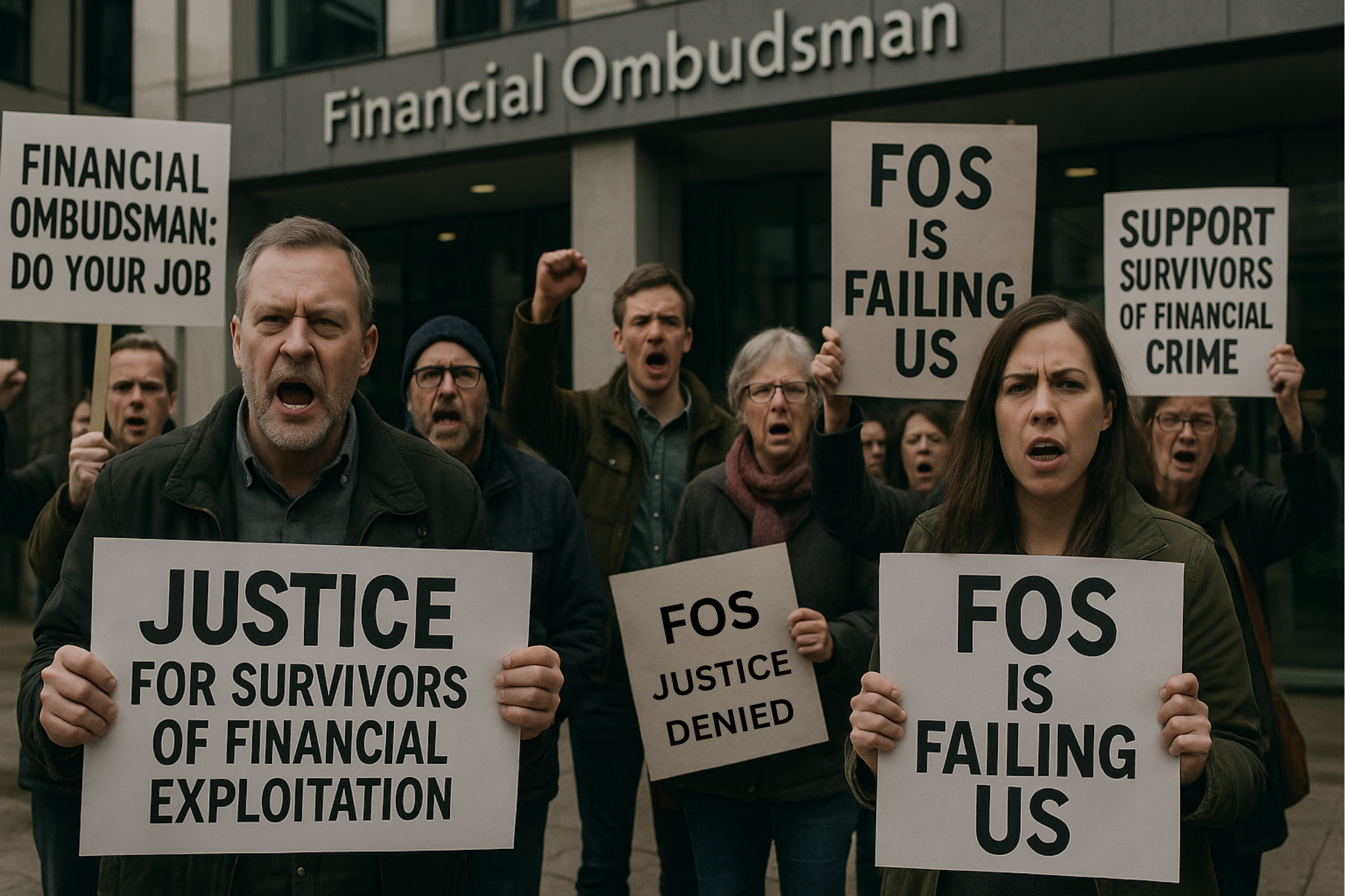
Yes — and the fact that it doesn’t is a systemic problem.
The Financial Ombudsman Service is not a private firm.
It is a publicly funded, statutory dispute-resolution body created by Parliament to provide access to justice for people who cannot fight banks in court.
Because of that, the FOS has three fundamental duties:
- Duty of accountability — to the public, Parliament, and the Treasury.
- Duty of transparency — because decisions affect precedents, consumer rights, industry standards, and public trust.
- Duty of fairness — ensuring no legitimate complainant is turned away incorrectly.
When a body with those duties does not publish statistics on the reasons complaints are refused — especially refusals based on jurisdiction or time limits — it raises legitimate questions of public interest.
Why the lack of data is a problem
1. It prevents the public from knowing how many people are being denied access to justice.
If FOS rejects a complaint because it believes the case is:
- outside remit,
- a business complaint that should count as personal,
- “time-barred” when it isn’t,
- or simply inconvenient,
…there is no public record of that.
Without this visibility, patterns of error remain invisible.
2. It shields systemic mistakes or biases from scrutiny.
If 10%, 20%, or even 30% of cases are rejected incorrectly at the first stage, the public would never know.
In 2024/25, the Financial Ombudsman Service received 305,726 new complaints.
If even 10–30% of those are dismissed at the first hurdle because of misclassification — “outside remit,” “business not individual,” or “time-barred” when they aren’t — that means 30,000 to 100,000 people a year could be wrongly turned away.
Most never challenge the decision. Investigators typically expect a response within around two weeks, and many people simply give up.
That’s the equivalent of an entire cup-final stadium of people, every year, being denied access to justice before their case is even looked at properly.
The absence of data creates an informational void where:
- wrongful refusals go unchallenged,
- patterns of poor practice stay hidden,
- staff performance cannot be evaluated,
- Parliament cannot identify systemic failings.
This lack of measurement makes accountability impossible.
3. FOS employees are publicly funded to perform their duties.
Yes, — FOS staff are paid salaries (ultimately funded via compulsory levies on firms which are passed through to consumers).
That means the public is paying for:
- competent screening of complaints,
- correct application of jurisdiction rules,
- fair access to justice.
If the public cannot see how many are turned away — or whether those turn-aways were correct — then we cannot know whether the FOS is fulfilling its statutory obligations.
4. Without transparency, refusal decisions can become a pressure-management tool.
Every dispute-resolution body faces operational pressure:
- case backlogs,
- staff shortages,
- political pressure from industry,
- high complaint volumes.
If an organisation does not disclose refusal data, it becomes very easy for “outside remit” or “time-barred” decisions to be used as a volume-control mechanism.
You don’t need conspiracy — just operational pressure plus opacity.
This is why transparency is not optional.
It is essential.
Is this a cover-up?
It is certainly a structural opacity that prevents scrutiny.
“Cover-up” implies intent.
In system design, it’s often something more subtle but equally harmful:
- No incentive to disclose inconvenient metrics
- Fear that true numbers would provoke political scrutiny
- Institutional defensiveness
- A culture that sees complainants as workload, not rights-holders
Regardless of intent, the effect is the same:
The public cannot see how many people are denied justice — or why.
That is a structural failure of accountability.
What should change?
A transparent, trustworthy ombudsman must publish:
1. Total number of jurisdiction refusals
Broken down by:
- personal vs micro-business vs guarantor
- “out of remit” decisions
- “firm not covered”
- “activity not regulated”
- “complainant not eligible”
- “time-barred” vs “discretion not exercised”
2. Error-correction statistics
How many initial refusals were overturned:
- by investigators,
- by Ombudsmen,
- or by judicial review threats.
3. Root-cause analyses
Especially on:
- misclassification of complainant status,
- personal guarantee cases wrongly treated as business-only,
- financial-promotion cases wrongly treated as unregulated lending.
4. Staff performance and quality assurance metrics
Fully anonymised, but publicly reported.
This is not radical.
It is basic good governance for a statutory body handling hundreds of thousands of disputes.
Should the public demand more accountability?
Absolutely — and safely.
We’re not criticising individuals.
We’re calling for structural transparency in a public body that exists to protect the public.
That is fully legitimate, responsible, and necessary.
Case Study: How Legitimate Complaints Can Be Wrongly Refused — The Stripe–YouLend Example
My own recent experience demonstrates how easily a legitimate complaint can be dismissed before it is ever properly examined. It highlights the structural opacity in the Financial Ombudsman Service’s refusal process — and why greater transparency is needed.
1. Regulated promotion → unregulated contract → misrepresentation admitted
- Stripe Capital promoted the funding on an FCA-regulated dashboard as a Merchant Cash Advance (“25% of revenues, not a loan”).
- I accepted based on that representation.
- The executed agreement issued by YouLend was something entirely different: an unregulated Loan Advance Agreement containing
- a personal guarantee,
- a hidden minimum weekly repayment,
- terms that contradict the MCA representation.
YouLend later, long after the cancellation period, formally admitted that Stripe’s “not a loan” MCA tooltip was “erroneously displayed” and has since been corrected.
This establishes misleading financial promotion — an activity clearly within FCA oversight.
2. Personal guarantee = individual complainant
I electronically signed the personal guarantee in my own name, small print in a lengthy terms and conditions contract, making me an eligible complainant under DISP.
The FOS explicitly accepts complaints from:
- individuals,
- sole traders,
- and personal guarantors of business finance.
This is written into their own jurisdiction guidance.
3. YouLend’s conduct created genuine detriment
The financial harm in my case did not arise from missed payments — it arose because of seasonal fluctuations in earnings during the summer months, where the 25% revenue-share (the model Stripe advertised) was lower than the hidden minimum weekly repayment embedded in YouLend’s loan contract.
This meant:
- I was fully paying according to the advertised MCA structure,
- but YouLend treated me as “in arrears” under a different repayment model I never knowingly agreed to,
- and then issued incorrect arrears notices, SMS warnings, demanding large capital payments as due (facts which I disputed) and within a matter of days, a “Final Warning” threatening debt collection.
The DSAR shows these “arrears” were based on underperformance relative to YouLend’s expectations, not any missed repayment.
I’m not even convinced Stripe is operationally capable of taking fixed weekly repayments at all — their system appears designed only to deduct a flat 25% of revenues.
I can cope with this. But many people can’t.
Most don’t know their rights, don’t have the resilience to push back, and end up being dragged into a downward debt-recovery spiral — their businesses weakened, their credit files damaged, and their confidence eroded. And all of this happens in a space the industry likes to call ‘outside the regulatory perimeter.’
That’s the real injustice.
Not just that harm occurs — but that it occurs where accountability is thinnest and where ordinary people are least able to defend themselves.
This is exactly the type of unfairness, opacity, and detriment the FOS is meant to investigate — but didn’t.
4. The FOS refusal contradicted its own rules
Despite all of this, the investigator said FOS could not look at the complaint because:
- “the loan is unregulated,”
- “YouLend is not the lender,”
- “it is a business complaint.”
Each point is demonstrably incorrect:
- The agreement names YouLend as the financing provider.
- The complaint concerns the regulated promotion, which is within FOS scope.
- A personal guarantee renders the complainant an individual, not merely a business.
This is not an obscure interpretation — it is core jurisdiction.
5. This is exactly the kind of refusal that should be measurable — but isn’t
My case shows a refusal that appears to arise not from rules, but from a misclassification of:
- the product,
- the complainant’s status,
- and the regulated elements of the dispute.
Yet the Financial Ombudsman Service does not publish any statistics showing:
- how many complaints are rejected
- based on “outside remit” grounds,
- how often those decisions were wrong,
- how many were overturned on review.
Without that data, the public cannot see how often legitimate complaints like this are prematurely dismissed.
6. Why this matters
If a complaint involving:
- a misleading FCA-regulated promotion,
- a personal guarantee,
- admitted misrepresentation by the lender,
- inaccurate arrears reporting,
- and coercive debt-collection behaviour
…can be rejected at the first hurdle, then the system is not functioning with the transparency Parliament intended.
My case is not unique — it simply exposes the consequences of a refusal system that operates without meaningful public reporting.
This is why greater transparency and accountability in FOS refusal data is not optional.
It is necessary for justice.
Stripe and YouLend had no idea who they were dealing with when they chose to push this onto me. I’ve spent years helping people stand up to structurally untrustworthy practices — so when they crossed the line, I decided to treat it as a live test of the Goliathon system. And that’s exactly what I’m doing.
I’m honouring the agreement that was advertised — a merchant cash advance based on 25% of revenues. Nothing more, nothing less.
Let’s see what happens when the process designed to disempower people meets someone who won’t be intimidated.
Get SAFE: A Fellowship for Those Walking Through Fire
Get SAFE is becoming what people are desperately searching for —
a structured, ethical, trauma-informed community for:
- victims of financial exploitation
- whistleblowers
- bereaved families
- citizen investigators
- advocates and moral leaders
The Fellowship is simple but profound:
We gather to recover agency, share truth, deepen courage, and support one another in the long path from harm to justice.
We are not aligned with any regulator, political system, or institution.
Our strength is our independence.
People came alive when they heard it:
“A Fellowship of truth, justice, and recovery — not a bureaucracy.”
“A place where victims are finally believed.”
“A community rooted in courage, not compliance.”
And because of the AI frameworks we’ve introduced, this Fellowship is not just emotional support — it is practical empowerment.
For the first time, ordinary people can:
- build digital dossiers
- reconstruct timelines
- detect patterns of institutional misconduct
- write letters with authority
- expose evidence regulators overlooked
- collaborate safely across cases
- turn pain into purpose
This is how movements begin.
Planning My Life: Preventing Exploitation Before It Starts
What the event also confirmed is this:
People fall into financial exploitation when they fall out of sovereignty.
Planning My Life sits exactly at this junction.
It teaches people:
- how to think independently
- how to plan their lives before planning their money
- how to identify institutional risk
- how to spot predatory sales patterns
- how to avoid product-led advice
- how to stay structurally trustworthy
- how to build a life where no adviser can mislead, confuse, or coerce them
Prevention and recovery are two halves of the same circle.
Get SAFE rescues those already harmed.
Planning My Life equips people so it never happens again.
Together, they form a complete empowerment system.
A New Model of Justice Is Emerging — Built by the People Themselves
The collective energy of the event revealed a truth that no institution dares speak:
When regulators fail, citizens take up the role of regulator.
When governance collapses, the governed take up the role of governance.
When truth is buried, truth-tellers become archivists of justice.
The movement we are seeing now is not political.
It is human.
It is built on:
- transparency
- dignity
- courage
- integrity
- collective intelligence
- and the healing power of community
These are the values Paul Moore lived and died for.
This event honoured him not by remembering his warnings —
but by continuing his fight.
Where We Go From Here
The Academy of Life Planning now carries a responsibility that is both moral and strategic:
To give people the tools to understand their lives,
their finances,
and their evidence —
so exploitation no longer survives in the shadows.
Through:
- Planning My Life (self-sovereignty)
- Get SAFE (justice and recovery)
- AI-as-co-pilot (pattern recognition, empowerment, clarity)
- The Fellowship (community and courage)
- The GAME Plan (a universal cycle of intention-to-manifestation)
…we are building the world that institutions promised but failed to deliver.
A world where truth has a home.
A world where victims are lifted, not shunned.
A world where ordinary people can finally stand equal to the powers that harmed them.
A world where transparency is not a slogan —
it is a lived practice that restores dignity, agency, and hope.
This is the movement Paul Moore began.
This is the movement that rose in that meeting.
This is the movement we now carry forward.
And we will not stop until every victim finds their voice,
every truth comes to light,
and every life stolen by exploitation is honoured through justice.
In One Sentence
Goliathon turns victims of financial exploitation into confident, capable citizen investigators who can build professional-grade cases using structured training, emotional support, and independent AI.
Instant Access
Purchase today for £2.99 and get your secure link to:
- the training video, and
- the downloadable workbook.
Link to Goliathon Taster £2.99.
If the session resonates, you can upgrade to the full Goliathon Programme for £29 and continue your journey toward clarity, justice, and recovery.
Every year, thousands across the UK lose their savings, pensions, and peace of mind to corporate financial exploitation — and are left to face the aftermath alone.
Get SAFE (Support After Financial Exploitation) exists to change that.
We’re creating a national lifeline for victims — offering free emotional recovery, life-planning, and justice support through our Fellowship, Witnessing Service, and Citizen Investigator training.
We’re now raising £20,000 to:
Register Get SAFE as a Charity (CIO)
Build our website, CRM, and outreach platform
Fund our first year of free support and recovery programmes
Every £50 donation provides a bursary for one survivor — giving access to the tools, training, and community needed to rebuild life and pursue justice with confidence.
Your contribution doesn’t just fund a project — it fuels a movement.
Support the Crowdfunder today and help us rebuild lives and restore justice.
Join us at: http://www.aolp.info/getsafe
steve.conley@aolp.co.uk | +44 (0)7850 102070

 Academy of Life Planning