
“When education becomes privilege, progress turns to paradox.”
For decades, we’ve been told that education and upskilling are the keys to prosperity. Economists, politicians, and business leaders have repeated the same story — invest in human capital, and inequality will fall.
But a recent study by Onur Ozdemir (2020), “Distributional Effects of Human Capital in Advanced Economies,” challenges that assumption. It reveals a troubling truth: while education initially narrows the income gap, in mature economies it often widens inequality.
This is the Paradox of Progress — and its lessons are critical for every Holistic Wealth Planner.
Lesson 1: Education Alone Doesn’t Equalise Wealth
In the early stages of development, increased access to education reduces inequality. People rise together.
But once societies reach higher levels of educational attainment, the returns to learning become concentrated among the already privileged — those with the right networks, capital, and social background.
Human capital, left unchecked, begins to mirror financial capital: it compounds for those who already have it.
For planners:
We must move beyond helping clients accumulate knowledge and toward helping them apply it equitably. Education should empower service, not superiority. The task is to convert learning into shared value — helping others rise as we rise.
Lesson 2: Globalisation Without Guardrails Fuels Inequality
The study shows a clear link between economic globalisation and rising inequality. Open markets, mobile capital, and digital platforms expand opportunity — but they also concentrate wealth in fewer hands.
As production globalises, labour’s bargaining power weakens. The skilled thrive; the rest struggle to keep pace.
For planners:
Encourage clients to anchor their prosperity locally — in ethical enterprise, community resilience, and cooperative wealth ecosystems. Global opportunities should serve human sovereignty, not replace it.
In the Aquarian Age of finance, we measure progress not by how far our money travels, but how many lives it touches.
Lesson 3: The Human Capital Kuznets Curve
Ozdemir’s research reveals a “Human Capital Kuznets Curve”:
- In the early phase, education narrows income gaps.
- Beyond a threshold, it widens them — unless redistribution and inclusion are built in.
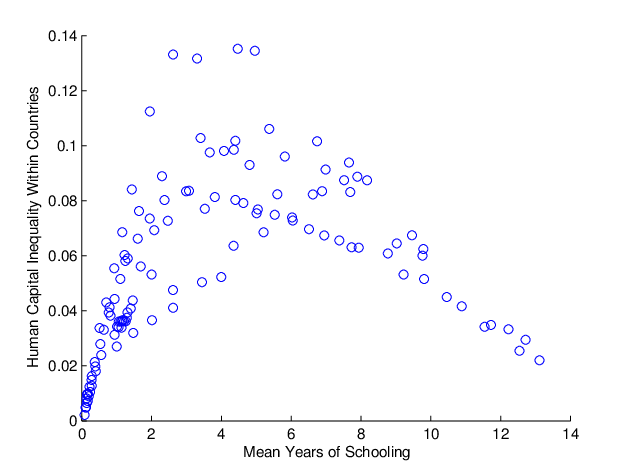
Fig.1.: The Kuznets Curve of Human Capital 1870-2010-Theil Index
For planners:
This is a call to democratise opportunity. Make mentorship, skill exchange, and intergenerational learning part of every plan. Human capital must circulate — not concentrate.
Lesson 4: Bargaining Power and Employment Quality Matter as Much as Education
The study finds that high unemployment and weak labour bargaining significantly increase inequality.
For planners:
Our clients’ security doesn’t come from jobs alone, but from agency — the power to negotiate, diversify income, and shape one’s own working life. Encourage portfolio careers, micro-enterprises, and self-employment capacity. These are modern forms of financial independence.
Lesson 5: Human Development Without Moral Development Fails Society
Even as nations rise on the Human Development Index (HDI), inequality grows. Progress measured only in income and life expectancy misses a deeper truth: prosperity without purpose divides.
For planners:
Integrate spiritual and social capital into every conversation. True wealth includes meaning, belonging, and contribution — the heart of the Kokoro model.
When clients align money with purpose, they become agents of justice, not just success.
The Holistic Planner’s Role in the Paradox of Progress
Human capital is not the enemy — but it needs a moral compass. As Holistic Wealth Planners, our role is to humanise capital, not just optimise it.
We do this by aligning education with equity, wealth with wisdom, and self-interest with social good.
| GAME Plan Element | Application to the Paradox of Progress |
|---|---|
| Goals | Define success in terms of well-being, not just income. |
| Actions | Turn skills into service — create impact enterprises and learning communities. |
| Means | Invest in human, social, and moral capital — not only financial assets. |
| Execution | Build cooperative wealth systems where knowledge and opportunity circulate. |
Final Reflection
The Academy of Life Planning exists to bridge this paradox. We believe that the next evolution of financial planning is human capital planning — designing lives where prosperity and purpose grow together.
As Ozdemir’s study reminds us: when education becomes exclusion, empowerment must step in.
Let us be the generation of planners who replace extraction with empowerment — where learning lifts all, not a few.
Join the Movement
If you’ve worked with me or the Academy, your voice matters. Please share your experience — your story inspires others to find theirs.
Leave a Google Review
If you’re new here, let’s explore how we can help you build your own freedom-based future.
Book a Free Call
Contact: steve.conley@aolp.co.uk
Website: www.aolp.info
Follow: Steve Conley on LinkedIn
 Academy of Life Planning