
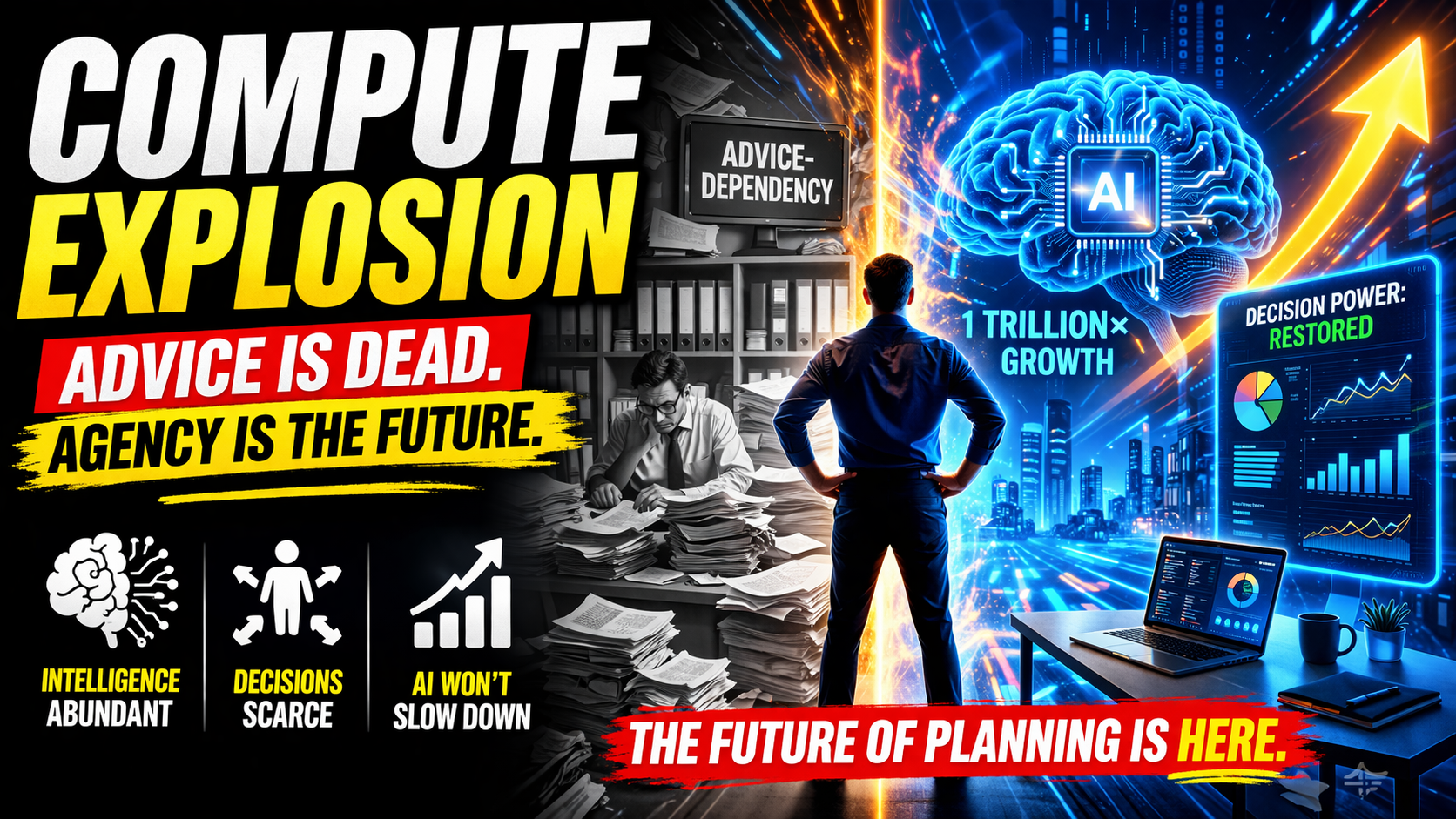
Why the future of financial planning is not advice—but agency
There are moments in history when a shift is so profound that it quietly redraws the boundaries of power.
Not through legislation.
Not through protest.
But through infrastructure.
We are living through one of those moments now.
Artificial intelligence is not simply improving. It is accelerating—faster than most professionals, institutions, or regulators can fully comprehend. And beneath that acceleration lies a deeper force: the exponential growth of compute.
This is not a story about better tools.
It is a story about the collapse in the cost of intelligence—and what that means for who holds control.
From Scarcity to Abundance: The End of Knowledge as Power
For decades, the financial advice model has been built on a simple premise:
Knowledge is scarce.
Therefore, those who hold it hold power.
That premise is now dissolving.
As compute scales and AI capabilities expand, intelligence is becoming:
- Always available
- Instantly queryable
- Continuously improving
- Rapidly declining in cost
The implications are profound.
We are moving from a world where individuals depend on intermediaries to interpret complexity…
to a world where individuals can interrogate complexity directly.
This is not evolution.
It is a structural break.
The Misdiagnosis: Automation vs Agency
Much of the current narrative around AI focuses on automation.
Jobs will be replaced. Tasks will be streamlined. Processes will be optimised.
But this framing misses the real shift.
The true disruption is not automation.
It is agency.
In the old model:
- The adviser interprets
- The client accepts
- The system executes
In the emerging model:
- The individual explores
- The system responds
- The human decides
The role of the professional changes—not because they are replaced, but because their position in the decision chain moves.
The Collapse of Intermediation
When intelligence becomes abundant, intermediation becomes unstable.
This is already visible.
Clients are no longer passive recipients of advice. They are:
- Uploading documents into AI systems
- Stress-testing assumptions in real time
- Asking deeper, more technical questions
- Identifying inconsistencies at the point of sale
The asymmetry is breaking.
And with it, the justification for many traditional fee structures.
If modelling becomes commoditised…
If analysis becomes instantaneous…
If reporting becomes automated…
Then what remains?
What Remains: Decision Integrity
In a world of cognitive abundance, the scarce resource is no longer knowledge.
It is judgment.
More specifically:
- The ability to frame the right problem
- The discipline to evaluate competing options
- The clarity to act in alignment with long-term intent
- The resilience to stay the course
This is what we refer to as decision capital.
And it is here—not in data, not in modelling, not in product selection—that the future of planning resides.
From Financial Planning to Decision Architecture
The implication is clear.
Financial planning, as traditionally understood, is no longer sufficient.
The future belongs to those who can design and guide decision systems.
This requires a different orientation:
- From product to purpose
- From advice to agency
- From transactions to transformation
At the Academy of Life Planning, this shift is expressed through the GAME Plan:
- Goals — conscious intention
- Actions — directed choice
- Means — aligned resources
- Execution — lived reality
Artificial intelligence enhances each stage.
But it does not replace the human at the centre of the cycle.
It amplifies them.
The Rise of the AI-Native Planner
This shift does not eliminate the planner.
It redefines them.
The planner of the future is not:
- A gatekeeper of knowledge
- A producer of reports
- A distributor of financial products
They are:
- An orchestrator of intelligence
- An interpreter of complexity
- A guardian of decision quality
They do not compete with AI.
They work with it—while ensuring that the human remains in control of the outcome.
The Real Risk: Thinking Linearly in an Exponential World
Perhaps the greatest danger is not technological.
It is psychological.
Humans are conditioned to think in linear terms.
We expect gradual change. Predictable progress. Manageable disruption.
But exponential systems do not behave this way.
They appear slow—until suddenly they are not.
The expansion of compute, the fall in cost, and the rise of AI agents are not separate trends.
They are compounding forces.
And they are accelerating.
A Window of Opportunity
This moment presents a choice.
To resist the shift—attempting to preserve models built on scarcity.
Or to embrace it—rebuilding around abundance.
For financial planners, this is not a threat.
It is an invitation.
An invitation to:
- Move beyond intermediation
- Reclaim the human dimension of planning
- Help individuals navigate complexity with clarity and confidence
- Restore agency where it has been outsourced
From Advice to Agency
The future of financial planning will not be defined by better products or more efficient processes.
It will be defined by a simple, fundamental question:
Who holds the power to decide?
As intelligence becomes cheap and ubiquitous, the answer must change.
Not toward institutions.
Not toward algorithms.
But back toward the individual.
Final Thought
The expansion of compute is not just a technological phenomenon.
It is a societal one.
When intelligence becomes abundant, the consequences of poor decisions scale with it.
Which means the real challenge of the next decade is not access to knowledge.
It is the cultivation of wisdom.
And that is where the future of planning begins.
Explore how the Academy of Life Planning is redefining financial planning for the age of AI—where agency is restored, and decisions are made with clarity, not dependency.
 Academy of Life Planning