
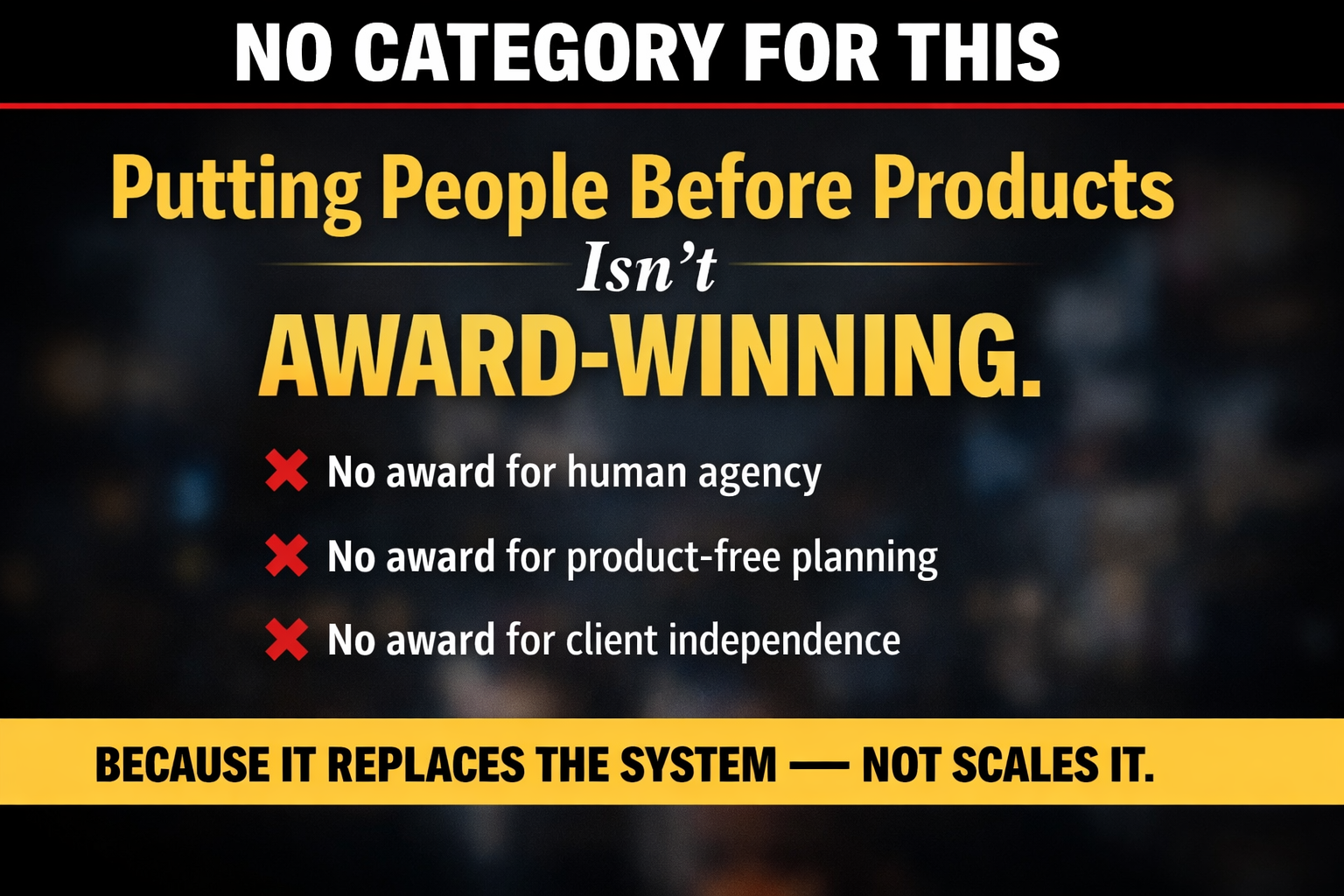
We looked at entering the Money Marketing Awards this year.
And realised something uncomfortable.
There isn’t a category for putting people before products.
At first glance, that might sound trivial.
Awards are just awards, after all.
But look a little closer, and something more revealing emerges.
Every category reflects a worldview.
And in this case, the worldview is clear.
Financial planning is defined as:
- Regulated advice
- Delivered by professionals
- Supported by platforms, products, and increasingly, AI
Everything revolves around improving, scaling, or refining that model.
And to be fair, there is a lot of good work happening within it.
But there’s also a question that isn’t being asked.
What if the model itself is changing?
Not incrementally.
Structurally.
Right now, something is happening beneath the surface of financial planning.
Not loudly. Not dramatically.
But persistently.
- Individuals are using AI tools to explore financial decisions before speaking to an adviser
- People are modelling scenarios, testing outcomes, and educating themselves in real time
- The gap between “expert” and “consumer” is narrowing
For the first time in history, access to financial thinking is becoming democratised.
Not through regulation.
Not through institutions.
But through technology.
The shift in agency
For decades, financial planning has operated on a simple premise:
The professional holds the knowledge.
The client relies on it.
That premise is now being challenged.
Because when a person can:
- Understand their options
- Explore trade-offs
- Model different futures
They begin to move from dependence… to participation.
And from participation… to agency.
What the industry is asking (and what it isn’t)
Much of the current conversation focuses on one question:
“How do we scale advice?”
Through:
- Better technology
- Streamlined processes
- AI-assisted workflows
- New delivery models
All valid.
All necessary.
But they all assume the same thing:
That advice remains the centre of the system.
The question that isn’t being asked is this:
What happens when people don’t need advice in the same way?
Not because advice disappears.
But because its role changes.
The invisible categories
Go back to the awards.
There are categories for:
- Advice firms
- Investment propositions
- Platforms
- AI used within advice
But there are no categories for:
- Teaching people how to think, rather than what to buy
- Designing financial lives without product dependency
- Building capability instead of reliance
- Restoring decision-making to the individual
Why?
Because these don’t expand the system.
They change its shape.
This isn’t anti-adviser
It’s important to be clear.
This is not an argument against financial advisers.
Far from it.
The need for human judgement, experience, and perspective will not disappear.
In fact, it may become more valuable.
But it will be applied differently.
From:
- Controller of information
To:
- Interpreter of complexity
From:
- Decision-maker
To:
- Thinking partner
From:
- Gatekeeper
To:
- Guide
From dependency to capability
At the Academy of Life Planning, we see this shift clearly.
The future of financial planning is not about removing professionals.
It’s about rebalancing the relationship.
- Individuals take primary agency
- Technology supports understanding and exploration
- Professionals step in where judgement, context, and human insight are needed
Not for everything.
But for the moments that matter most.
This is the move:
From a system built on dependency
To a system built on capability
Why this doesn’t fit neatly into awards
Because awards tend to recognise what already exists.
They celebrate excellence within established frameworks.
They reward:
- Performance
- Growth
- Innovation… within the model
But they rarely capture:
The transition between models.
And that’s where we are now.
In the transition.
Between:
- Advice as a service
- And planning as a capability
Between:
- Professional control
- And individual agency
Between:
- Product-led thinking
- And life-led planning
What happens next
If this shift continues—and all signals suggest it will—
We won’t just see new categories emerge.
We may see:
- Fewer people needing traditional advice in its current form
- A redefinition of what it means to be a financial planner
- A shift in value from distribution… to interpretation
And over time:
A system that looks very different from the one we have today.
A different question
So perhaps the real question isn’t:
“Which category do we fit into?”
But:
“What category needs to be created next?”
Because if the most important work in financial planning is helping people think, decide, and act for themselves…
Then it deserves recognition.
Even if, for now, that category doesn’t exist.
Curious how others see this.
 Academy of Life Planning