
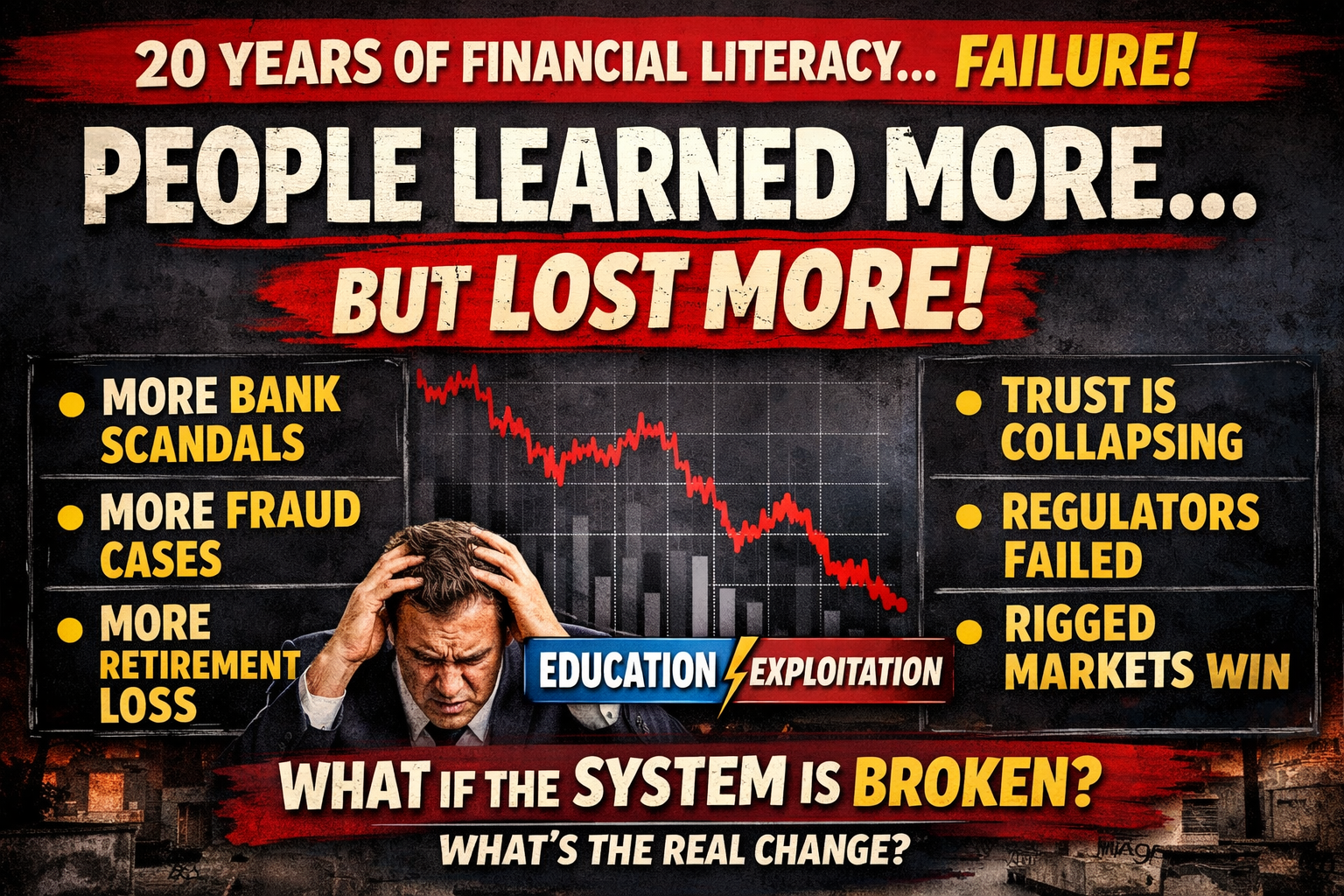
For over 20 years, we’ve been trying to fix financial outcomes with education.
It hasn’t worked.
That’s not a criticism.
It’s now being acknowledged at the highest levels of policy and regulation.
At a recent European conference on Investor Trust & Confidence,
Alexandra Jour-Schroeder, Deputy Director-General for Financial Stability, outlined the European Commission’s strategy:
- Build financial capability
- Restore trust
- Increase participation in capital markets
The goal is clear:
Help citizens better understand finance so they can engage more confidently with the system.
At the same event, speakers explored a deeper concern:
Why does trust in financial services remain so fragile?
And whether independent, evidence-based financial education can help rebuild it.
It’s a serious question.
But it leads to an even more important one:
What if education alone isn’t the answer?
The uncomfortable truth
We are solving the wrong problem.
Because the issue was never just knowledge.
People don’t want financial education
Let’s be honest.
Most people:
- Don’t want to study finance
- Don’t want to analyse products
- Don’t want to spend hours managing money
They want something much simpler:
Peace of mind.
But the system keeps responding with:
- More information
- More complexity
- More responsibility
Knowledge doesn’t change behaviour
We’ve known this for decades.
People can:
- Understand risk… and still take it
- Know they should save… and not act
- Be “financially literate”… and still struggle
Because decisions are not driven by knowledge.
They are driven by:
- Context
- Emotion
- Timing
- Identity
And now we’ve made it worse
Enter:
- Social media “finfluencers”
- AI tools like ChatGPT
- Frictionless investing apps
We now have a generation that:
- Has access to more information than ever
- Feels more confident than ever
- Is often less grounded than ever
Perceived knowledge has outpaced real capability.
The system’s response? More education.
Even now, the answer remains:
- Teach more
- Explain better
- Measure outcomes
- Coordinate stakeholders
But here’s the problem:
You cannot educate your way out of a structural design flaw.
The real issue is not literacy. It’s agency.
Financial literacy teaches people:
“How to make financial decisions.”
But it rarely asks:
“Why are you making them in the first place?”
This is where everything changes
The future is not:
- More education
- More content
- More product understanding
The future is:
Better decision systems.
From Financial Literacy → To Total Wealth Planning
At the Academy of Life Planning, we take a different view.
We don’t start with money.
We start with the person.
Instead of asking:
“What should I invest in?”
We ask:
- What kind of life are you trying to build?
- What does security mean to you?
- What trade-offs are you willing to make?
- What is your human capital worth?
Because once those are clear:
👉 Financial decisions become simpler
👉 Risk becomes contextual
👉 Behaviour becomes aligned
This is the shift
Old model:
- Learn about money
- Choose products
- Hope it works
New model:
- Define your life
- Structure your decisions
- Align money to purpose
And this is where AI actually helps
Not by replacing thinking.
But by supporting it.
Used properly, AI can:
- Guide structured decision-making
- Help people explore scenarios
- Reduce overwhelm
- Support action, not just knowledge
The role of the adviser is changing too
The future adviser is not:
- A product selector
- A technical expert
- A gatekeeper of information
They are:
A thinking partner. A guide. A translator of complexity into clarity.
So where does this leave financial literacy?
It still matters.
But it’s no longer the solution.
It’s just the starting point.
The real question now
Are we trying to make people better at navigating a broken system…
or are we ready to redesign the system itself?
A final thought
For 20 years, we’ve tried to teach people how to play the game.
Maybe it’s time to help them:
Understand the rules.
Question the structure.
And design a better one.
That’s what Total Wealth Planning is about.
If you’re a professional beginning to see this shift, you’re not alone.
The Academy of Life Planning exists for those who want to move beyond financial literacy—and become part of what comes next.
Curious how others see this.
Not all financial education is equal
To be fair, some initiatives are doing better than others.
A Danish programme for high school students has shown what works:
- young people want this knowledge
- they respond better to relatable, near-peer educators
- they engage when the content connects to real goals
- trust improves when the education is independent and non-commercial
That matters.
It shows the future is not more dry content, more brochures, or more product messaging disguised as education.
It shows that when learning is practical, human, and relevant, people respond.
But it also reveals the limit.
Even the best financial education still sits downstream of a bigger question:
What is money for in the first place?
That is where Total Wealth Planning begins.
So where does this leave us?
We now have clarity on three things.
First, financial literacy matters.
No one is arguing against that.
Second, better delivery improves engagement.
When education is:
- human
- relatable
- independent
- connected to real life
…people respond.
But third—and this is the part we can no longer ignore:
Even the best financial education is not enough.
Because the problem was never just knowledge
We’ve seen it from policymakers.
We’ve heard it from practitioners.
We’ve watched it play out over decades.
People don’t fail because they lack information.
They struggle because:
- decisions are complex
- incentives are misaligned
- trust is fragile
- and life itself is uncertain
So the question changes
Not:
“How do we teach people more about money?”
But:
“How do we help people make better decisions in the reality they actually live in?”
This is the shift now underway
Across the system, you can feel it:
- Education is being questioned
- Trust is being re-examined
- Behaviour is being prioritised
- Technology is accelerating everything
But the pieces are still disconnected.
What’s missing is a unifying model
One that:
- Starts with the person, not the product
- Connects money to meaning
- Supports decisions, not just knowledge
- Adapts as life changes
- Restores agency to the individual
This is what comes next
Not more complexity.
Not more content.
Not more nudging people into markets they don’t fully understand.
But something simpler—and far more powerful:
A system that helps people think clearly, act deliberately, and build lives that actually work.
That is the role of Total Wealth Planning
It doesn’t replace financial literacy.
It completes it.
It moves us:
- from information → to insight
- from knowledge → to action
- from products → to purpose
- from dependency → to agency
And this is the real opportunity
Not to make people better consumers of finance.
But to help them become:
Designers of their own lives.
Because when that happens, everything else—money included—starts to fall into place.
 Academy of Life Planning