
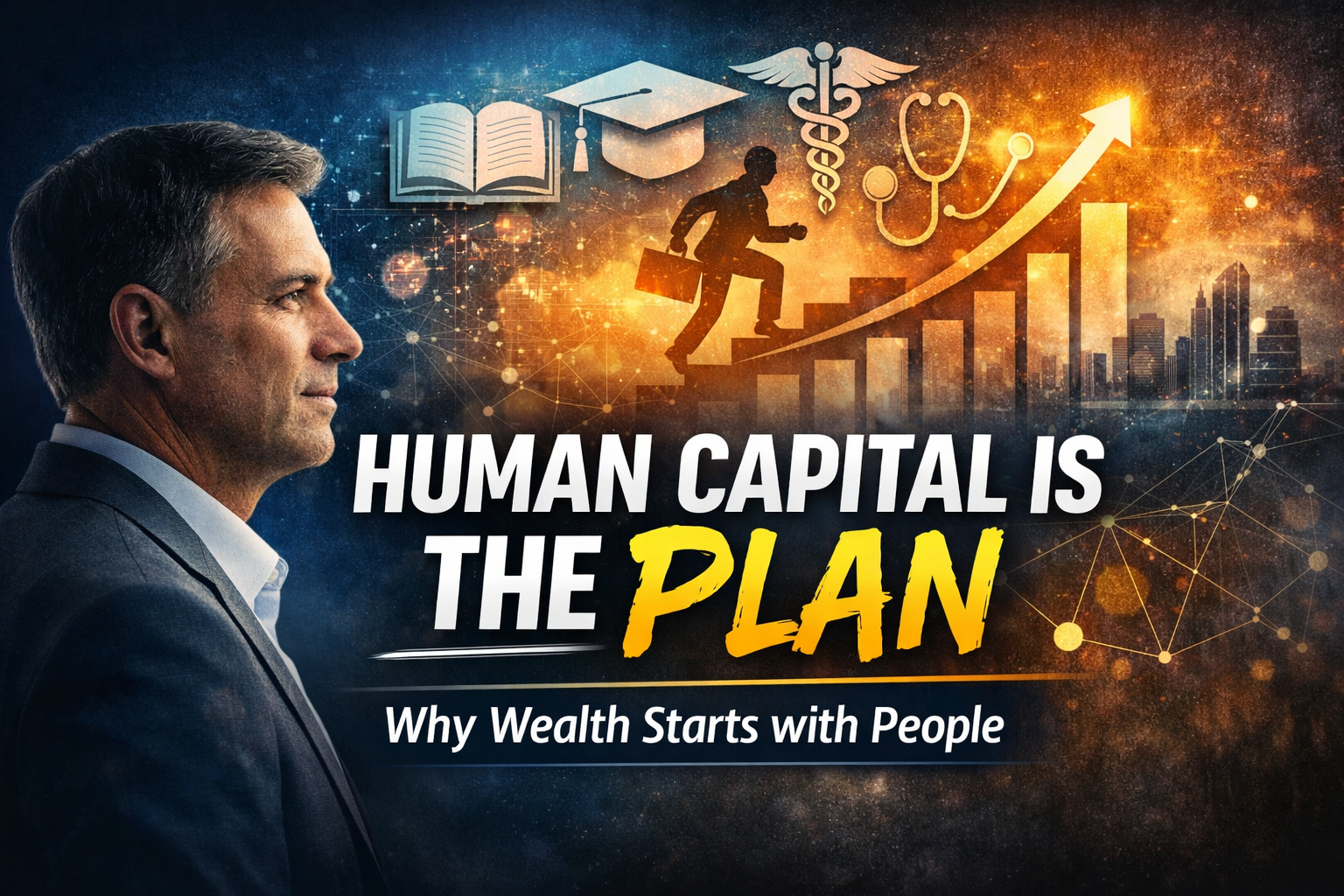
Lessons for Total Wealth Planners from Economic Growth Research
The uncomfortable truth most financial plans ignore
For decades, financial planning has focused on one dominant question:
How do we grow financial capital?
But the research tells a very different story.
Human capital — the skills, knowledge, health, and capabilities of a person — is not just a factor in economic success.
It is the factor.
As highlighted in this study, a nation’s long-term prosperity depends more on its human capital than almost any other resource.
That insight doesn’t just apply to countries.
It applies to every individual and every household you work with.
The core shift: From managing money → developing people
Traditional planning optimises:
- Investment returns
- Tax efficiency
- Product selection
Total Wealth Planning starts somewhere else:
- Capability
- Decision-making
- Adaptability
- Purpose
Because financial capital is a derivative.
Human capital is the source.
The study reinforces this clearly:
- Skills and knowledge drive productivity
- Education and training increase output
- Health improves both longevity and economic contribution
This is not theory.
This is the operating system of wealth.
The Four Pillars of Human Capital (and why planners should care)
The research identifies four key pillars. Each one maps directly into your role as a Total Wealth Planner:
1. Education (Capability Building)
Not just formal qualifications — but:
- Financial literacy
- Decision frameworks
- AI fluency
- Self-awareness
Planner implication:
Your role is not to provide answers.
It is to increase the client’s ability to generate their own.
2. Health & Wellbeing (Energy & Longevity)
Health is not a lifestyle issue.
It is a financial variable.
- Poor health reduces earning capacity
- Good health extends productive years
- Mental wellbeing improves decision quality
Planner implication:
A retirement plan without a health strategy is incomplete.
3. Workforce & Skills (Earning Power)
Human capital grows through:
- Experience
- Training
- Skill acquisition
- Adaptation
The study highlights that productivity — and therefore income — is directly linked to skill development.
Planner implication:
Your client’s biggest asset is not their pension.
It is their ability to generate income — now and in the future.
4. Enabling Environment (Context & Opportunity)
This includes:
- Access to information
- Infrastructure
- Legal and economic systems
Planner implication:
Planning is not just internal (mindset + money).
It is external (environment + opportunity design).
The compounding effect planners often miss
Here’s where this becomes powerful.
Human capital doesn’t just grow linearly.
It compounds:
- Education → better decisions
- Better decisions → better outcomes
- Better outcomes → more opportunities
- More opportunities → accelerated growth
This is the real “compounding curve.”
And it starts long before money is invested.
Why traditional planning models are now obsolete
The study highlights a critical risk:
Poor human capital development leads to misallocation, inefficiency, and underperformance.
Translate that into financial planning:
- Clients with money but no capability → poor decisions
- Clients with investments but no clarity → anxiety
- Clients with plans but no execution ability → stagnation
This is why many “good financial plans” fail in real life.
They optimise capital.
But ignore the human operating system behind it.
The role of the Total Wealth Planner
This is where your role becomes indispensable.
Not as a product expert.
Not as a portfolio manager.
But as a human capital architect.
You help clients:
- Think clearly
- Decide confidently
- Adapt continuously
- Align money with life
And crucially:
You help them avoid becoming dependent on you.
Because the goal is not control.
It is agency.
A practical reframing for your client conversations
Instead of asking:
“How much do you need to retire?”
Start asking:
- What capabilities will sustain your life?
- How adaptable is your income model?
- What skills will matter in 10 years?
- How resilient is your health and energy?
- Where are you underinvesting in yourself?
That is Total Wealth Planning.
The strategic opportunity for planners at the bridge
This is not just philosophical.
It is commercial.
The study makes it clear:
Investment in human capital generates returns for both individuals and the wider economy.
Translate that:
Clients who grow:
- Earn more
- Decide better
- Stay engaged longer
- Value your role more deeply
You move from:
Transactional planner → Transformational partner
Final thought: Plan the person before the portfolio
If human capital is the primary driver of wealth…
Then financial planning must start there.
Not as a module.
Not as a conversation.
But as the foundation.
Because the future of planning isn’t about managing money better.
It’s about helping people become more capable.
A quiet invitation
If you’re a planner beginning to sense that the old model no longer fits…
You’re not alone.
There is a different way to practise.
One that aligns with how wealth is actually created.
And how people actually live.
Curious how others are seeing this shift.
For further details, visit the Academy of Life Planning.
 Academy of Life Planning